Loading...
Done
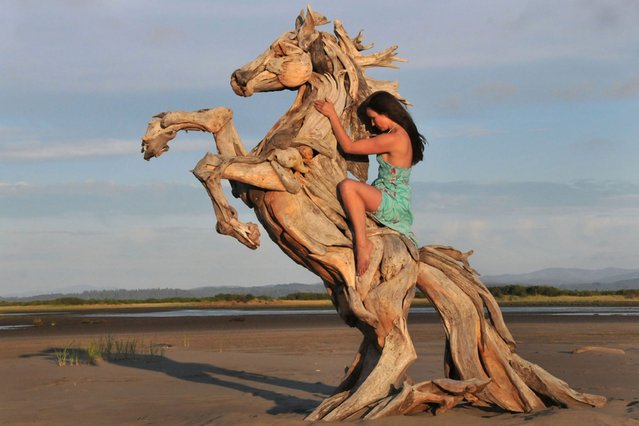
A horse sculpture entirely made from driftwood by artist Jeffro Uitto. (Photo by Jeff Uitto/Caters News)

Artist Jeff Uitto creates intricate sculptures from driftwood he finds along the coast of Washington. Uitto has sculpted wild horses, soaring eagles, and even a giraffe out of salvaged tree branches. But his work is more than giant animal sculptures. Uitto also has a clear talent for creating beautiful home furniture from driftwood. Finding the right piece of driftwood can take months, and the sculpting can take years.

Photo: A horse sculpture entirely made from driftwood by artist Jeffro Uitto. (Photo by Jeff Uitto/Caters News)
Details
28 Jun 2013 06:38:00
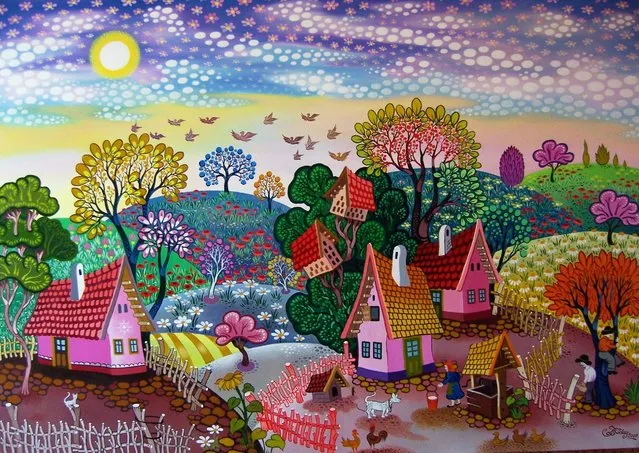
Painting By Koday Laszlo

Laszlo Koday was born in Hungary in 1945. In 1970 he began as a self-tought painter. The life and work of Henri Rousseau made a deep impression on him. His pictures are fairy tales expressed by pictorial means, human, animal and nature are equally important in them. There are bright, with unmixed pure colours, compositions wich spread calmness and gaiety. Kaday's works are know not only in Hungary but in many countries and are included in many private and public collections. His paintings can be found in galleries abroad, for example the GINA Gallery.
Details
23 Jul 2013 09:00:00
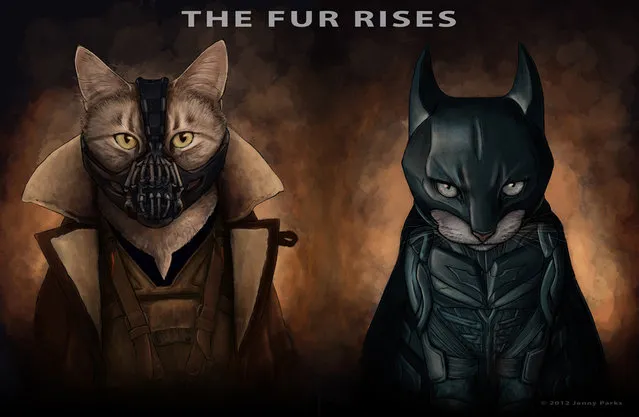
Super Cats By Jenny Parks

Jenny Parks is a scientific illustrator that also happens to be a shameless nerd, with a penchant for drawing animals, dinosaurs, imaginary creatures… and occasionally, people as cats. Somehow, she found herself with a bit of internet fame with the illustration ‘Doctor Mew’, and has been baffled ever since. With a BFA in illustration from the California College of the Arts, and a graduate degree in Science Illustration from UC Santa Cruz, she now resides in San Francisco as a freelance illustrator, fulfilling her destiny to make a living drawing cute, fuzzy things.
Details
25 Jul 2013 10:50:00
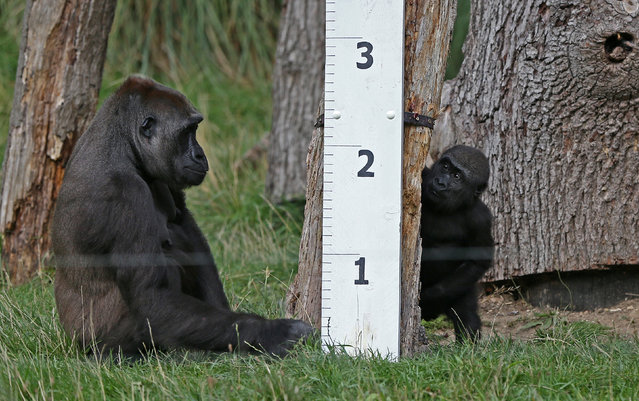
Gorillas sit next to a ruler during a photocall for the annual weigh-in at London Zoo in London, Britain August 24, 2017. (Photo by Neil Hall/Reuters)

Gorillas sit next to a ruler during a photocall for the annual weigh-in at London Zoo in London, Britain August 24, 2017. During the weigh-in, animals across the zoo have their vital statistics recorded including their height and weight and the information is then shared with zoos across the world to help zookeepers compare important information on thousands of endangered species. (Photo by Neil Hall/Reuters)
Details
26 Aug 2017 08:16:00
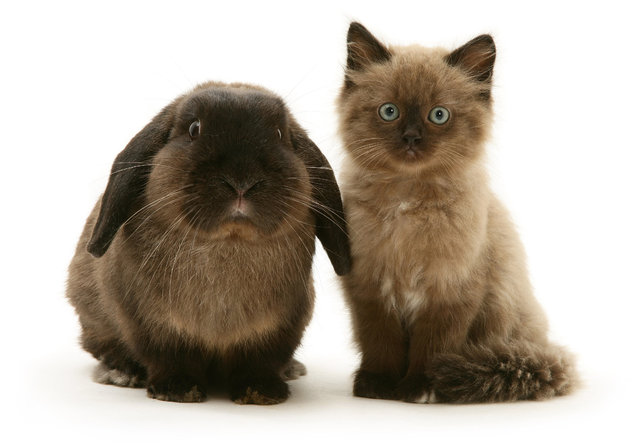
Chocolate Birman-cross kitten with chocolate Lop rabbit. (Photo by Mark Taylor/Warren Photographic/Caters News Agency)

These “snapcats” have found their bunny doppelgängers in a series of sweet photo shoots. Animal photographer Mark Taylor, from Surrey, England, and his assistants have scoured the U.K. to bring together carbon-copy rabbits and cats. Here: Chocolate Birman-cross kitten with chocolate Lop rabbit. (Photo by Mark Taylor/Warren Photographic/Caters News Agency)
Details
11 Nov 2017 07:14:00
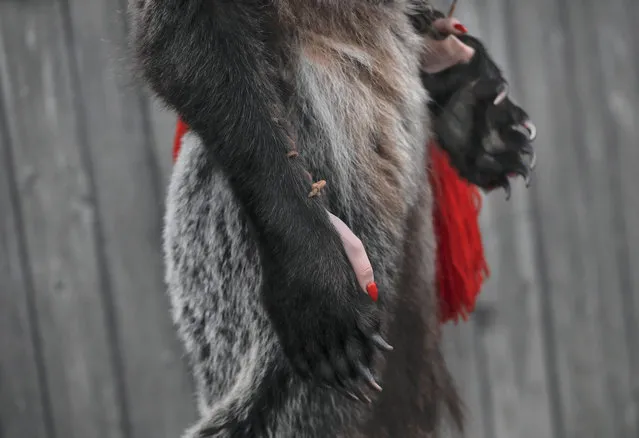
In this Saturday, December 30, 2017, picture a girl wearing a bear fur costume takes part in an annual bear parade in Comanesti, Romania. (Photo by Vadim Ghirda/AP Photo)

In this Saturday, December 30, 2017, picture a girl wearing a bear fur costume takes part in an annual bear parade in Comanesti, Romania. It's a tradition that originated in pre-Christian times, when dancers wearing colored costumes or animal furs went from house to house in villages, singing and dancing to ward off evil. (Photo by Vadim Ghirda/AP Photo)
Details
08 Jan 2018 07:05:00
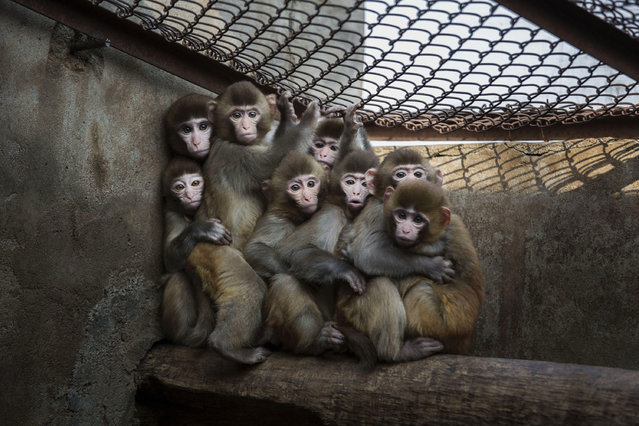
Macaque monkeys crowd together in their cage at a monkey farm on February 3, 2016 in Xinye county, Henan province, China. The area boasts a centuries-long and lucrative history of raising and training monkeys for performance. In Xinye, villagers are seeing an increase in business with the lunar calendar's “Year of the Monkey”. Farmers say most of the monkeys are bred and raised for domestic zoos, circuses, and performing groups, but add that some are also sold for medical research in China and the United States. Despite the popularity of the tradition, critics contend the training methods and conditions constitute animal cruelty. (Photo by Kevin Frayer/Getty Images)

Macaque monkeys crowd together in their cage at a monkey farm on February 3, 2016 in Xinye county, Henan province, China. The area boasts a centuries-long and lucrative history of raising and training monkeys for performance. In Xinye, villagers are seeing an increase in business with the lunar calendar's “Year of the Monkey”. Farmers say most of the monkeys are bred and raised for domestic zoos, circuses, and performing groups, but add that some are also sold for medical research in China and the United States. Despite the popularity of the tradition, critics contend the training methods and conditions constitute animal cruelty. (Photo by Kevin Frayer/Getty Images)
Details
31 Dec 2016 09:56:00
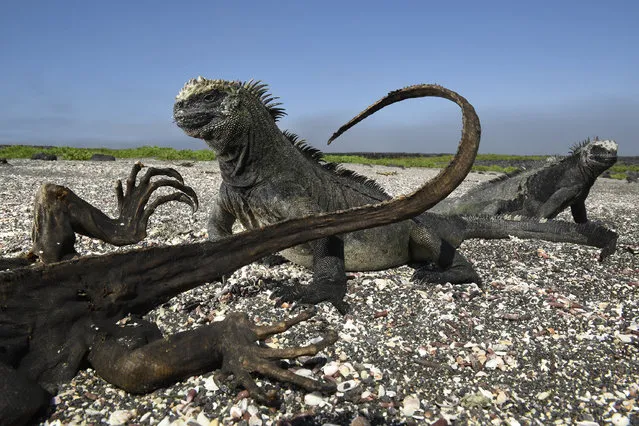
Galapagos – Rocking the Cradle: Four major ocean currents converge along the Galapagos archipelago, creating the conditions for an extraordinary diversity of animal life, April 25, 2016. The islands are home to at least 7,000 flora and fauna species, of which 97 percent of the reptiles, 80 percent of the land birds, 50 percent of the insects and 30 percent of the plants are endemic. The local ecosystem is highly sensitive to the changes in temperature, rainfall and ocean currents that characterize the climatic events known as El Niño and La Niña. These changes cause marked fluctuations in weather and food availability. Many scientists expect the frequency of El Niño and La Niña to increase as a result of climate change, making the Galapagos a possible early-warning location for its effects. (Photo by Thomas P. Peschak for National Geographic/World Press Photo)

Galapagos – Rocking the Cradle: Four major ocean currents converge along the Galapagos archipelago, creating the conditions for an extraordinary diversity of animal life, April 25, 2016. The islands are home to at least 7,000 flora and fauna species, of which 97 percent of the reptiles, 80 percent of the land birds, 50 percent of the insects and 30 percent of the plants are endemic. (Photo by Thomas P. Peschak for National Geographic/World Press Photo)
Details
16 Apr 2018 00:01:00