Loading...
Done
Greyhounds race after a Hare at the last Waterloo Cup Hare coursing event

“The Waterloo Cup was a coursing event. The three day event was run annually at Great Altcar in Lancashire, England from 1836 to 2005 and it used to attract tens of thousands of spectators to watch and gamble on the coursing matches. It was founded by William Philip Molyneux, 2nd Earl of Sefton, and, originally, was supported by his patronage”. – Wikipedia

Photo: A Greyhound races after Hare at the last Waterloo Cup Hare coursing event, February 14, 2005, near Liverpool, England. (Photo by Christopher Furlong/Getty Images)
Details
18 Feb 2012 11:26:00
Salar de Uyuni

Salar de Uyuni (or Salar de Tunupa) is the world's largest salt flat at 10,582 square kilometers (4,086 sq mi). It is located in the Potosí and Oruro departments in southwest Bolivia, near the crest of the Andes, and is elevated 3,656 meters (11,995 ft) above mean sea level. The Salar was formed as a result of transformations between several prehistoric lakes. It is covered by a few meters of salt crust, which has an extraordinary flatness with the average altitude variations within one meter over the entire area of the Salar.
Details
04 Aug 2012 08:42:00
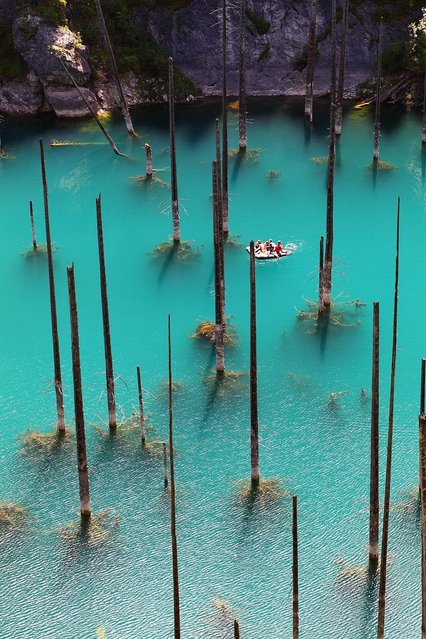
Kaindy Lake in Kazakhstan

Kaindy Lake (Kazakh: Қайыңды көлі, Qayındı köli) is a 400 metre long lake in Kazakhstan that reaches depths near 30 metres in some areas. It is located 129 km ESE of the city of Almaty and is 2,000 metres above sea level. It was created by the result of an enormous limestone landslide, triggered by the 1911 Kebin earthquake. The track to Kaindy lake has many scenic views to the Saty Gorge, the Chilik River valley and the Kaindy Gorge. Dried-out trunks of submerged Picea schrenkiana trees rise above the surface.
Details
06 Aug 2012 09:58:00
stone art by Hirotoshi Itoh

Hirotoshi Itoh graduated from Tokyo National Fine Arts University in 1982 and later went into his family business as a stonemason. He spent several years working with metal before turning his attention to stones. He utilizes stones found in a river bank near his home, and he creates sculptures that juxtapose the original shape and hardness of the material with surprising humor and texture. You can find more of his work on his Deviant Art page.
Details
17 May 2012 10:58:00
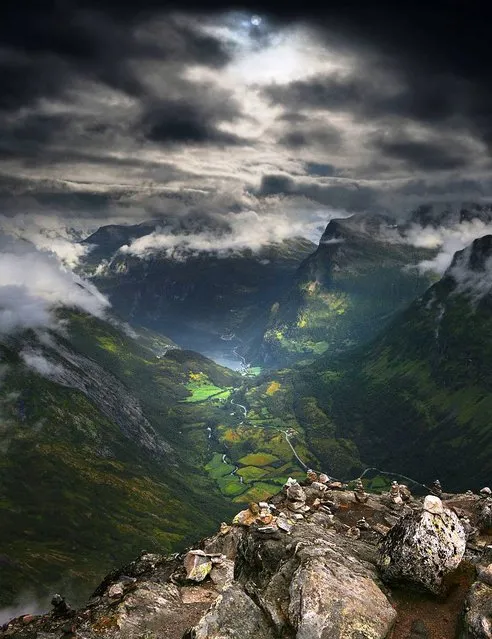
The Majesty Of Norway's Dalsnibba Mountain

Dalsnibba is a mountain in Stranda Municipality in More og Romsdal county, Norway. It is located at the end of the Geiranger valley, about 21 kilometres (13 mi) south of the village of Geiranger and the Geirangerfjorden. The 2-square-kilometre (0.77 sq mi) lake Djupvatnet lies directly to the southeast of the mountain. The mountain is located very near the county border with both Oppland and Sogn og Fjordane counties, in the southeastern part of Møre og Romsdal county.
Details
24 Jul 2013 10:28:00
In this  Monday, March 10, 2014 photo, a 9,000 year-old mask is on display at the Israel Museum in Jerusalem.  (Photo by Tsafrir Abayov/AP Photo)

In this Monday, March 10, 2014 photo, a 9,000 year-old mask is on display at the Israel Museum in Jerusalem. The exhibition called “Face To Face” shows eleven stone masks, said to have been discovered in the Judean desert and hills near Jerusalem, which date back 9,000 years and offer a rare glimpse at some of civilization's first communal rituals. (Photo by Tsafrir Abayov/AP Photo)
Details
14 Mar 2014 08:25:00
Chernobyl

Scaffolding holding a remnant of the Soviet Union, the hammer and sickle, is seen on a rooftop of an abandoned building in the town of Pripyat on January 25, 2006 near Chernobyl, Ukraine. The town of Pripyat, deserted since the 1986 catastrophe, once housed 30,000 people, the majority of being workers from the Chernobyl Nuclear Power Plant. Days after the catastrophe the inhabitants were relocated to other locations in the Soviet Union. The town of Pripyat has remained uninhabited since. Prypyat and the surrounding area will not be safe for human habitation for several centuries. Scientists estimate that the most dangerous radioactive elements will take up to 900 years to decay sufficiently to render the area safe.
Details
14 Mar 2011 10:20:00


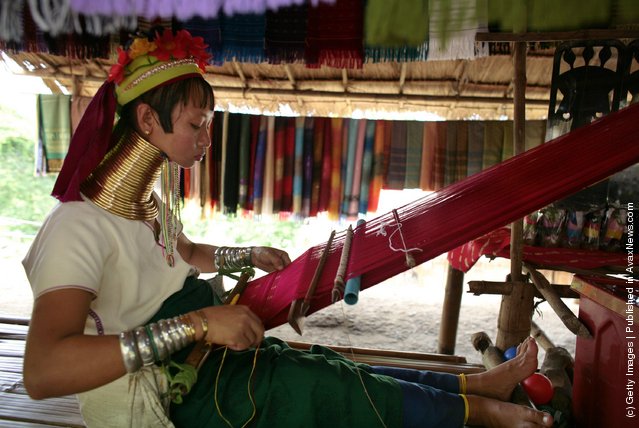
Mah Chan, a Long Neck Padaung hill tribe woman weaves a scraf for sale to tourists in a small village where 30 familes live July 13, 2006 in Chiang Dao, Thailand. All the Long Neck villages are set up for tourists and just over a year ago the hill tribe members were hand picked to move closer to Chiang Mai from more remote communities so that they could be more accessible. The Padaung women famously wear brass rings around their necks, beginning at five-years-old, to distort the growth of their collarbones and making them look like they have long necks. They are originally from eastern Burma near the Thailand border. (Photo by Paula Bronstein/Getty Images)
Details
19 Apr 2011 11:56:00