Loading...
Done
Chinese Taipei's Hsiao-Wen Huang reacts after winning her fight against Serbia's Nina Radovanovic during their women's fly (48-51kg) quarter-final boxing match during the Tokyo 2020 Olympic Games at the Kokugikan Arena in Tokyo on August 1, 2021. (Photo by Ueslei Marcelino/Reuters)

Chinese Taipei's Hsiao-Wen Huang reacts after winning her fight against Serbia's Nina Radovanovic during their women's fly (48-51kg) quarter-final boxing match during the Tokyo 2020 Olympic Games at the Kokugikan Arena in Tokyo on August 1, 2021. (Photo by Ueslei Marcelino/Reuters)
Details
05 Aug 2021 08:30:00
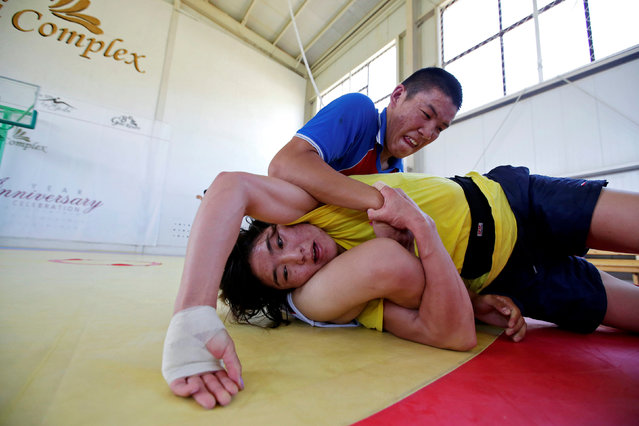
Mongolia's Olympic wrestler Battsetseg Soronzonbold (front) fights with her training partner during a daily training session at the Mongolia Women’s National Wrestling Team training centre in Bayanzurkh district of Ulaanbaatar, Mongolia, July 1, 2016. Battsetseg Soronzonbold became a national hero in her native Mongolia after winning wrestling bronze at the London Olympics and is determined to turn the medal into gold in Rio next month. (Photo by Jason Lee/Reuters)

Mongolia's Olympic wrestler Battsetseg Soronzonbold (front) fights with her training partner during a daily training session at the Mongolia Women’s National Wrestling Team training centre in Bayanzurkh district of Ulaanbaatar, Mongolia, July 1, 2016. Battsetseg Soronzonbold became a national hero in her native Mongolia after winning wrestling bronze at the London Olympics and is determined to turn the medal into gold in Rio next month. (Photo by Jason Lee/Reuters)
Details
07 Jul 2016 11:54:00
A woman with a sign that reads in Portuguese “Being woman without Temer”, stands next to a police barricade during a protest against the gang rape of a 16-year-old girl in Sao Paulo, Brazil, Wednesday, June 1, 2016. In response to the assault, Brazil's interim President Michel Temer said that the country will set up a specialized group to fight violence against women. (Photo by Andre Penner/AP Photo)

A woman with a sign that reads in Portuguese “Being woman without Temer”, stands next to a police barricade during a protest against the gang rape of a 16-year-old girl in Sao Paulo, Brazil, Wednesday, June 1, 2016. In response to the assault, Brazil's interim President Michel Temer said that the country will set up a specialized group to fight violence against women. (Photo by Andre Penner/AP Photo)
Details
03 Jun 2016 13:05:00
A young tiger tries to get at poultry parts hidden in a pumpkin at Magdeburg Zoo, Germany on October 30, 2025. The zoo is celebrating Halloween from October 31, 2025 to November 1, 2025. In addition to the puppet theater, children's carousel and children's train, visitors can carve their own pumpkins, which are then distributed to the zoo animals and serve as food. (Photo by Klaus-Dietmar Gabbert/Avalon)

A young tiger tries to get at poultry parts hidden in a pumpkin at Magdeburg Zoo, Germany on October 30, 2025. The zoo is celebrating Halloween from October 31, 2025 to November 1, 2025. In addition to the puppet theater, children's carousel and children's train, visitors can carve their own pumpkins, which are then distributed to the zoo animals and serve as food. (Photo by Klaus-Dietmar Gabbert/Avalon)
Details
02 Nov 2025 05:02:00
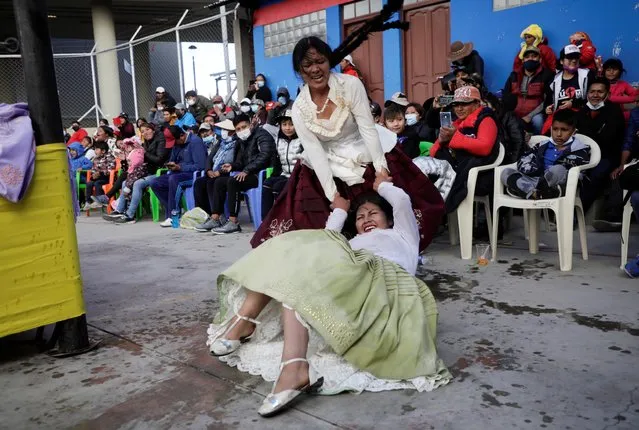
Barbara Quisbert and Susana La Bonita, cholitas wrestlers, fight during their return to the ring after the coronavirus disease (COVID-19) restrictions, in El Alto outskirts of La Paz, November 29, 2020. (Photo by David Mercado/Reuters)

The Fighting Cholitas are a group of female wrestlers who perform in El Alto, Bolivia. Tickets to the exhibitions cost $1. Like the general population of El Alto, which consists almost entirely of Aymara and Quechua residents, the Cholitas are indigenous. They wear braided hair, bowler hats and multilayered skirts in the ring. Here: Barbara Quisbert and Susana La Bonita, cholitas wrestlers, fight during their return to the ring after the coronavirus disease (COVID-19) restrictions, in El Alto outskirts of La Paz, November 29, 2020. (Photo by David Mercado/Reuters)
Details
12 Dec 2020 00:03:00
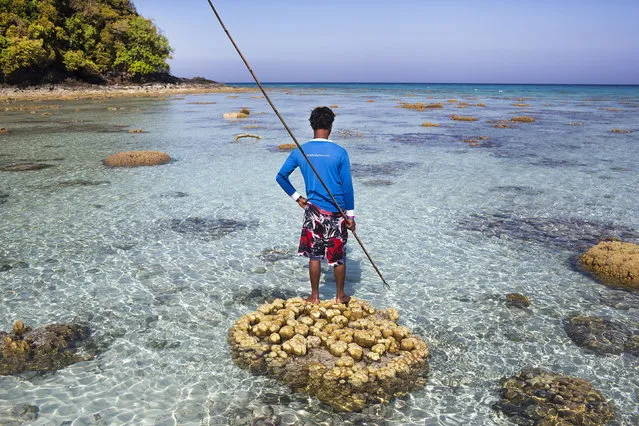
Hook, an indigenous Moken man, holds a three-pronged throwing spear and searches for fish in the waters of Ko Surin National Park. March 1, 2013 – Ko Surin, Thailand. (Photo by Taylor Weidman/zReportage via ZUMA Press)

“For centuries, the Moken sea nomads have traveled the islands between Thailand and Myanmar fishing and foraging for food on the sea floor. Throughout the Mergui Archipelago, Moken migrate in flotillas of Kabangs (traditional boat of the Moken people), stopping at different islands and beaches. Expert freedivers, the Moken have adapted physically to an aquatic life, developing unique characteristics that let them see better and hold their breath longer while underwater”. – Taylor Weidman. Photo: Hook, an indigenous Moken man, holds a three-pronged throwing spear and searches for fish in the waters of Ko Surin National Park. March 1, 2013 – Ko Surin, Thailand. (Photo by Taylor Weidman/zReportage via ZUMA Press)
Details
24 Mar 2014 06:45:00
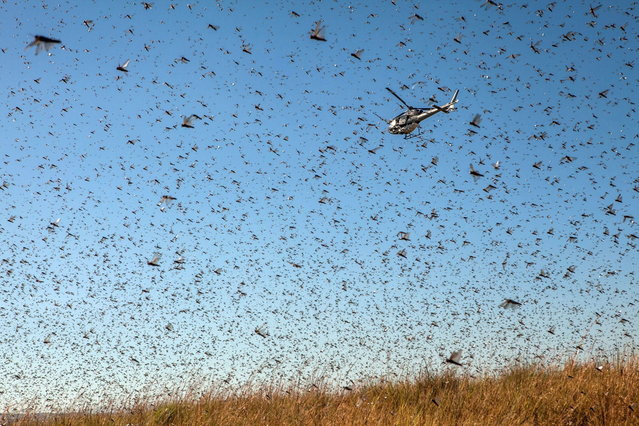
A helicopter of the Food and Agriculture Organization of the United Nations (FAO) flies through millions of Locusts as spreads pesticide to fight against a swarm of locusts threatening to reach Amparihibe village on May 7, 2014 in Tsiroanomandidy , Madagascar. FAO mission is to fight the locust's swarm with an insecticide. (Photo by AFP Photo/RIJASOLO)

A helicopter of the Food and Agriculture Organization of the United Nations (FAO) flies through millions of Locusts as spreads pesticide to fight against a swarm of locusts threatening to reach Amparihibe village on May 7, 2014 in Tsiroanomandidy, Madagascar. FAO mission is to fight the locust's swarm with an insecticide. (Photo by AFP Photo/RIJASOLO)
Details
16 May 2014 08:32:00
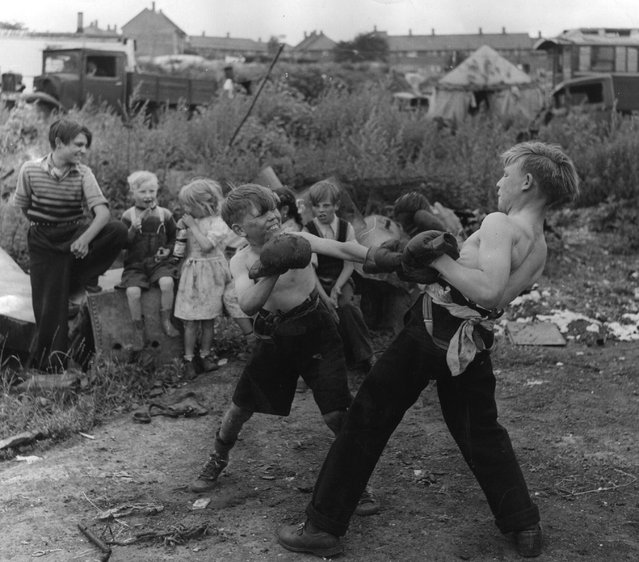
The unromantic gypsies. Children boxing in a gypsy camp in Kent, England on July 1, 1951. Like all boys these gypsy lads like to try their hand at boxing. Encouraged by their friends they fight it out on Corke's Meadow. Few Romanies now live a life of wandering romance. Most are like the three hundred squatters of Corke's Meadow, Kent, which is part of a “gypsy problem” that involves about 100,000 today. Of those about 25,000 can be rightly called gypsies, the rest are Mumpers and Posh-rats and Hobos. Corke's Meadow has both kinds. “Picture Post” cameraman Bert Hardy photographs the Corke's Meadow gypsies in their encampment. (Photo by Hulton-Deutsch Collection/Corbis via Getty Images)

The unromantic gypsies. Children boxing in a gypsy camp in Kent, England on July 1, 1951. Like all boys these gypsy lads like to try their hand at boxing. Encouraged by their friends they fight it out on Corke's Meadow. Few Romanies now live a life of wandering romance. Most are like the three hundred squatters of Corke's Meadow, Kent, which is part of a “gypsy problem” that involves about 100,000 today. Of those about 25,000 can be rightly called gypsies, the rest are Mumpers and Posh-rats and Hobos. Corke's Meadow has both kinds. “Picture Post” cameraman Bert Hardy photographs the Corke's Meadow gypsies in their encampment. (Photo by Hulton-Deutsch Collection/Corbis via Getty Images)
Details
12 Mar 2017 00:01:00