Loading...
Done
Saleem Bagga, seen by some as a lookalike of U.S. President-elect Donald Trump, poses for a selfie with a customer while selling kheer, a traditional South Asian rice pudding, along a road in Sahiwal, Pakistan on January 13, 2025. (Photo by Nida Meboob/Reuters)

Saleem Bagga, seen by some as a lookalike of U.S. President-elect Donald Trump, poses for a selfie with a customer while selling kheer, a traditional South Asian rice pudding, along a road in Sahiwal, Pakistan on January 13, 2025. (Photo by Nida Meboob/Reuters)
Details
18 Feb 2025 03:57:00
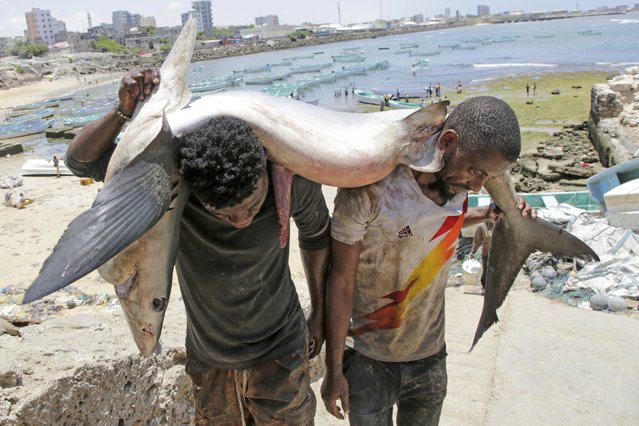
Fishermen carry a tuna fish to the market in Mogadishu, Somalia, April 2, 2025. (Photo by Farah Abdi Warsameh/AP Photo)

Fishermen carry a tuna fish to the market in Mogadishu, Somalia, April 2, 2025. (Photo by Farah Abdi Warsameh/AP Photo)
Details
10 Apr 2025 03:02:00
American singer Sabrina Carpenter performs onstage at the 2024 Coachella Valley Music and Arts Festival at Empire Polo Club on April 12, 2024 in Indio, California. (Photo by Emma McIntyre/Getty Images for Coachella)

American singer Sabrina Carpenter performs onstage at the 2024 Coachella Valley Music and Arts Festival at Empire Polo Club on April 12, 2024 in Indio, California. (Photo by Emma McIntyre/Getty Images for Coachella)
Details
19 Aug 2025 04:37:00
Bujang, a 35-year-old male orangutan rescued from a circus in Sumatra, washes his face on a sanctuary island surrounded by a river where non-releasable orangutans are protected for life at the Samboja Lestari Orangutan Rehabilitation Center run by the non-profit Borneo Orangutan Survival (BOS) Foundation in Samboja, East Kalimantan, on July 12, 2024. (Photo by Yasuyoshi Chiba/AFP Photo)

Bujang, a 35-year-old male orangutan rescued from a circus in Sumatra, washes his face on a sanctuary island surrounded by a river where non-releasable orangutans are protected for life at the Samboja Lestari Orangutan Rehabilitation Center run by the non-profit Borneo Orangutan Survival (BOS) Foundation in Samboja, East Kalimantan, on July 12, 2024. (Photo by Yasuyoshi Chiba/AFP Photo)

Details
14 Nov 2025 03:17:00
1952:  Shepherds from the north wear their traditional heavy woollen mantles as they stand ready to shear sheep with sycthe-like shears

Shepherds from the north wear their traditional heavy woollen mantles as they stand ready to shear sheep with sycthe-like shears. (Photo by Three Lions/Getty Images). Circa 1952
Details
03 Dec 2011 13:34:00
An Indian women offers early-morning prayers or a “puja” at a ghat early in the morning on the banks of the Betawa River in Orchha in the state of Madhya Pradesh on July 5, 2015. (Photo by Rebecca Conway/AFP Photo)

An Indian women offers early-morning prayers or a “puja” at a ghat early in the morning on the banks of the Betawa River in Orchha in the state of Madhya Pradesh on July 5, 2015. (Photo by Rebecca Conway/AFP Photo)
Details
08 Jul 2015 11:56:00
Hotel staff practice self-defence skills after a training session given by team member of Special Weapons and Tactics (SWAT) team, in Hangzhou, Zhejiang province, April 7, 2016. (Photo by Reuters/Stringer)

Hotel staff practice self-defence skills after a training session given by team member of Special Weapons and Tactics (SWAT) team, in Hangzhou, Zhejiang province, April 7, 2016. (Photo by Reuters/Stringer)
Details
12 Apr 2016 11:37:00
This Thursday, January 22, 2015 photo made with a long exposure shows the glow from a Noctiluca scintillans algal bloom along the seashore in Hong Kong. The luminescence, also called Sea Sparkle, is triggered by farm pollution that can be devastating to marine life and local fisheries, according to University of Georgia oceanographer Samantha Joye. (Photo by Kin Cheung/AP Photo)

This Thursday, January 22, 2015 photo made with a long exposure shows the glow from a Noctiluca scintillans algal bloom along the seashore in Hong Kong. The luminescence, also called Sea Sparkle, is triggered by farm pollution that can be devastating to marine life and local fisheries, according to University of Georgia oceanographer Samantha Joye. Noctiluca itself does not produce neurotoxins like other similar organisms do. But its role as both prey and predator tends can eventually magnify the accumulation of toxins in the food chain, according to R. Eugene Turner at Louisiana State University. (Photo by Kin Cheung/AP Photo)

Details
23 Jan 2015 13:12:00