Loading...
Done
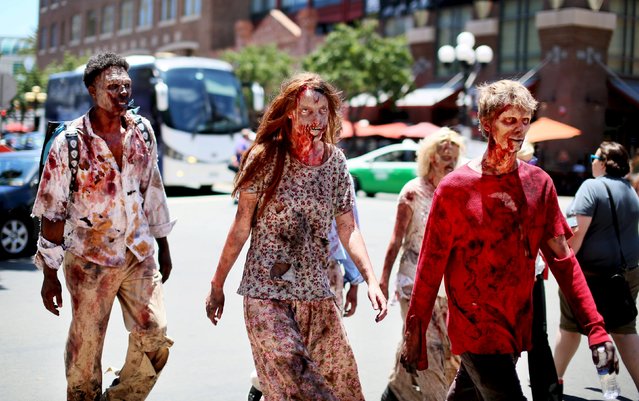
Attnedees dressed in Zombie outfits walk down the Gaslamp Quarter outside of the 2015 Comic-Con International in San Diego, California July 8, 2015. (Photo by Sandy Huffaker/Reuters)

Attnedees dressed in Zombie outfits walk down the Gaslamp Quarter outside of the 2015 Comic-Con International in San Diego, California July 8, 2015. (Photo by Sandy Huffaker/Reuters)
Details
09 Jul 2015 12:27:00
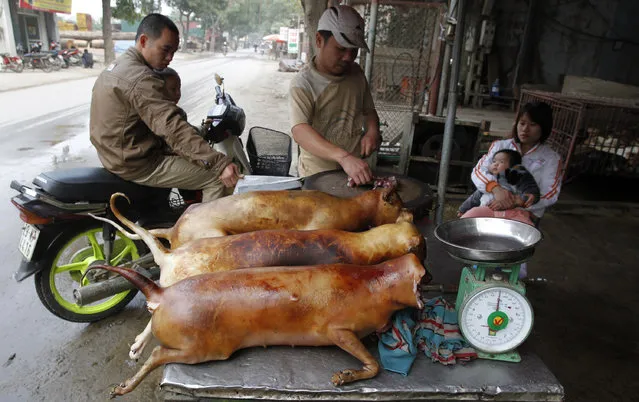
A vendor (C) cuts slaughtered dogs for sale at his roadside stall in Duong Noi village, outside Hanoi December 16, 2011. While animal rights activists have condemned eating dog meat as cruel treatment of the animals, it is still an accepted popular delicacy for some Vietnamese, as well in some other Asian countries. (Photo by Reuters/Kham)

A vendor (C) cuts slaughtered dogs for sale at his roadside stall in Duong Noi village, outside Hanoi December 16, 2011. While animal rights activists have condemned eating dog meat as cruel treatment of the animals, it is still an accepted popular delicacy for some Vietnamese, as well in some other Asian countries. Duong Noi is well-known as a dog-meat village, where hundreds of dogs are killed each day for sale as popular traditional food. Dog-eating as a custom is rooted in Vietnam and was developed as a result of poverty. One kilogram of dog meat costs about 130,000 dongs ($6.2). (Photo by Reuters/Kham)
Details
16 Jul 2013 11:40:00
A sales woman of a fish shop shows king crabs to a customer and negotiates the price in Noryangjin Fish Market is seen on August 1, 2015 in Seoul, South Korea. Noryangjin Fish Market was established in 1927 as Gyeongseong Susan in Jung-gu near Seoul Station and moved to its current location in 1971. (Photo by Shin Woong-jae/The Washington Post)

A sales woman of a fish shop shows king crabs to a customer and negotiates the price in Noryangjin Fish Market is seen on August 1, 2015 in Seoul, South Korea. Noryangjin Fish Market was established in 1927 as Gyeongseong Susan in Jung-gu near Seoul Station and moved to its current location in 1971. (Photo by Shin Woong-jae/The Washington Post)
Details
11 Sep 2015 12:21:00
A reveller takes part in an annual block party known as “Cordao de Prata Preta”, one of the many carnival parties to take place in the neighbourhoods of Rio de Janeiro, February 6, 2016. (Photo by Pilar Olivares/Reuters)

A reveller takes part in an annual block party known as “Cordao de Prata Preta”, one of the many carnival parties to take place in the neighbourhoods of Rio de Janeiro, February 6, 2016. (Photo by Pilar Olivares/Reuters)
Details
07 Feb 2016 07:22:00
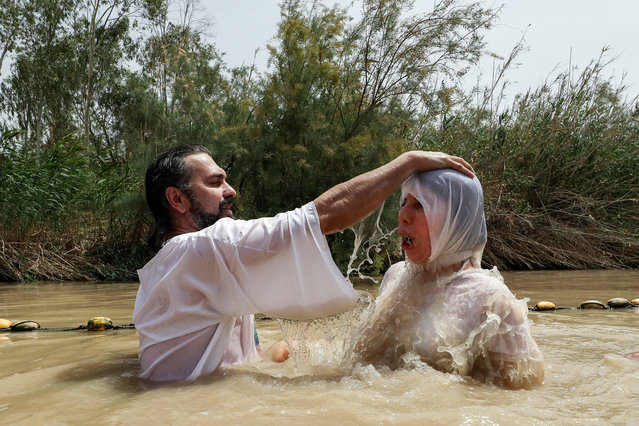
A Christian pilgrim is baptised by a priest in the muddy water of the Jordan River at the Kasser-Al-Yahud baptismal site near the West Bank city of Jericho, on April 11, 2017. According to the gospels Jesus Christ was baptised in the waters of the Jordan River by John the Baptist. (Photo by Gali Tibbon/AFP Photo)

A Christian pilgrim is baptised by a priest in the muddy water of the Jordan River at the Kasser-Al-Yahud baptismal site near the West Bank city of Jericho, on April 11, 2017. According to the gospels Jesus Christ was baptised in the waters of the Jordan River by John the Baptist. (Photo by Gali Tibbon/AFP Photo)
Details
12 Apr 2017 10:21:00
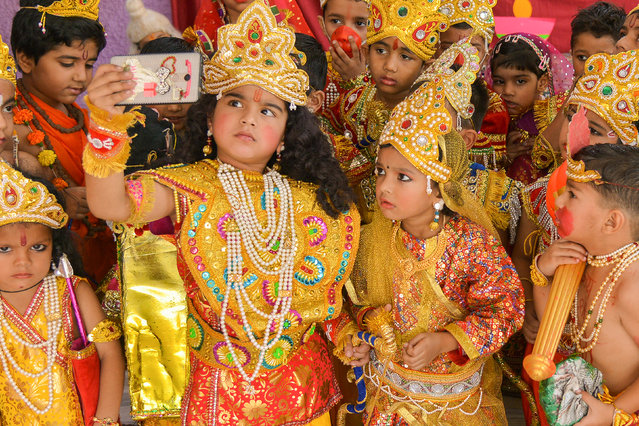
Indian children dressed up as the Hindu deities Rama and Sita take a selfie photograph at an event to celebrate the Diwali festival in Ajmer in western Rajasthan state on November 6, 2018. (Photo by Shaukat Ahmed/AFP Photo)

Indian children dressed up as the Hindu deities Rama and Sita take a selfie photograph at an event to celebrate the Diwali festival in Ajmer in western Rajasthan state on November 6, 2018. (Photo by Shaukat Ahmed/AFP Photo)
Details
08 Nov 2018 00:05:00
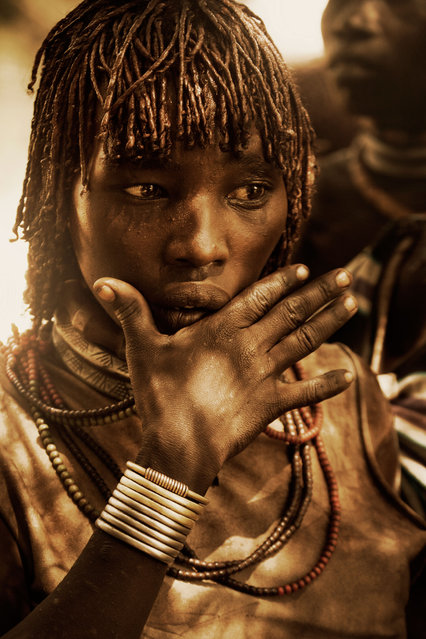
The Hamar people traditionally use red ocher clay to braid the hair of their women. (Photo by Diego Arroyo)

During his time in Ethiopia, New York-based art director and photographer Diego Arroyo spent time with the Hamar, Mursi, Dassanech, and Arbore Tribes. They, along with several others tribes, make up the 200,000 people situated in Africa’s Great Rift Valley. The people of the Omo Valley are still primarily herders and farmers, living an isolated and simple life. While they have yet to be truly touched by globalization, they could soon disappear. Their way of life is being threatened by a massive hydroelectric dam. (Photo by Diego Arroyo)
Details
13 Aug 2014 10:00:00
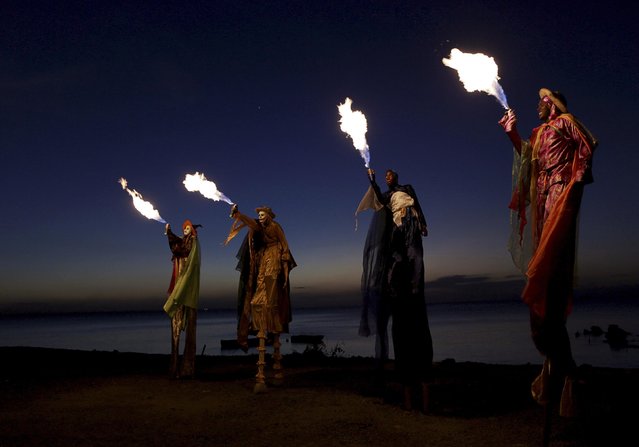
Members of the Kaisokah Moko Jumbies perform with fire on the waterfront near their San Fernando, Trinidad base February 10, 2015. (Photo by Andrea De Silva/Reuters)

Members of the Kaisokah Moko Jumbies perform with fire on the waterfront near their San Fernando, Trinidad base February 10, 2015. (Photo by Andrea De Silva/Reuters)
Details
16 Feb 2015 13:29:00