Loading...
Done
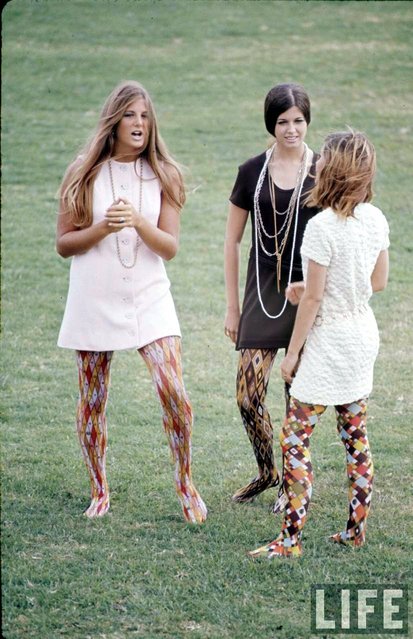
Corona del Mar High School students Kim Robertson, Pat Auvenshine and Pam Pepin wear “hippie” fashions, 1969. (Photo by Arthur Schatz/Time & Life Pictures/Getty Images)

“By 1969, the fashion choices of tens of millions of young American men and women were as variegated and ever-evolving as the world around them. Cultural transformation was an irresistible force during the Sixties, and across America and around the globe civil rights, women’s and gay liberation, the sexual revolution and, of course, the explosive soundtrack of R&B, soul and rock and roll informed everything from politics to fashion”. – LIFE. Photo: Corona del Mar High School students Kim Robertson, Pat Auvenshine and Pam Pepin wear “hippie” fashions, 1969. (Photo by Arthur Schatz/Time & Life Pictures)
Details
11 Aug 2013 12:43:00
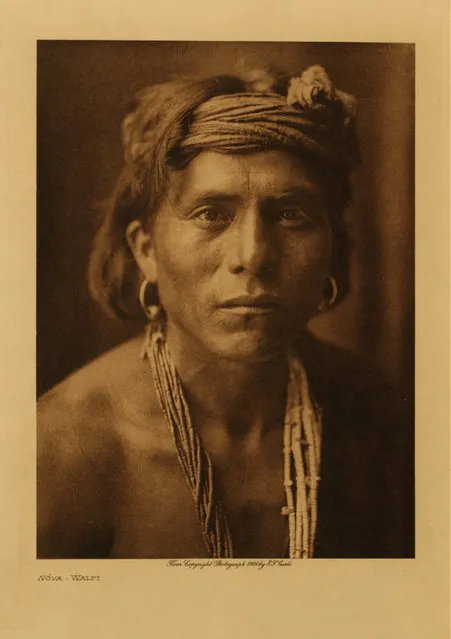
Nova, a Walpi, in 1906. (Photo by Edward S. Curtis)

At the beginning of the 20th century, Edward S. Curtis set out to document what he saw as a disappearing race: the Native American. From 1907 to 1930, Curtis took more than 2,000 photos of 80 tribes stretching from the Great Plains to the Pacific Northwest and Alaska. He then published and sold these photos, along with narrative text, in 20 volumes of work known as “The North American Indian”. It is one of the most significant collections of its kind, “probably the most important photographic document of its age and its topic,” said Jeffrey Garrett, associate university librarian for Special Libraries at Northwestern University. (Photo by Edward S. Curtis)
Details
07 Sep 2014 12:57:00
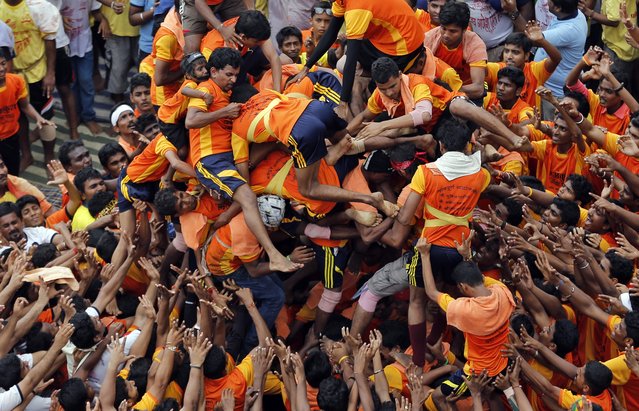
People fall down as they try to form a human pyramid to break the “Dahi handi”, an earthen pot filled with curd, an integral part of celebrations to mark Janmashtami in Mumbai, India, Monday, August 18, 2014. (Photo by Rafiq Maqbool/AP Photo)

People fall down as they try to form a human pyramid to break the “Dahi handi”, an earthen pot filled with curd, an integral part of celebrations to mark Janmashtami in Mumbai, India, Monday, August 18, 2014. Hindu devotees take part in the celebration in which an earthen pot is suspended high above the ground and groups of young men and children form a human pyramid to reach the pot and break it. The festival celebrates the birth of Hindu god Lord Krishna, one of the most popular gods in Hinduism. (Photo by Rafiq Maqbool/AP Photo)
Details
21 Aug 2014 09:38:00
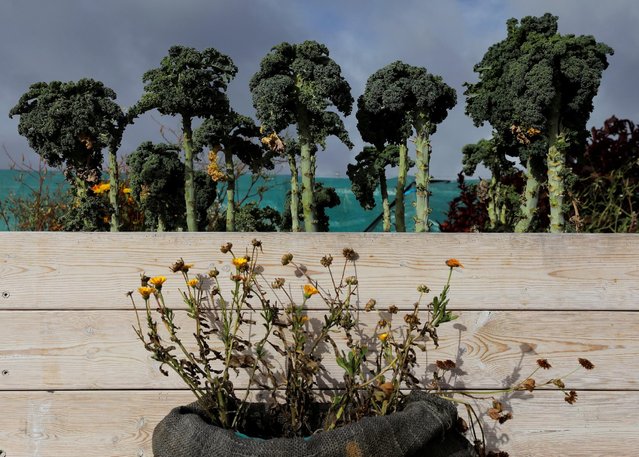
Kale grows at Kajodlingen farm in Gothenburg, Sweden, September 28, 2016. (Photo by Maxim Shemetov/Reuters)

Kale grows at Kajodlingen farm in Gothenburg, Sweden, September 28, 2016. They are doing it on the rooftops, on tower block balconies and even on a disused railway: Swedes have discovered a passion for urban gardening as a way of growing fresh food and getting back in touch with nature. Part of a global movement, an increasing number of Swedish city-dwellers are growing their own in window boxes and allotments or are visiting public gardens built in or on industrial or office spaces. (Photo by Maxim Shemetov/Reuters)
Details
11 Nov 2016 07:58:00
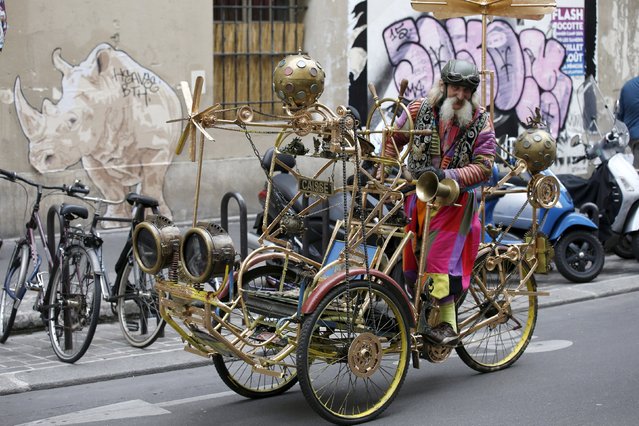
French artist Gino rides the “Celestial Cyclo” tricycle built by him in Le Marais neighbourhood in Paris, France, August 15, 2015. (Photo by Pascal Rossignol/Reuters)

French artist Gino rides the “Celestial Cyclo” tricycle built by him in Le Marais neighbourhood in Paris, France, August 15, 2015. (Photo by Pascal Rossignol/Reuters)
Details
16 Aug 2015 13:57:00
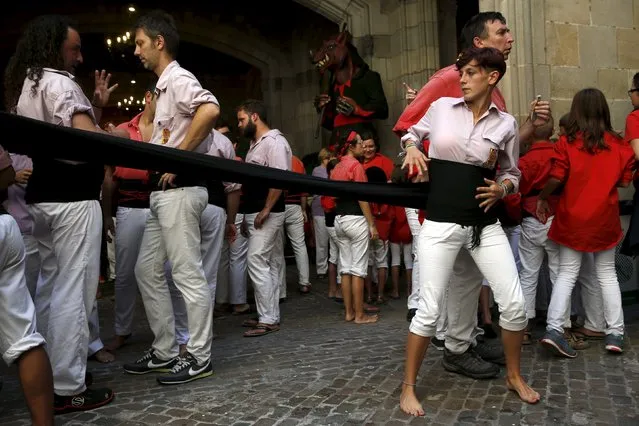
A member of the “Castellers Minyons de Terrassa” adjusts her belt before forming a human tower or ÒcastellÓ during the festival of the patron saint of Barcelona “The Virgin of Mercy” at Sant Jaume square in Barcelona, Spain, September 20, 2015. The formation of human towers is a tradition in Catalonia dating back to the 18th century. (Photo by Susana Vera/Reuters)

A member of the “Castellers Minyons de Terrassa” adjusts her belt before forming a human tower or ÒcastellÓ during the festival of the patron saint of Barcelona “The Virgin of Mercy” at Sant Jaume square in Barcelona, Spain, September 20, 2015. The formation of human towers is a tradition in Catalonia dating back to the 18th century. (Photo by Susana Vera/Reuters)
Details
21 Sep 2015 12:35:00
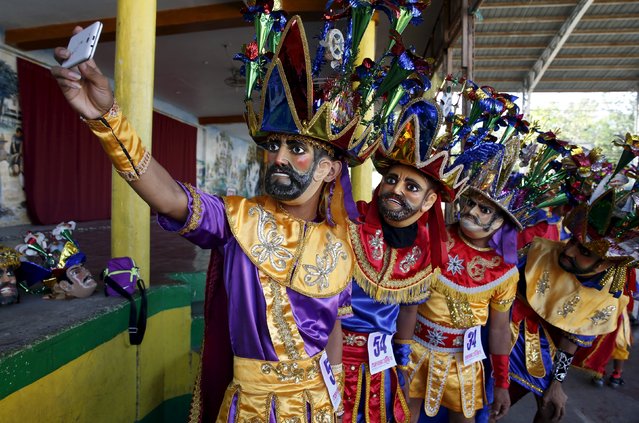
Penitents wearing masks, known locally as “Morions” take a selfie during the start of Holy Week celebrations in Mogpog, Marinduque in central Philippines March 21, 2016. (Photo by Erik De Castro/Reuters)

Penitents wearing masks, known locally as “Morions” take a selfie during the start of Holy Week celebrations in Mogpog, Marinduque in central Philippines March 21, 2016. The Moriones is an annual festival held on Holy Week on the island of Marinduque, Philippines. The “Moriones” are men and women in costumes and masks replicating the garb of biblical Roman soldiers as interpreted by local folks. (Photo by Erik De Castro/Reuters)
Details
22 Mar 2016 11:29:00
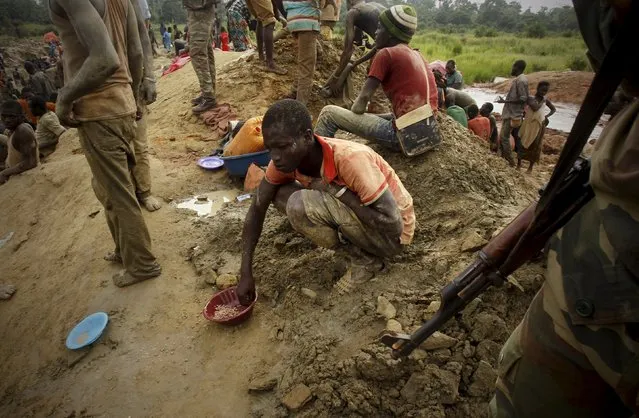
A gold prospector sits and eats close to a soldier at a gold mine near the village of Gamina, in western Ivory Coast, March 18, 2015. (Photo by Luc Gnago/Reuters)

Nestled among the cocoa plantations of western Ivory Coast is a gold mine that does not feature on any official maps. It is not run by an industrial mining company, nor does it pay taxes to the central government. The unlicensed mine is a key part of a lucrative business empire headed by the deputy commander of the West African nation's elite Republican Guard, United Nations investigators allege. Here: A gold prospector sits and eats close to a soldier at a gold mine near the village of Gamina, in western Ivory Coast, March 18, 2015. (Photo by Luc Gnago/Reuters)
Details
08 May 2015 13:54:00