Loading...
Done
Bill Wyatt, owner of the Y Que Trading Post in the Los Feliz neighborhood of Los Angeles, wears a Donald Trump face mask in his shop during the novel coronavirus COVID-19 pandemic on April 23, 2020. Wyatt has transformed his topical tee shirt business to a topical face mask business now called Y Que Mask and PPE Trading Post, since the start of the coronavirus crisis. According to Wyatt, the mask featuring Dr. Anthony Fauci is a best seller, as are masks with characters from the Netflix hit “Tiger King” and also popular internet memes. (Photo by Robyn Beck/AFP Photo)

Bill Wyatt, owner of the Y Que Trading Post in the Los Feliz neighborhood of Los Angeles, wears a Donald Trump face mask in his shop during the novel coronavirus COVID-19 pandemic on April 23, 2020. Wyatt has transformed his topical tee shirt business to a topical face mask business now called Y Que Mask and PPE Trading Post, since the start of the coronavirus crisis. According to Wyatt, the mask featuring Dr. Anthony Fauci is a best seller, as are masks with characters from the Netflix hit “Tiger King” and also popular internet memes. (Photo by Robyn Beck/AFP Photo)
Details
01 May 2020 00:01:00
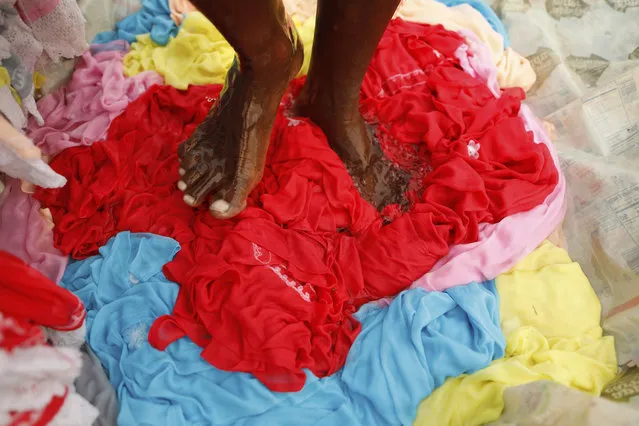
A dhobi, or a washerman washes cloths on the banks of the River Gomti in Lucknow, India, Saturday, September 12, 2020. Dhobis are traditional laundry workers who wash clothes by hand and dry them in the sun, an occupation which has been in existence for generations. Most cities in India have a Dhobi Ghat, or washermen's area, where the city's pile of clothes is laundered. This practice is still popular in India, despite of modern technology. Around 1,000 families work in Lucknow's Dhobi Ghat. However, in light of the novel coronavirus, their wages have decreased drastically. With each family earning around US$100-200 per month. (Photo by Rajesh Kumar Singh/AP Photo)

A dhobi, or a washerman washes cloths on the banks of the River Gomti in Lucknow, India, Saturday, September 12, 2020. Dhobis are traditional laundry workers who wash clothes by hand and dry them in the sun, an occupation which has been in existence for generations. Most cities in India have a Dhobi Ghat, or washermen's area, where the city's pile of clothes is laundered. This practice is still popular in India, despite of modern technology. Around 1,000 families work in Lucknow's Dhobi Ghat. However, in light of the novel coronavirus, their wages have decreased drastically. With each family earning around US$100-200 per month. (Photo by Rajesh Kumar Singh/AP Photo)
Details
25 Sep 2020 00:03:00
A CIT guard carries his gun handgun while bringing a bag containing cash inside an armoured vehicle during a money collection in Johannesburg's CBD, on December 8, 2020. As the Christmas festive season approaches, cash-in-transit (CIT) companies are gearing up as they continue to be target of crime, with about 3000 money vans traveling daily nationwide. Despite the COVID-19 lockdown, there have been 260 cash-in-transit heist incidents in South Africa this year, with 19 CIT crew members killed. Cash-in-transit heists in the country are often military-style planned operations with criminals recurring to bomb making and assault rifles attacks. (Photo by Michele Spatari/AFP Photo)

A CIT guard carries his gun handgun while bringing a bag containing cash inside an armoured vehicle during a money collection in Johannesburg's CBD, on December 8, 2020. As the Christmas festive season approaches, cash-in-transit (CIT) companies are gearing up as they continue to be target of crime, with about 3000 money vans traveling daily nationwide. Despite the COVID-19 lockdown, there have been 260 cash-in-transit heist incidents in South Africa this year, with 19 CIT crew members killed. Cash-in-transit heists in the country are often military-style planned operations with criminals recurring to bomb making and assault rifles attacks. (Photo by Michele Spatari/AFP Photo)
Details
18 Dec 2020 00:01:00
Greek actress Xanthi Georgiou, playing the role of the High Priestess, lights up the torch during the flame lighting ceremony for the Beijing 2022 Winter Olympics at the Ancient Olympia archeological site, birthplace of the ancient Olympics in southern Greece on October 18, 2021. The Olympic flame will once again be lit in an empty stadium on Ovtober 18, 2021, as it starts its truncated journey to Beijing for the Winter Games in February. Like the ceremony in March 2020 to light the flame for Tokyo, and like those Games, which were put back a year, Monday's ceremony is a victim of coronavirus restrictions. (Photo by Aris Messinis/AFP Photo)

Greek actress Xanthi Georgiou, playing the role of the High Priestess, lights up the torch during the flame lighting ceremony for the Beijing 2022 Winter Olympics at the Ancient Olympia archeological site, birthplace of the ancient Olympics in southern Greece on October 18, 2021. The Olympic flame will once again be lit in an empty stadium on Ovtober 18, 2021, as it starts its truncated journey to Beijing for the Winter Games in February. Like the ceremony in March 2020 to light the flame for Tokyo, and like those Games, which were put back a year, Monday's ceremony is a victim of coronavirus restrictions. (Photo by Aris Messinis/AFP Photo)
Details
19 Oct 2021 08:13:00
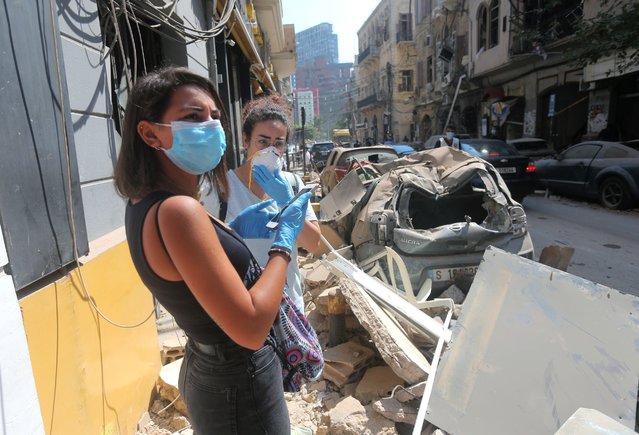
Young Lebanese women wearing protective masks and gloves against the coronavirus pandemic, stand on August 5, 2020 amid the rubble in Beirut's Gimmayzeh commercial district which was heavily damaged by the previous day's powerful explosion that tore through Lebanon's capital, resulting from the ignition of a huge depot of ammonium nitrate at the city's main port. Rescuers searched for survivors in Beirut after a cataclysmic explosion at the port sowed devastation across entire neighbourhoods, killing more than 100 people, wounding thousands and plunging Lebanon deeper into crisis. The blast, which appeared to have been caused by a fire igniting 2,750 tonnes of ammonium nitrate left unsecured in a warehouse, was felt as far away as Cyprus, some 150 miles (240 kilometres) to the northwest. (Photo by AFP Photo/Stringer)

Young Lebanese women wearing protective masks and gloves against the coronavirus pandemic, stand on August 5, 2020 amid the rubble in Beirut's Gimmayzeh commercial district which was heavily damaged by the previous day's powerful explosion that tore through Lebanon's capital, resulting from the ignition of a huge depot of ammonium nitrate at the city's main port. Rescuers searched for survivors in Beirut after a cataclysmic explosion at the port sowed devastation across entire neighbourhoods, killing more than 100 people, wounding thousands and plunging Lebanon deeper into crisis. The blast, which appeared to have been caused by a fire igniting 2,750 tonnes of ammonium nitrate left unsecured in a warehouse, was felt as far away as Cyprus, some 150 miles (240 kilometres) to the northwest. (Photo by AFP Photo/Stringer)
Details
10 Aug 2020 00:05:00
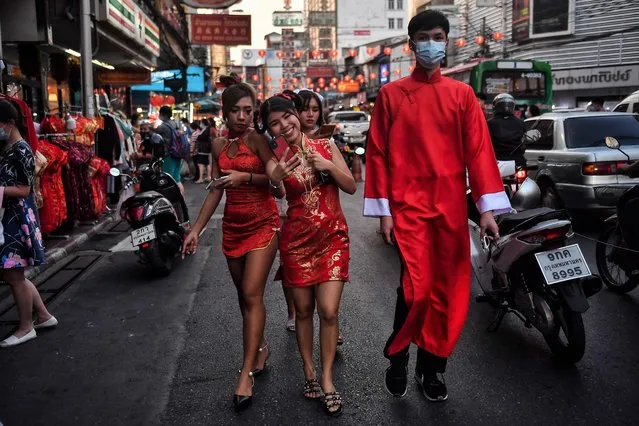
People wear traditional Chinese outfits as they walk in Chinatown in Bangkok on February 11, 2021, ahead of the start of the Lunar New Year, which ushers in the Year of the Ox on February 12. (Photo by Lillian Suwanrumpha/AFP Photo)

People wear traditional Chinese outfits as they walk in Chinatown in Bangkok on February 11, 2021, ahead of the start of the Lunar New Year, which ushers in the Year of the Ox on February 12. (Photo by Lillian Suwanrumpha/AFP Photo)
Details
12 Jan 2022 07:40:00
A preserved Sumatran Tiger (Panthera tigris sumatrae) that was collected by the Natural Resources Conservation Board (BKSDA) as evidence is burnt in Palembang, Indonesia on March 18, 2022. (Photo by Novaa Wahyudi/Antara Foto via Reuters)

A preserved Sumatran Tiger (Panthera tigris sumatrae) that was collected by the Natural Resources Conservation Board (BKSDA) as evidence is burnt in Palembang, Indonesia on March 18, 2022. (Photo by Novaa Wahyudi/Antara Foto via Reuters)
Details
26 May 2022 04:34:00
Japanese Yuuka Hasumi, 17, and Ibuki Ito, 17, also from Japan, who want to become K-pop stars, perform during their street performance in Hongdae area of Seoul, South Korea, March 21, 2019. Hasumi put high school in Japan on hold and flew to South Korea in February to try her chances at becoming a K-pop star, even if that means long hours of vocal and dance training, no privacy, no boyfriend, and even no phone. “It is tough”, Hasumi said. “Going through a strict training and taking my skill to a higher level to a perfect stage, I think that's when it is good to make a debut”. (Photo by Kim Hong-Ji/Reuters)

Japanese Yuuka Hasumi, 17, and Ibuki Ito, 17, also from Japan, who want to become K-pop stars, perform during their street performance in Hongdae area of Seoul, South Korea, March 21, 2019. (Photo by Kim Hong-Ji/Reuters)
Details
28 Feb 2021 10:09:00