Loading...
Done
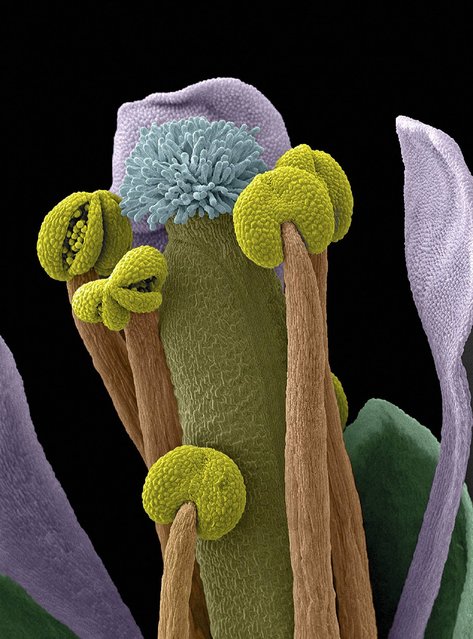
Scanning electron micrograph (SEM) of an Arabidopsis thaliana flower, also commonly known as thale cress. Some of the anthers are open, revealing pollen grains ready for dispersal. Arabidopsis was the first plant to have its entire genome sequenced and is widely used as a model organism in molecular and plant biology. Horizontal width of image is 1200 microns. Magnification 100x. (Photo by Stefan Eberhard/Wellcome Images)

Beautiful, strange and occasionally alarming pictures from the shortlist for this year’s Wellcome image awards – which celebrate the very best in science photography and imaging – from an x-ray of a bat to a micrograph of a kidney stone. The exhibition opens on 12 March at three science centres and the Museum of Science and Industry in Manchester. Photo: Scanning electron micrograph (SEM) of an Arabidopsis thaliana flower, also commonly known as thale cress. Some of the anthers are open, revealing pollen grains ready for dispersal. Arabidopsis was the first plant to have its entire genome sequenced and is widely used as a model organism in molecular and plant biology. Horizontal width of image is 1200 microns. Magnification 100x. (Photo by Stefan Eberhard/Wellcome Images)
Details
11 Mar 2014 05:58:00
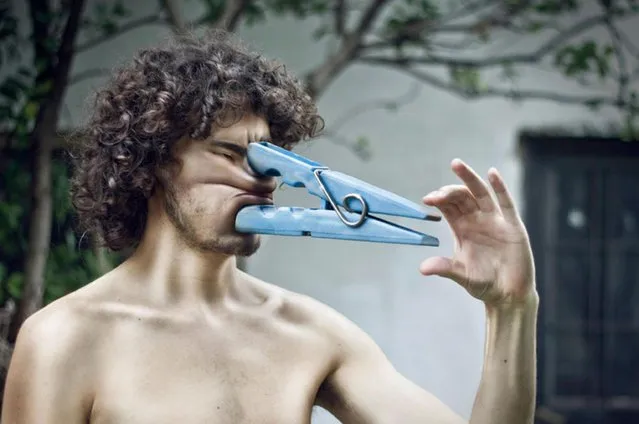
Martin De Pasquale with his creative photographs. Here's a look at the incredible world of a digital artist who creates mind-bending works of art with Photoshop. (Photo by Martin De Pasquale/Caters News)

Martin De Pasquale with his creative photographs. Here's a look at the incredible world of a digital artist who creates mind-bending works of art with Photoshop. (Photo by Martin De Pasquale/Caters News)
Details
25 Jun 2014 06:07:00
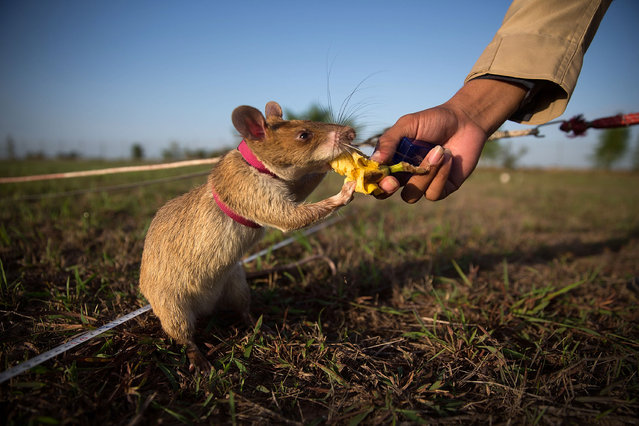
A mine detection rat is given banana as a reward after successfully identifying an inactive mine on July 2, 2015 in Siem Reap, Cambodia. (Photo by Taylor Weidman/Getty Images)

A mine detection rat is given banana as a reward after successfully identifying an inactive mine on July 2, 2015 in Siem Reap, Cambodia. The Cambodian Mine Action Center (CMAC) working with the Belgian NGO APOPO has recently begun testing the feasability of using large mine detection rats from Tanzania to help clear fields of mines and unexploded ordnance in one of the most bombed and mined countries in the world. (Photo by Taylor Weidman/Getty Images)
Details
03 Jul 2015 13:31:00
An Afghan policeman stands guard in front of a French restaurant  "Le Jardin" after a suicide attack in Kabul, Afghanistan January 2, 2016. A suicide attack on a French restaurant in the Afghan capital Kabul on Friday killed a 12-year-old boy and wounded more than a dozen other people, officials said. (Photo by Mohammad Ismail/Reuters)

An Afghan policeman stands guard in front of a French restaurant “Le Jardin” after a suicide attack in Kabul, Afghanistan January 2, 2016. A suicide attack on a French restaurant in the Afghan capital Kabul on Friday killed a 12-year-old boy and wounded more than a dozen other people, officials said. (Photo by Mohammad Ismail/Reuters)
Details
04 Jan 2016 08:00:00
“Pretty 丁丁”. (Photo by c0466 WANG)

“Pretty 丁丁”. (Photo by c0466 WANG)
Details
28 Jun 2013 13:09:00
A woman sits as she gets a tattoo on her leg during the annual Panama City Ink Fest in Panama City August 16, 2015. (Photo by Carlos Jasso/Reuters)

A woman sits as she gets a tattoo on her leg during the annual Panama City Ink Fest in Panama City August 16, 2015. (Photo by Carlos Jasso/Reuters)
Details
18 Aug 2015 14:40:00
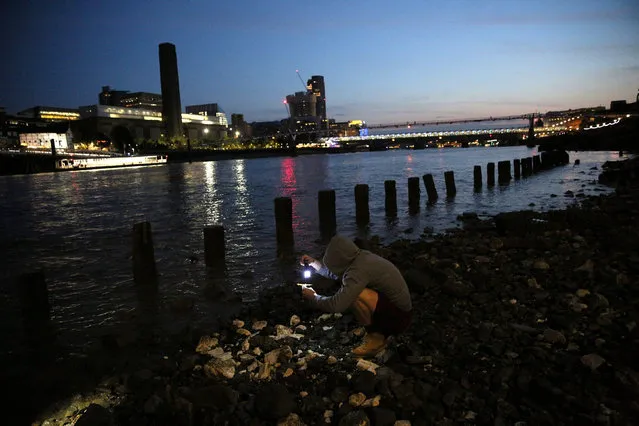
A mudlark uses a torch to look for items on the bank of the River Thames in London, Britain June 06, 2016. Mudlarking is believed to trace its origins to the 18th and 19th century, when scavengers searched the Thames' shores for items to sell. These days, history and archaeology fans are the ones hoping to find old relics such as coins, ceramics, artifacts or everyday items from across centuries. They wait for the low tide and then scour specific areas of exposed shores. "If you're in a field you could be out all day long, with the river you're restricted to about two or three hours," mudlark Nick Stevens said. While many just use the naked eye for their searches, others rely on metal detectors for which a permit from the Port of London Authority is needed. Digging also requires consent. (Photo by Neil Hall/Reuters)

A mudlark uses a torch to look for items on the bank of the River Thames in London, Britain June 06, 2016. Mudlarking is believed to trace its origins to the 18th and 19th century, when scavengers searched the Thames' shores for items to sell. These days, history and archaeology fans are the ones hoping to find old relics such as coins, ceramics, artifacts or everyday items from across centuries. their finds with the Portable Antiquities Scheme. Any item over 300 years old must be recorded. (Photo by Neil Hall/Reuters)
Details
27 Aug 2016 10:43:00
A woman picks marigold flowers used to make garlands and offer prayers, before selling them to the market for the Tihar festival, also called Diwali, in Kathmandu, Nepal October 17, 2017. (Photo by Navesh Chitrakar/Reuters)

A woman picks marigold flowers used to make garlands and offer prayers, before selling them to the market for the Tihar festival, also called Diwali, in Kathmandu, Nepal on October 17, 2017. (Photo by Navesh Chitrakar/Reuters)
Details
18 Oct 2017 09:07:00