Loading...
Done
Kenyan photographer and art director Barbara Minishi (L) takes pictures of her room mate and fashion stylist Wambui Thimba (R) wearing a creation by a Kenyan fashion designer on the rooftop of their apartment in Nairobi, Kenya, on June 1, 2020. After their scheduled works was cancelled due to the spread of the COVID-19 coronavirus, Minishi and Thimba have started their own project called “the Kenya Fashion & Style Diary in 21 days” to showcase a Kenyan fashion brand everyday for 3 weeks on social networking services since May 22, 2020 by only shooting at their apartment. (Photo by Yasuyoshi Chiba/AFP Photo)

Kenyan photographer and art director Barbara Minishi (L) takes pictures of her room mate and fashion stylist Wambui Thimba (R) wearing a creation by a Kenyan fashion designer on the rooftop of their apartment in Nairobi, Kenya, on June 1, 2020. After their scheduled works was cancelled due to the spread of the COVID-19 coronavirus, Minishi and Thimba have started their own project called “the Kenya Fashion & Style Diary in 21 days” to showcase a Kenyan fashion brand everyday for 3 weeks on social networking services since May 22, 2020 by only shooting at their apartment. (Photo by Yasuyoshi Chiba/AFP Photo)
Details
03 Jul 2020 00:05:00
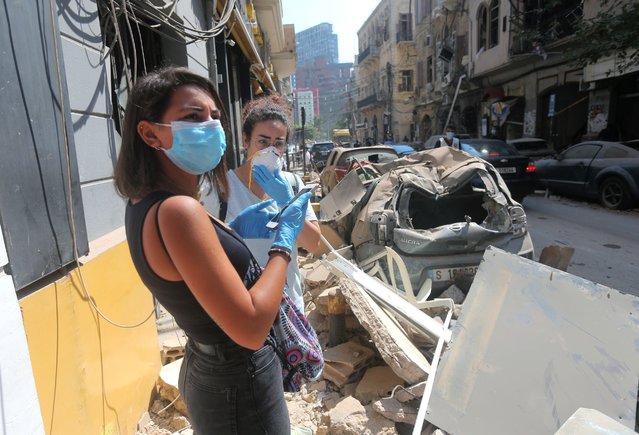
Young Lebanese women wearing protective masks and gloves against the coronavirus pandemic, stand on August 5, 2020 amid the rubble in Beirut's Gimmayzeh commercial district which was heavily damaged by the previous day's powerful explosion that tore through Lebanon's capital, resulting from the ignition of a huge depot of ammonium nitrate at the city's main port. Rescuers searched for survivors in Beirut after a cataclysmic explosion at the port sowed devastation across entire neighbourhoods, killing more than 100 people, wounding thousands and plunging Lebanon deeper into crisis. The blast, which appeared to have been caused by a fire igniting 2,750 tonnes of ammonium nitrate left unsecured in a warehouse, was felt as far away as Cyprus, some 150 miles (240 kilometres) to the northwest. (Photo by AFP Photo/Stringer)

Young Lebanese women wearing protective masks and gloves against the coronavirus pandemic, stand on August 5, 2020 amid the rubble in Beirut's Gimmayzeh commercial district which was heavily damaged by the previous day's powerful explosion that tore through Lebanon's capital, resulting from the ignition of a huge depot of ammonium nitrate at the city's main port. Rescuers searched for survivors in Beirut after a cataclysmic explosion at the port sowed devastation across entire neighbourhoods, killing more than 100 people, wounding thousands and plunging Lebanon deeper into crisis. The blast, which appeared to have been caused by a fire igniting 2,750 tonnes of ammonium nitrate left unsecured in a warehouse, was felt as far away as Cyprus, some 150 miles (240 kilometres) to the northwest. (Photo by AFP Photo/Stringer)
Details
10 Aug 2020 00:05:00
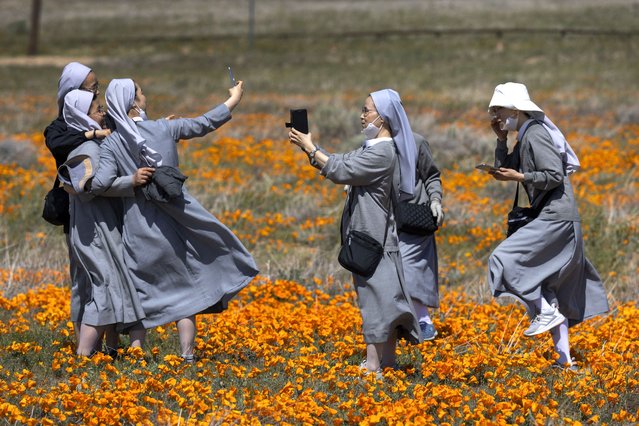
People walk in a field of California poppies and other wildflowers outside of the Antelope Valley California Poppy Reserve, after recent rains moved the region's second-driest winter on record up to its seventh-driest, near Lancaster, California, on April 2, 2022. The California Department of Water Resources reported that about one-third of the Sierra Nevada snowpack's water equivalency melted last week under higher-than-normal temperatures, leaving the statewide snow-water equivalent at 38% of normal for the date. (Photo by David Mcnew/AFP Photo)

People walk in a field of California poppies and other wildflowers outside of the Antelope Valley California Poppy Reserve, after recent rains moved the region's second-driest winter on record up to its seventh-driest, near Lancaster, California, on April 2, 2022. The California Department of Water Resources reported that about one-third of the Sierra Nevada snowpack's water equivalency melted last week under higher-than-normal temperatures, leaving the statewide snow-water equivalent at 38% of normal for the date. (Photo by David Mcnew/AFP Photo)
Details
12 Apr 2022 06:02:00
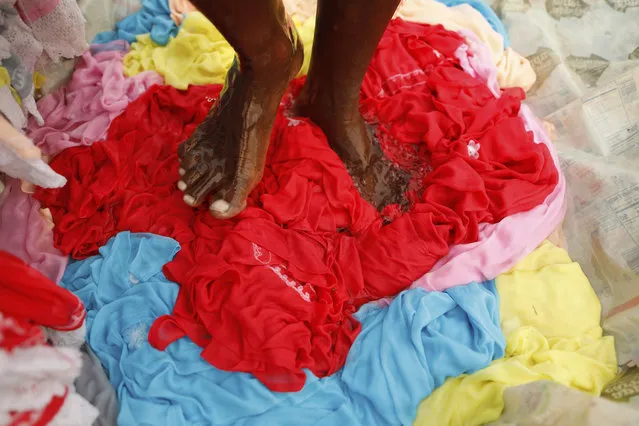
A dhobi, or a washerman washes cloths on the banks of the River Gomti in Lucknow, India, Saturday, September 12, 2020. Dhobis are traditional laundry workers who wash clothes by hand and dry them in the sun, an occupation which has been in existence for generations. Most cities in India have a Dhobi Ghat, or washermen's area, where the city's pile of clothes is laundered. This practice is still popular in India, despite of modern technology. Around 1,000 families work in Lucknow's Dhobi Ghat. However, in light of the novel coronavirus, their wages have decreased drastically. With each family earning around US$100-200 per month. (Photo by Rajesh Kumar Singh/AP Photo)

A dhobi, or a washerman washes cloths on the banks of the River Gomti in Lucknow, India, Saturday, September 12, 2020. Dhobis are traditional laundry workers who wash clothes by hand and dry them in the sun, an occupation which has been in existence for generations. Most cities in India have a Dhobi Ghat, or washermen's area, where the city's pile of clothes is laundered. This practice is still popular in India, despite of modern technology. Around 1,000 families work in Lucknow's Dhobi Ghat. However, in light of the novel coronavirus, their wages have decreased drastically. With each family earning around US$100-200 per month. (Photo by Rajesh Kumar Singh/AP Photo)
Details
25 Sep 2020 00:03:00
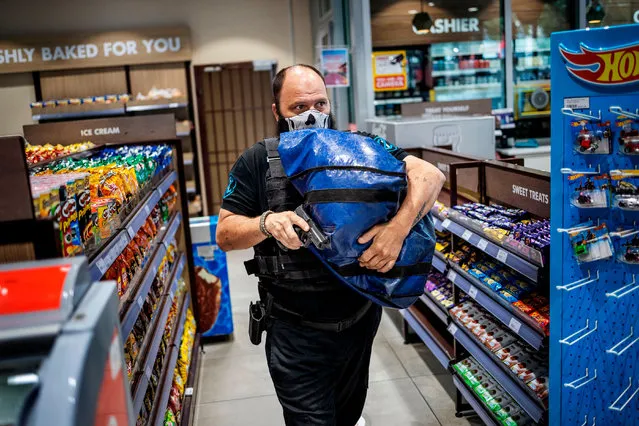
A CIT guard carries his gun handgun while bringing a bag containing cash inside an armoured vehicle during a money collection in Johannesburg's CBD, on December 8, 2020. As the Christmas festive season approaches, cash-in-transit (CIT) companies are gearing up as they continue to be target of crime, with about 3000 money vans traveling daily nationwide. Despite the COVID-19 lockdown, there have been 260 cash-in-transit heist incidents in South Africa this year, with 19 CIT crew members killed. Cash-in-transit heists in the country are often military-style planned operations with criminals recurring to bomb making and assault rifles attacks. (Photo by Michele Spatari/AFP Photo)

A CIT guard carries his gun handgun while bringing a bag containing cash inside an armoured vehicle during a money collection in Johannesburg's CBD, on December 8, 2020. As the Christmas festive season approaches, cash-in-transit (CIT) companies are gearing up as they continue to be target of crime, with about 3000 money vans traveling daily nationwide. Despite the COVID-19 lockdown, there have been 260 cash-in-transit heist incidents in South Africa this year, with 19 CIT crew members killed. Cash-in-transit heists in the country are often military-style planned operations with criminals recurring to bomb making and assault rifles attacks. (Photo by Michele Spatari/AFP Photo)
Details
18 Dec 2020 00:01:00
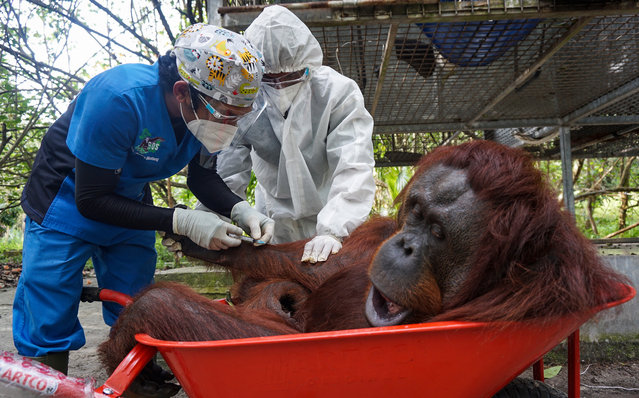
A handout photo made available by Borneo Orangutan Survival Foundation (BOSF) shows veterinarian wearing protective masks and suit, conducting anesthesia procedure on Nenuah, a nine year old Bornean Orangutan before being transported and released to the Bukit Batikap protection forest, at the Nyaru Menteng Orangutan Rehabilitation Center in Palangkaraya, Central Kalimantan, Indonesia, 15 February 2021. BOSF and the national nature conservation agency (BKSDA) released 10 orangutans back to the wild in Bukit Batikap Protection Forest in Central Kalimantan and the Kehje Sewen Forest in East Kalimantan amid the pandemic according to BOSF. (Photo by BOSF Handout/EPA/EFE)

A handout photo made available by Borneo Orangutan Survival Foundation (BOSF) shows veterinarian wearing protective masks and suit, conducting anesthesia procedure on Nenuah, a nine year old Bornean Orangutan before being transported and released to the Bukit Batikap protection forest, at the Nyaru Menteng Orangutan Rehabilitation Center in Palangkaraya, Central Kalimantan, Indonesia, 15 February 2021. BOSF and the national nature conservation agency (BKSDA) released 10 orangutans back to the wild in Bukit Batikap Protection Forest in Central Kalimantan and the Kehje Sewen Forest in East Kalimantan amid the pandemic according to BOSF. (Photo by BOSF Handout/EPA/EFE)
Details
07 Mar 2021 09:54:00
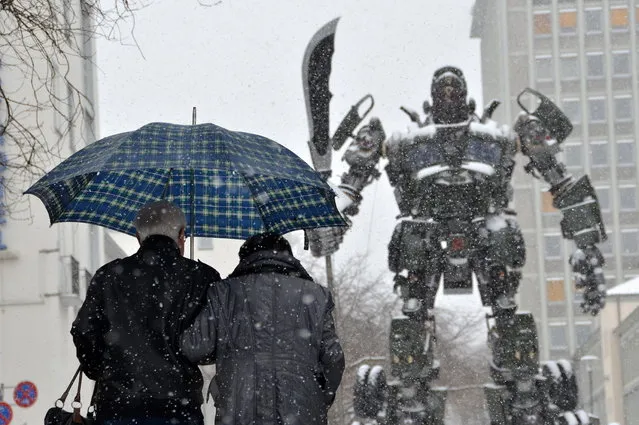
A couple passes the sculpture “Transformer” by Chinese artist Bi Heng during snowfall  in Kassel, central Germany, Tuesday March 12, 2013.  Frankfurt airport closed, a quarter of flights out of Paris were canceled, Belgium suffered record traffic jams and high-speed trains were stuck in stations – all because of a sudden dump of oddly late snowfall on Western Europe.   Less prepared for the kind of heavy snow that regularly hits northern and eastern neighbors, France, Britain and Belgium struggled Tuesday to keep moving amid the frosty, blustery conditions. (Photo by Uwe Zucchi/AP Photo/Dpa)

A couple passes the sculpture “Transformer” by Chinese artist Bi Heng during snowfall in Kassel, central Germany, Tuesday March 12, 2013. Frankfurt airport closed, a quarter of flights out of Paris were canceled, Belgium suffered record traffic jams and high-speed trains were stuck in stations – all because of a sudden dump of oddly late snowfall on Western Europe. Less prepared for the kind of heavy snow that regularly hits northern and eastern neighbors, France, Britain and Belgium struggled Tuesday to keep moving amid the frosty, blustery conditions. (Photo by Uwe Zucchi/AP Photo/Dpa)
Details
14 Mar 2013 13:46:00
A tear rolls down the cheek of Karima el-Mahroug, also known as Ruby, a Moroccan woman at the center of ex-Premier Silvio Berlusconi's s*x-for-hire trial, as she reads a statement to reporters during a protest outside the court house, in Milan, Italy, Thursday, April 4, 2013. The Moroccan woman at the center of ex-Premier Silvio Berlusconi's s*x-for-hire trial has denounced what she says is psychological warfare being waged against her by Italian prosecutors. Ruby, read out a lengthy statement Thursday to a gaggle of reporters in front of Milan's courthouse denying she was a prostitute and insisting that prosecutors hear her side of the story. (Photo by Luca Bruno/AP Photo)

A tear rolls down the cheek of Karima el-Mahroug, also known as Ruby, a Moroccan woman at the center of ex-Premier Silvio Berlusconi's s*x-for-hire trial, as she reads a statement to reporters during a protest outside the court house, in Milan, Italy, Thursday, April 4, 2013. The Moroccan woman at the center of ex-Premier Silvio Berlusconi's s*x-for-hire trial has denounced what she says is psychological warfare being waged against her by Italian prosecutors. Ruby, read out a lengthy statement Thursday to a gaggle of reporters in front of Milan's courthouse denying she was a prostitute and insisting that prosecutors hear her side of the story. (Photo by Luca Bruno/AP Photo)
Details
14 May 2013 10:44:00