Loading...
Done
Festival goer practice yoga during the O.Z.O.R.A. festival on August 4, 2016 in Tolna, Hungary. Ozora is a village in Tolna County. In recent times it has become famous for the O.Z.O.R.A. psychedelic trance festival which has been held on an estate in Ozora near small village Dadpuszta every year since 2004. The first party was called Solipse and took place during the Solar eclipse of August 11, 1999. The Ozora festival (with Solar United Natives festival) is one of the two big psytrance festivals in Hungary, and is fastest growing psytrance festivals on the world, achieving incredible 60 000 visitors in 2015. (Photo by Mohai Balázs/MTI/MTVA)

Festival goer practice yoga during the O.Z.O.R.A. festival on August 4, 2016 in Tolna, Hungary. Ozora is a village in Tolna County. In recent times it has become famous for the O.Z.O.R.A. psychedelic trance festival which has been held on an estate in Ozora near small village Dadpuszta every year since 2004. The first party was called Solipse and took place during the Solar eclipse of August 11, 1999. (Photo by Mohai Balázs/MTI/MTVA)
Details
05 Aug 2016 13:40:00
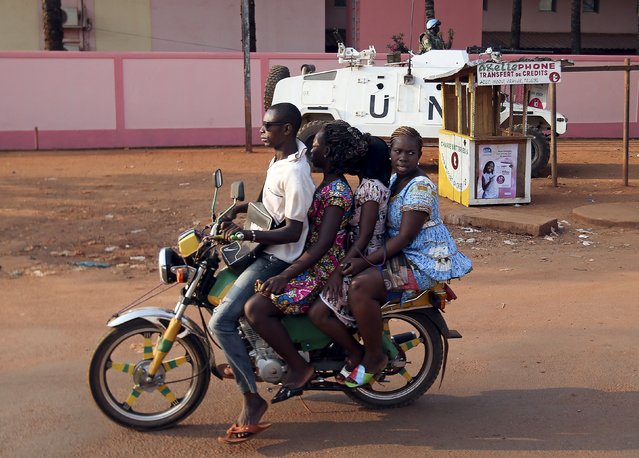
People ride a motorcycle near Koudoukou Mosque where Pope Francis meets Imam Tidiani Moussa Naibi in Bangui, Central African Republic, November 30, 2015. (Photo by Stefano Rellandini/Reuters)

People ride a motorcycle near Koudoukou Mosque where Pope Francis meets Imam Tidiani Moussa Naibi in Bangui, Central African Republic, November 30, 2015. (Photo by Stefano Rellandini/Reuters)
Details
01 Dec 2015 09:30:00
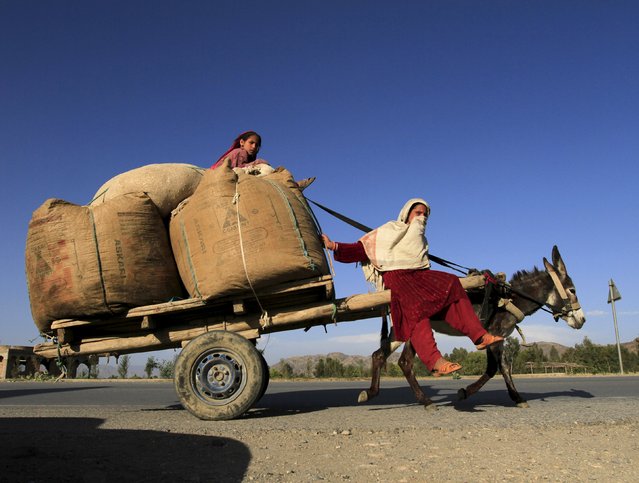
Girls ride on a donkey cart with grass for animals on the outside of Nangarhar province, Afghanistan May 19, 2015. (Photo by Reuters/Parwiz)

Girls ride on a donkey cart with grass for animals on the outside of Nangarhar province, Afghanistan May 19, 2015. (Photo by Reuters/Parwiz)
Details
28 Jul 2015 12:07:00
An art installation formed with milk churns, made by land art artist Gerard Benoit a la Guillaume, is seen at the Chenau de Mayen in the resort of Leysin, Switzerland August 7, 2015. More than 80 milk churns were placed between the Tour d'Ai and the Tour de Mayen summits at an altitude of 2,000 meters (6,561 feet) above sea level under the direction of the artist, to be photographed for his ongoing art project entitled “Milk churns without borders”. (Photo by Denis Balibouse/Reuters)

An art installation formed with milk churns, made by land art artist Gerard Benoit a la Guillaume, is seen at the Chenau de Mayen in the resort of Leysin, Switzerland August 7, 2015. More than 80 milk churns were placed between the Tour d'Ai and the Tour de Mayen summits at an altitude of 2,000 meters (6,561 feet) above sea level under the direction of the artist, to be photographed for his ongoing art project entitled “Milk churns without borders”. (Photo by Denis Balibouse/Reuters)
Details
08 Aug 2015 13:16:00
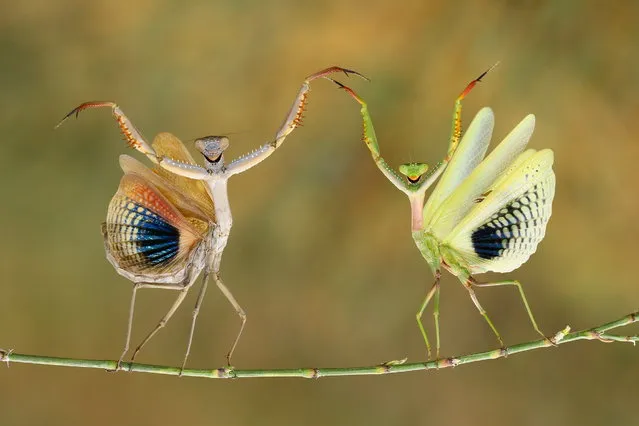
“Show Time”. It's a normal behavior of mantis. They're doing defence. When they're afraid of; raising their arms and spreading their wings. They looks like smiling dancer. Photo location: Nicosia, Cyprus. (Photo and caption by Hasan Baglar/National Geographic Photo Contest)

“Show Time”. It's a normal behavior of mantis. They're doing defence. When they're afraid of; raising their arms and spreading their wings. They looks like smiling dancer. Photo location: Nicosia, Cyprus. (Photo and caption by Hasan Baglar/National Geographic Photo Contest)
Details
28 Oct 2014 13:01:00
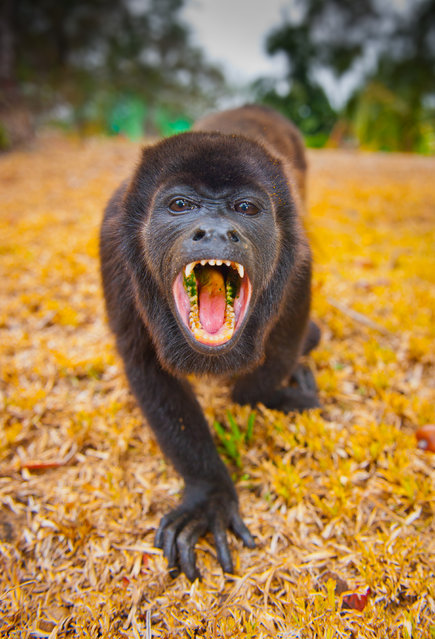
“Attacking Howler Monkey”. Due to a major tropical rainstorm my wife and I were forced to stay overnight in a Howler Monkey Rescue center in Panama. I used the time to explore the area and to take photos of the monkeys. Just after the rain finally stopped, I ran into this monkey that tried to mock attack me. I quickly took a couple of photos before retreating to a (more) safe distance. (Photo and caption by Christian Mueller-Planitz/National Geographic Traveler Photo Contest)

“Attacking Howler Monkey”. Due to a major tropical rainstorm my wife and I were forced to stay overnight in a Howler Monkey Rescue center in Panama. I used the time to explore the area and to take photos of the monkeys. Just after the rain finally stopped, I ran into this monkey that tried to mock attack me. I quickly took a couple of photos before retreating to a (more) safe distance. (Photo and caption by Christian Mueller-Planitz/National Geographic Traveler Photo Contest)

ATTENTION! All pictures are presented in high resolution. To see Hi-Res images – just TWICE click on any picture. In other words, click small picture – opens the BIG picture. Click BIG picture – opens VERY BIG picture.
Details
30 Jun 2013 12:25:00
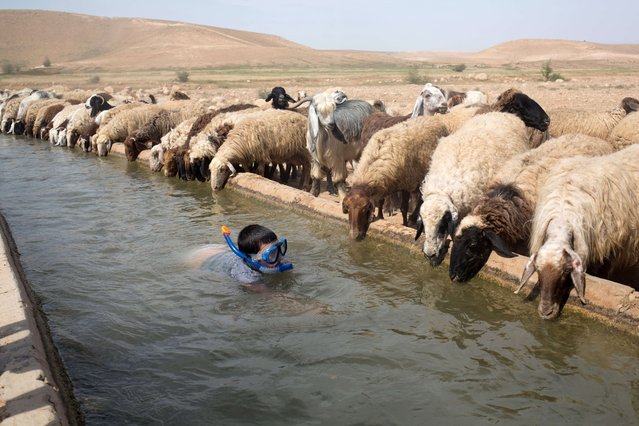
An Israeli boy swims next to sheep belonging to a Palestinian farmer in the West Bank village of Al-Auja in the Jordan Valley on April 8, 2015 during the Jewish Passover holiday. Thousands of Israelis spent the day outdoors, picnicking and touring the country during the eight-day Passover holiday, which commemorates the Israelites' exodus from Egypt some 3,500 years ago. (Photo by Menahem Kahana/AFP Photo)

An Israeli boy swims next to sheep belonging to a Palestinian farmer in the West Bank village of Al-Auja in the Jordan Valley on April 8, 2015 during the Jewish Passover holiday. Thousands of Israelis spent the day outdoors, picnicking and touring the country during the eight-day Passover holiday, which commemorates the Israelites' exodus from Egypt some 3,500 years ago. (Photo by Menahem Kahana/AFP Photo)
Details
11 Apr 2015 10:59:00
On August 31, 2012, a long filament of solar material that had been hovering in the sun's atmosphere, the corona, erupted out into space at 4:36 p.m. EDT. The coronal mass ejection, or CME, traveled at over 900 miles per second. The CME did not travel directly toward Earth, but did connect with Earth's magnetic environment, or magnetosphere, causing aurora to appear on the night of Monday, September 3. (Photo by NASA/GSFC/SDO)

On August 31, 2012, a long filament of solar material that had been hovering in the sun's atmosphere, the corona, erupted out into space at 4:36 p.m. EDT. The coronal mass ejection, or CME, traveled at over 900 miles per second. The CME did not travel directly toward Earth, but did connect with Earth's magnetic environment, or magnetosphere, causing aurora to appear on the night of Monday, September 3. (Photo by NASA/GSFC/SDO via The Atlantic)
Details
14 Sep 2012 09:01:00