A participant takes part in the High-Heels Race as part of the Pride celebrations, in the Chueca neighbourhood in Madrid on July 7, 2022. MADO (Madrid Pride) is a series of street celebrations that take place during the city's LGBTIQ (lesbian, gay, bisexual, transgender, intersеx and queer) Pride week. The Pride parade on July 9 will be the highlight of the week. (Photo by Javier Soriano/AFP Photo)
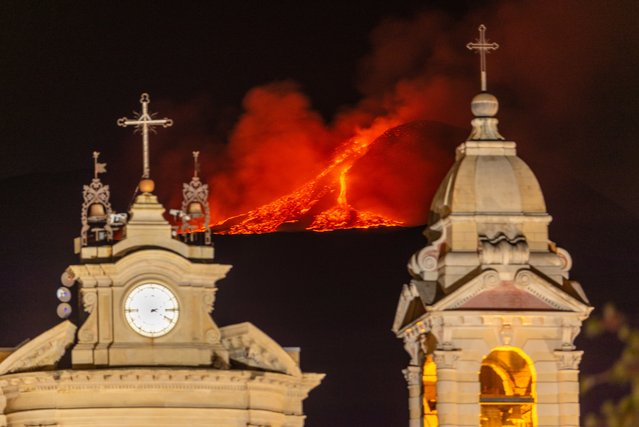
Lava erupts from a crater of Mt. Etna, Europe's largest active volcano, behind Santa Maria della Guardia church in Belpasso, near Catania, in southern Italian island of Sicily, early Friday, June 18, 2021. Since Feb. 16, 2021, Mt. Etna has begun a series of spectacular eruptive episodes. (Photo by Salvatore Allegra/AP Photo)
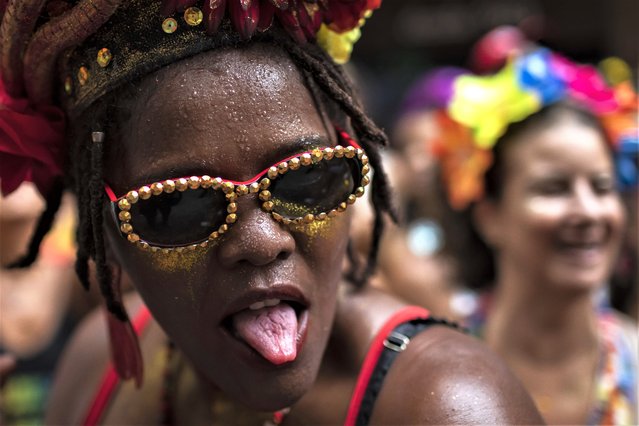
A reveler playfully sticks out her tongue during a street pre-carnival party by the “Cordao do Boitata” Block, in Rio de Janeiro, Brazil, Sunday, February 12, 2023. Revelers are taking to the streets for the open-air block parties, leading up to Carnival's official Feb. 17th opening. (Photo by Bruna Prado/AP Photo)
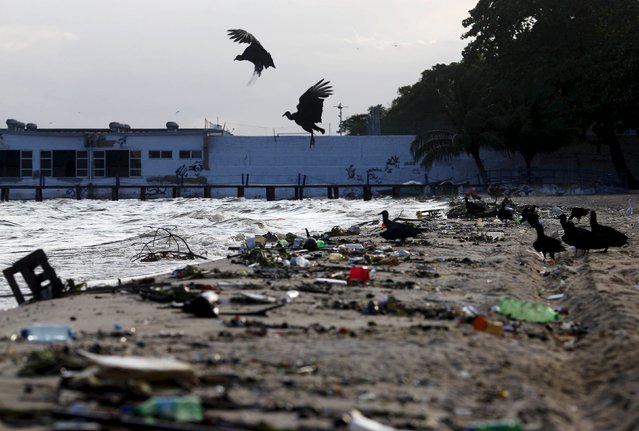
Vultures gather to eat waste in Bica beach, on the banks of the Guanabara Bay, with the Sugar Loaf mountain in background, 500 days ahead the Rio 2016 Olympic Games in Rio de Janeiro March 24, 2015. As part of its Olympic bid, Rio promised to clean up 80 percent of the bay for the games. But local government officials have already admitted that a cleanup by 2016 is not achievable. Despite millions of dollars of investment over the years, the bay still stinks of sewage. Sailors who visited the city for test events complained of a floating sofa and a dead dog in the water. (Photo by Ricardo Moraes/Reuters)
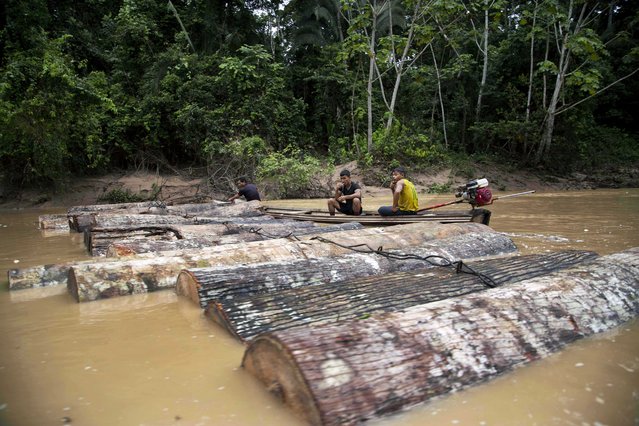
In this March 17, 2015 photo, Ashaninka Indian men, identified by locals as illegal loggers, tie tree trunks together to move them along the Putaya River near the hamlet of Saweto, Peru. Illegal logging persists unabated in this remote Amazon community where four indigenous leaders who resisted it were slain in September. The Putaya River is the waterway that transports felled trees, cut both legally and illegally, to the city of Pucallpa. (Photo by Martin Mejia/AP Photo)
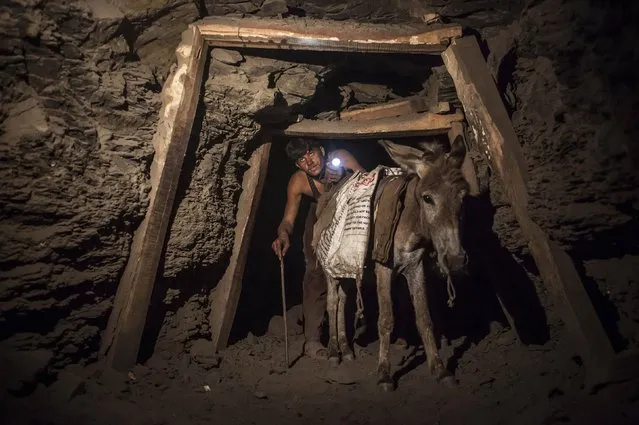
A miner with a donkey makes his way through the low and narrow tunnel leading out of a coal mine in Choa Saidan Shah in Punjab province, April 29, 2014. Workers at this mine in Choa Saidan Shah dig coal with pick axes, break it up and load it onto donkeys to be transported to the surface. Employed by private contractors, a team of four workers can dig about a ton of coal a day, for which they earn around $10 to be split between them. The coalmine is in the heart of Punjab, Pakistan's most populous and richest province, but the labourers mostly come from the poorer neighbouring region of Khyber Pakhtunkhwa. (Photo by Sara Farid/Reuters)
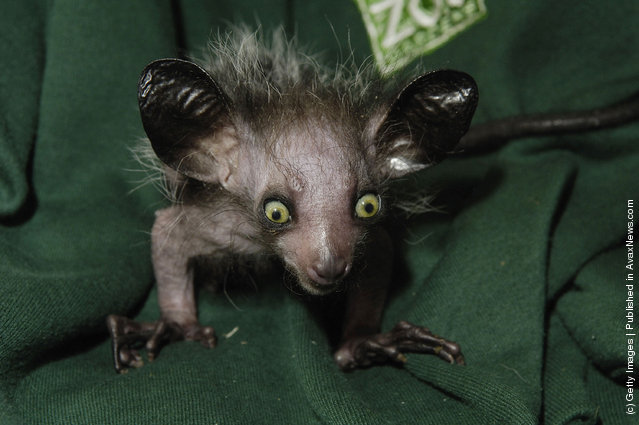
“The aye-aye (Daubentonia madagascariensis) is a lemur, a strepsirrhine primate native to Madagascar that combines rodent-like teeth and a special thin middle finger to fill the same ecological niche as a woodpecker. It is the world's largest nocturnal primate, and is characterized by its unusual method of finding food; it taps on trees to find grubs, then gnaws holes in the wood and inserts its narrow middle finger to pull the grubs out. The only other animal species known to find food in this way is the striped possum. From an ecological point of view the aye-aye fills the niche of a woodpecker as it is capable of penetrating wood to extract the invertebrates within”. – Wikipedia
Photo: In this handout image from Bristol Zoo is seen the first captive bred aye-aye in the UK named “Kintana” (meaning star in Malagasy) April 15, 2005 at Bristol Zoo Gardens, England. The zoo announced today only the second baby aye-aye to be hand-reared in the world (the first was in Jersey Zoo) and has now made his first public appearance since his birth on 11 February 2005. (Photo by Rob Cousins/Bristol Zoo via Getty Images)