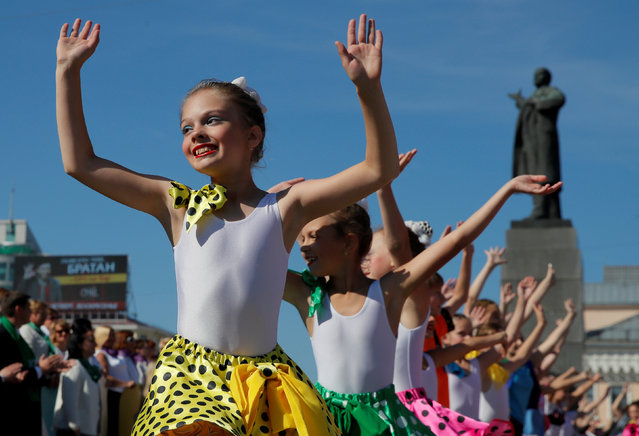
Young girls perform in front of the monument to Soviet state founder Vladimir Lenin during the City Day celebrations in Yekaterinburg, Russia on August 19, 2017. (Photo by Maxim Shemetov/Reuters)
Police officers in action during the eviction of the “Liebig 34” squat, at Friedrichshain district in Berlin, Germany, 09 October 2020. A local court ruled in favor of the eviction of the self-declared “anarcha-queer feminist” house project at Liebig street 34 in June 2020. The house project is considered a stronghold of the left-wing scene in the German capital. (Photo by Filip Singer/EPA/EFE)
Canada's Suzanna Shahbazian competes with the ball in the individual all-around rhythmic gymnastics final at the Arena Birmingham, on day eight of the Commonwealth Games in Birmingham, central England, on August 5, 2022. (Photo by Jason Cairnduff/Reuters)
Italy's Giada Greggi, Elena Linari and teammates celebrate after qualifying for the Women's Euro 2025, in Bolzano, Italy on July 16, 2024. (Photo by Jennifer Lorenzini/Reuters)
A demonstrator gestures during protests around the Argentine Parliament in Buenos Aires, Argentina, 10 March 2022. Serious disturbances were registered in the surroundings of the seat of the Argentine Parliament when demonstrators protesting against the new agreement with the International Monetary Fund (IMF) clashed with the police of the city of Buenos Aires. (Photo by Juan Ignacio Roncoroni/EPA/EFE)
Zuo Tong of China performs on floor exercise during the women's team artistic gymnastics event of the 19th Asian Games in Hangzhou, China, Monday, September 25, 2023. China team won the gold. (Photo by Aaron Favila/AP Photo)
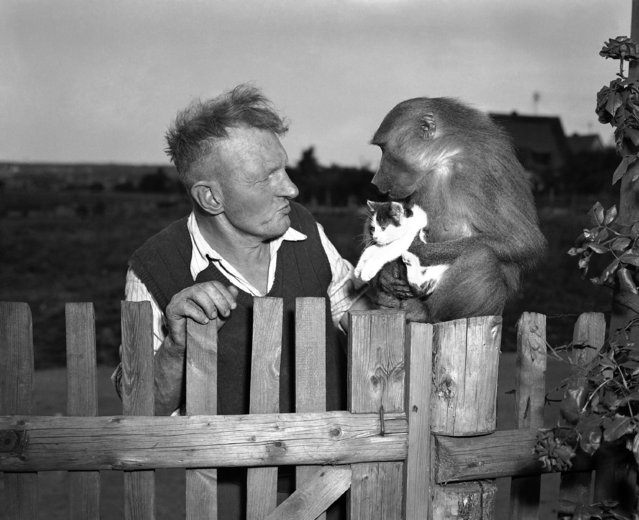
Leonhard Nienbling is shown with his 6-month old pet baboon Jackl, who holds a 6-month old kitten, its playmate, June 29, 1952. Niebling has quite an animal collection at his home in Zirndorf, Germany. (Photo by Heinrich Sanden/AP Photo)
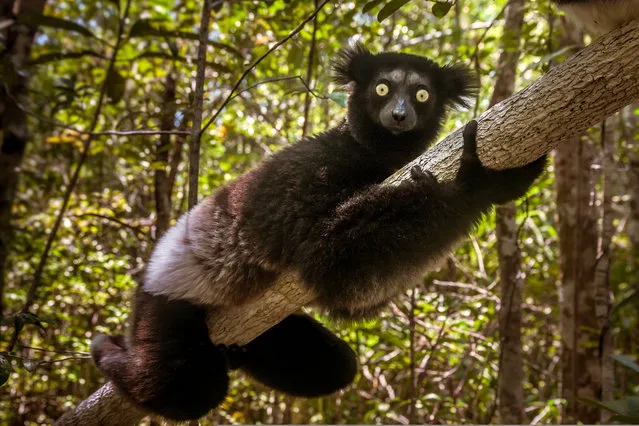
The secretive indri (Indri indri) of Madagascar, the largest living lemur. It is also critically endangered and highly evolutionarily distinct with no close relatives, which makes its branch one of most precarious on the mammal evolutionary tree. In the likely event that the indri goes extinct, we will lose 19m years of unique evolutionary history from the mammal tree of life. (Photo by Pierre-Yves Babelon/Aarhus University)