Loading...
Done
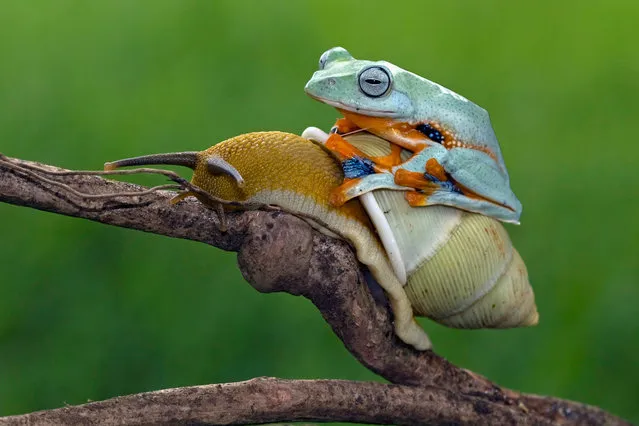
Going nowhere in a hurry, this friendly Javan Tree frog can be seen casually hopping aboard the slow-paced snail who like a lonely highway trucker is only too happy to have the company.  These cute critters chew the fat until froggy reaches his destination and alights at the top of the branch. (Photo by Kurit Afsheen/Media Drum World)

Going nowhere in a hurry, this friendly Javan Tree frog can be seen casually hopping aboard the slow-paced snail who like a lonely highway trucker is only too happy to have the company. These cute critters chew the fat until froggy reaches his destination and alights at the top of the branch. Creative Designer and amateur photographer Kurit Afsheen (34) was able to capture this special sequence while out in his back garden in Ciledug, Indonesia. (Photo by Kurit Afsheen/Media Drum World)
Details
19 Jul 2015 09:17:00
Actors reenact the famous picture of a sailor kissing a nurse on the 70th anniversary of Victory over Japan Day, near a replica sculpture in New York's Times Square August 14, 2015. The replica is being displayed to celebrate the 70th anniversary of the iconic photograph of the most famous kiss in American history that was captured between an American sailor and nurse on August 14, 1945, marking the end of World War Two. (Photo by Brendan McDermid/Reuters)

Actors reenact the famous picture of a sailor kissing a nurse on the 70th anniversary of Victory over Japan Day, near a replica sculpture in New York's Times Square August 14, 2015. The replica is being displayed to celebrate the 70th anniversary of the iconic photograph of the most famous kiss in American history that was captured between an American sailor and nurse on August 14, 1945, marking the end of World War Two. The actors are hired by a tour bus company to pose for groups to photograph. (Photo by Brendan McDermid/Reuters)
Details
15 Aug 2015 11:55:00
Villagers from the Porto Novo community load into their canoes arapaima or pirarucu, the largest freshwater fish species in South America and one of the largest in the world, while fishing in Poco Fundo lake along a branch of the Solimoes river, one of the main tributaries of the Amazon, in the Mamiraua nature reserve near Fonte Boa about 600 km (373 miles) west of Manaus, November 26, 2013. (Photo by Bruno Kelly/Reuters)

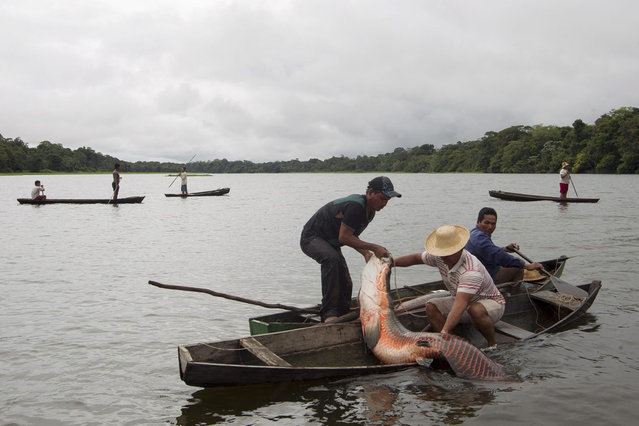
Villagers from the Porto Novo community load into their canoes arapaima or pirarucu, the largest freshwater fish species in South America and one of the largest in the world, while fishing in Poco Fundo lake along a branch of the Solimoes river, one of the main tributaries of the Amazon, in the Mamiraua nature reserve near Fonte Boa about 600 km (373 miles) west of Manaus, November 26, 2013. Catching the arapaima, a fish that is sought after for its meat and is considered by biologists to be a living fossil, is only allowed once a year by Brazil's environmental protection agency. The minimum size allowed for a fisherman to keep an arapaima is 1.5 meters (4.9 feet). (Photo by Bruno Kelly/Reuters)
Details
17 Dec 2013 08:03:00
Mikhail Kalashnikov, the father of the world's most popular assault rifle, is handed  an AK-74 November 23, 2002 in Izhevsk,1000 East km. from Moscow. November 23 marked the 55th anniversary of the release of the first Kalashnikov gun. According to the Moscow-based Center for Analysis of Strategic and Technologies some 70 million to 100 million Kalashnikovs have been built worldwide since 1947, compared about 7 million to Kalashnikov's Western rival the M-16 assault rifles. (Photo by Oleg Nikishin/Getty Images)

Mikhail Kalashnikov, the father of the world's most popular assault rifle, is handed an AK-74 November 23, 2002 in Izhevsk,1000 East km. from Moscow. November 23 marked the 55th anniversary of the release of the first Kalashnikov gun. According to the Moscow-based Center for Analysis of Strategic and Technologies some 70 million to 100 million Kalashnikovs have been built worldwide since 1947, compared about 7 million to Kalashnikov's Western rival the M-16 assault rifles. (Photo by Oleg Nikishin/Getty Images)
Details
24 Dec 2013 09:12:00
In this photo taken on Saturday, April, 4, 2015, a bear chews on a corncob at a shelter that attracts hundreds of visitors and volunteers from around the world every year, in Kutarevo, Croatia. Over a decade ago, Ivan Crnkovic-Pavenka, a retired Croatian social worker decided to help bears become “ambassadors of the wilderness” among people and set up a unique shelter for brown bears in the idyllic mountain village of Kutarevo in central Croatia, where eight bears currently live in two huge enclosures. (Photo by Amel Emric/AP Photo)

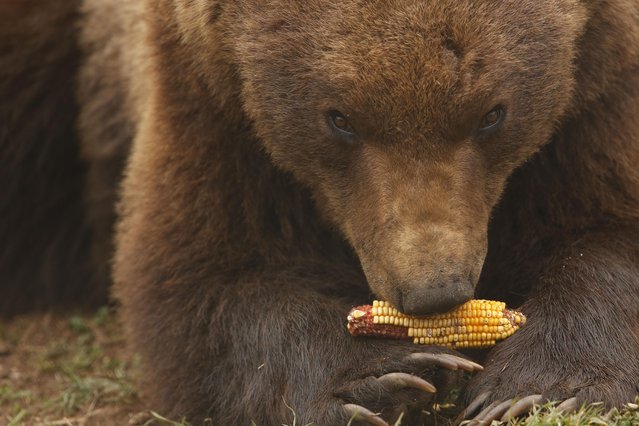
In this photo taken on Saturday, April, 4, 2015, a bear chews on a corncob at a shelter that attracts hundreds of visitors and volunteers from around the world every year, in Kutarevo, Croatia. Over a decade ago, Ivan Crnkovic-Pavenka, a retired Croatian social worker decided to help bears become “ambassadors of the wilderness” among people and set up a unique shelter for brown bears in the idyllic mountain village of Kutarevo in central Croatia, where eight bears currently live in two huge enclosures. (Photo by Amel Emric/AP Photo)
Details
20 Apr 2015 13:03:00
The carriages have decayed over time, on February 27, 2015, in Purwakarta, Indonesia. Dozens of trains are stacked on top of each other in what looks like a post-apocalyptic world. The old electric trains that travelled in and out of Jakarta, Indonesia, are weathered and decayed over time. The trains were used everyday since the 1980s and carried thousands of people to work. (Photo by HKV/Barcroft Media)

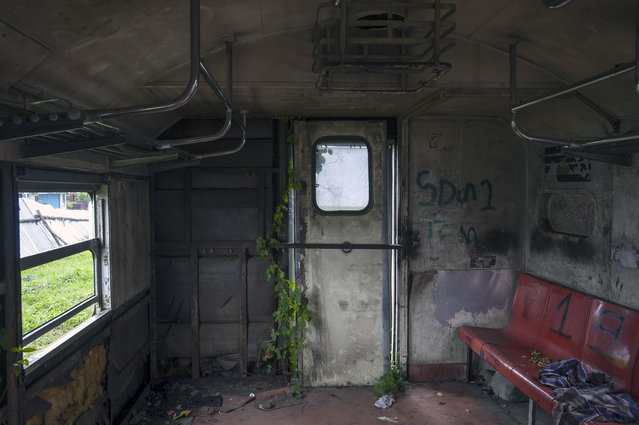
The carriages have decayed over time, on February 27, 2015, in Purwakarta, Indonesia. Dozens of trains are stacked on top of each other in what looks like a post-apocalyptic world. The old electric trains that travelled in and out of Jakarta, Indonesia, are weathered and decayed over time. The trains were used everyday since the 1980s and carried thousands of people to work. Now the carriages, which were once the lifeblood of public transport in the south-Asian city, have been left to rust among shrubbery. (Photo by HKV/Barcroft Media)
Details
21 Apr 2015 11:13:00
A Zimbabwean subsistence farmer holds a stunted maize cob in his field outside Harare, January 20, 2016. About 14 million people face hunger in Southern Africa because of a drought that has been exacerbated by an El Nino weather pattern, the United Nations World Food Programme (WFP) said on Monday. In Zimbabwe, 1.5 million people, more than 10 percent of the population, face hunger, WFP said. (Photo by Philimon Bulawayo/Reuters)

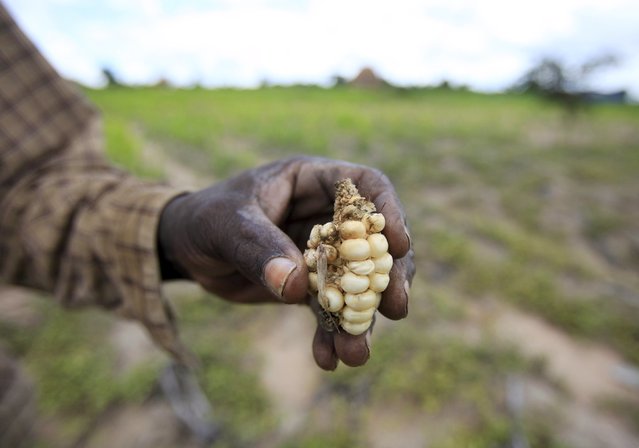
A Zimbabwean subsistence farmer holds a stunted maize cob in his field outside Harare, January 20, 2016. About 14 million people face hunger in Southern Africa because of a drought that has been exacerbated by an El Nino weather pattern, the United Nations World Food Programme (WFP) said on Monday. In Zimbabwe, 1.5 million people, more than 10 percent of the population, face hunger, WFP said. (Photo by Philimon Bulawayo/Reuters)
Details
22 Jan 2016 10:06:00
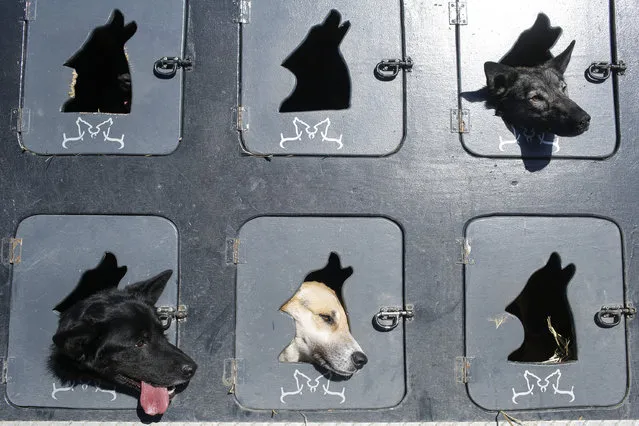
Musher Justin Savidis' dogs wait in the truck before the restart of the Iditarod Trail Sled Dog Race in Willow, Alaska March 6, 2016. Mushers and dog sled teams from around the world embark on the first leg of Alaska's grueling Iditarod Trail Sled Dog Race, starting a nearly 1,000-mile (1,609 km) journey through the state's unforgiving wilderness. (Photo by Nathaniel Wilder/Reuters)

Musher Justin Savidis' dogs wait in the truck before the restart of the Iditarod Trail Sled Dog Race in Willow, Alaska March 6, 2016. Mushers and dog sled teams from around the world embark on the first leg of Alaska's grueling Iditarod Trail Sled Dog Race, starting a nearly 1,000-mile (1,609 km) journey through the state's unforgiving wilderness. (Photo by Nathaniel Wilder/Reuters)
Details
08 Mar 2016 13:26:00