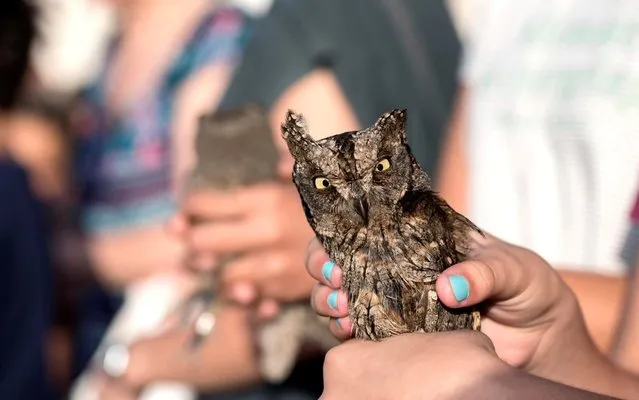
Volunteers of a Wild Nature Preservation center release a group of owl chicks from the Toro Mountain in Menorca, Balearic Islands, Spain, 31 July 2019. (Photo by David Arquimbau Sintes/EPA/EFE/Rex Features/Shutterstock)
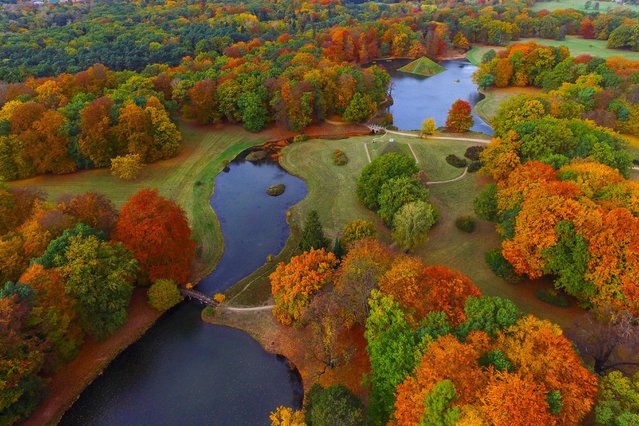
An aerial view taken with a drone shows the autumnally colored Fuerst-Pueckler-Park near Cottbus, eastern Germany, Saturday, October 29, 2016. The park, composed with great sensitivity in the 19th century by Prince Hermann von Pueckler-Muskau, is considered as one of the last great German landscape gardens. (Photo by Patrick Pleul/DPA via AP Photo)
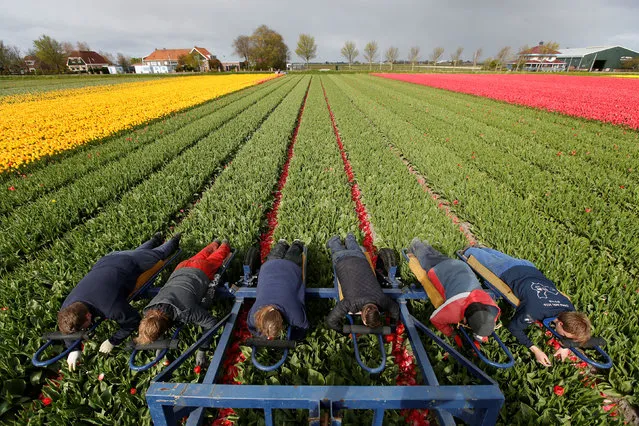
Laborers lay down upon a field to cut off the tulips that remained uncut by the tractor in Den Helder, Netherlands April 22, 2017. (Photo by Cris Toala Olivares/Reuters)
Tube passengers take a selfie next to a London underground roundel designed for the launching of the Night Tubes on display at Oxford Circus underground station in London, Britain, 19 August 2016. The long delayed Night Tubes service launched on 19 August. The 24-hour service will operate on Fridays and Saturdays. (Photo by Hannah Mckay/EPA)
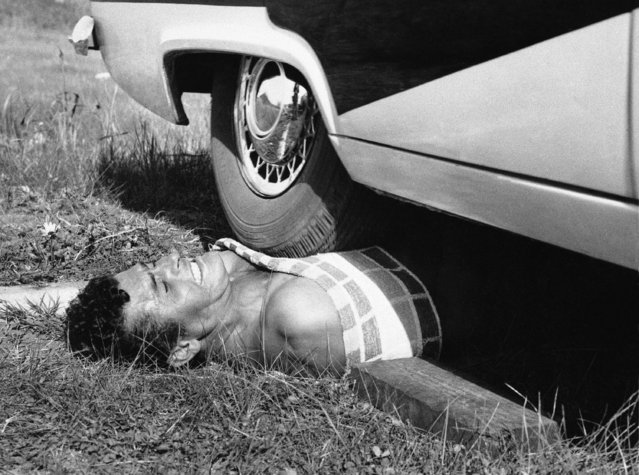
Leon Samson, 24-year-old showman, grimaces as an automobile is driven across his chest at Perth, Australia on October 9, 1960. Samson said the towel on his chest is to prevent the wheel from tearing his flesh. (Photo by AP Photo)
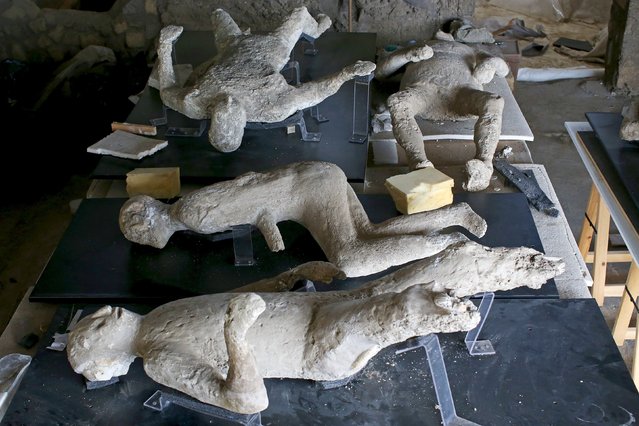
Plaster cast moulds of victims of the Mount Vesuvius eruption lie on a display table in a laboratory at Pompeii October 13, 2015. An expert team made up of archaeologists, radiologists, orthodontists and anthropologists began on September 2015 to use CAT scan technology (computerised axial tomography) to peer inside the plaster cast moulds of Pompeii's victims, in a study that has added more detail to previous findings. A 16-layer scan had to be used in order to penetrate the hardened plaster but the results showed up impressive skeletal remains and near perfect teeth. (Photo by Alessandro Bianchi/Reuters)
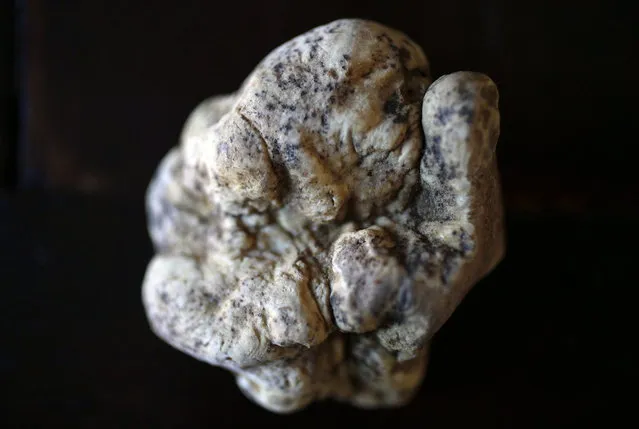
A truffle is seen on a table in Alba, north-western Italy November 11, 2013. Located in the heart of the Langhe – the hilly southern area of Italy's northwestern Piedmont region – Alba is the country's capital of white truffles, a variety of the prized fungus which grows underground. Truffles are found two to eight inches (5-20cm) below the ground near the roots of trees. They give off an odour which lasts for a limited period of time and can be detected with the assistance of well-trained dogs and experienced hunters. Output of white truffles, which are not cultivated and only grow naturally in forests, has fallen in Italy over the past few years, largely because climate change has brought a damaging mix of drought and torrential rains. (Photo by Stefano Rellandini/Reuters)