Loading...
Done
Bicycle Cafe In Zurich, Switzerland

In the past, having a car was synonymous to success. Now, however, having a bicycle in the new trend. Riding a bicycle is all pros and no cons. It makes you slimmer and healthier, it allows you to enjoy the fresh air, traffic jams are no longer a problem, and of course you don’t waste money on gas. However, there was always a problem of leaving your bike unattended. With thieves lurking behind every corner, there is always a risk of someone stealing your bicycle. Thus, the authorities of Zurich have decided to do something for cyclists. They’ve created the first café for cyclists where the person can sit on his bike while enjoying a cup of coffee. This is a great idea since the visitors will not have to worry about their bikes being stolen. Though to visit such a café, you might want to bring a cushion with you, since sitting on small, hard plastic seat is not very relaxing.
Details
22 Dec 2014 11:49:00
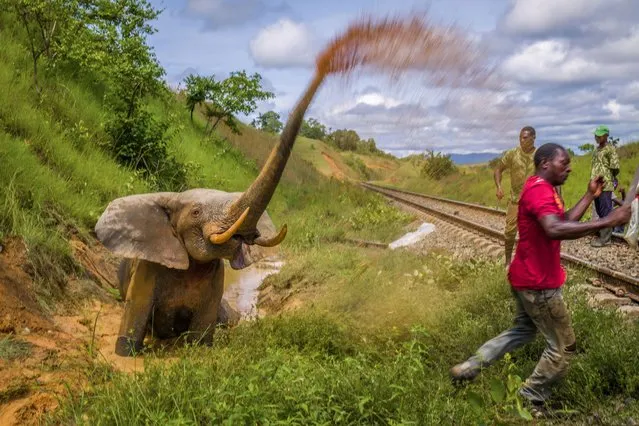
Grand prize winner: environmental photographer of the year 2023; also 1st place in the humanity v nature category; and winner of the 2023 public award. Lopé national park, Gabon, 2021. An angry elephant tries to defend itself after it was hit by a train that crosses paths the animals use within Lopé national park. Park officials decided the elephant was too severely injured to be saved. After it was killed, the park director distributed the meat to local people. As the forest loses its carrying capacity to sustain its megafauna, this kind of human-wildlife conflict is increasing. (Photo by Jasper Doest/Environmental Photography Award)

Grand prize winner: environmental photographer of the year 2023; also 1st place in the humanity v nature category; and winner of the 2023 public award. Lopé national park, Gabon, 2021. An angry elephant tries to defend itself after it was hit by a train that crosses paths the animals use within Lopé national park. Park officials decided the elephant was too severely injured to be saved. After it was killed, the park director distributed the meat to local people. As the forest loses its carrying capacity to sustain its megafauna, this kind of human-wildlife conflict is increasing. (Photo by Jasper Doest/Environmental Photography Award)
Details
09 Jul 2023 03:06:00
Creative Animal Hair Style Collections

Her website calls theses ‘hair hats’ which are styled into the form of various kind of animals such as a lion, rabbit, elephant, rhino and many others using hand crafted hair weaves that are made using a mold or mesh of wire.
Details
10 Jun 2015 08:17:00
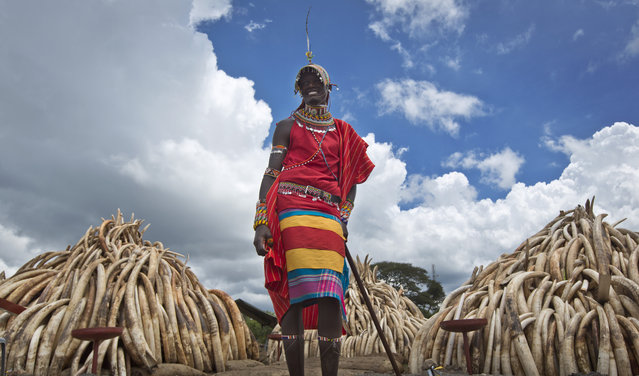
A Maasai man in ceremonial dress poses for visitors to take photographs of him in front of one of around a dozen pyres of ivory, in Nairobi National Park, Kenya Thursday, April 28, 2016. The Kenya Wildlife Service (KWS) has stacked 105 tons of ivory consisting of 16,000 tusks, and 1 ton of rhino horn, from stockpiles around the country, in preparation for it to be torched on Saturday to encourage global efforts to help stop the poaching of elephants and rhinos. (Photo by Ben Curtis/AP Photo)

A Maasai man in ceremonial dress poses for visitors to take photographs of him in front of one of around a dozen pyres of ivory, in Nairobi National Park, Kenya Thursday, April 28, 2016. The Kenya Wildlife Service (KWS) has stacked 105 tons of ivory consisting of 16,000 tusks, and 1 ton of rhino horn, from stockpiles around the country, in preparation for it to be torched on Saturday to encourage global efforts to help stop the poaching of elephants and rhinos. (Photo by Ben Curtis/AP Photo)
Details
29 Apr 2016 11:58:00
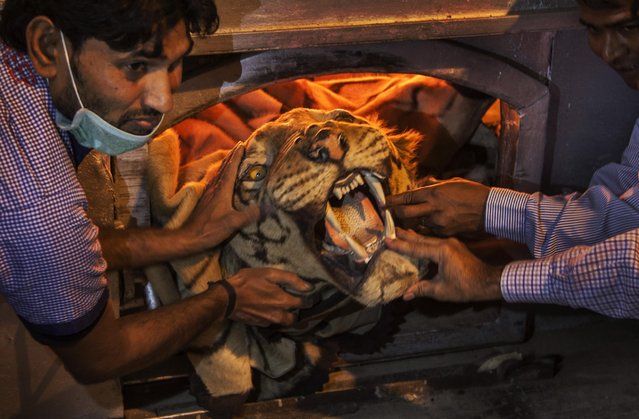
Indian authorities hold a tiger skin as they set fire to a stockpile of illegal wildlife parts at the Delhi Zoo in New Delhi, India, Sunday, November 2, 2014. A stockpile of tiger skins, elephant tusks, rhino horns and other illegal animal parts were burned Sunday in an effort to discourage wildlife smuggling in South Asia. (Photo by Tsering Topgyal/AP Photo)

Indian authorities hold a tiger skin as they set fire to a stockpile of illegal wildlife parts at the Delhi Zoo in New Delhi, India, Sunday, November 2, 2014. A stockpile of tiger skins, elephant tusks, rhino horns and other illegal animal parts were burned Sunday in an effort to discourage wildlife smuggling in South Asia. (Photo by Tsering Topgyal/AP Photo)
Details
03 Nov 2014 12:44:00
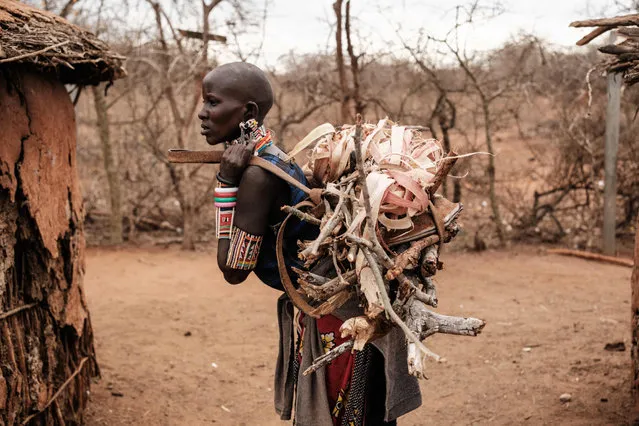
A Maasai woman arrives with collected firewoods at a village nearby Selenkay Conservancy, a community-owned conservation area running by a private company, in Amboseli, Kenya, on June 22, 2022. The camp's ten luxurious tents see tourists flocking again, after the shutdown linked to Covid-19. They observe in small groups elephants, giraffes, antelopes or lions on 5,000 hectares, located on the edge of Amboseli National Park, in the south of the country, and have a glimpse of the life of the Masai, the owners of the land. (Photo by Yasuyoshi Chiba/AFP Photo)

A Maasai woman arrives with collected firewoods at a village nearby Selenkay Conservancy, a community-owned conservation area running by a private company, in Amboseli, Kenya, on June 22, 2022. The camp's ten luxurious tents see tourists flocking again, after the shutdown linked to Covid-19. They observe in small groups elephants, giraffes, antelopes or lions on 5,000 hectares, located on the edge of Amboseli National Park, in the south of the country, and have a glimpse of the life of the Masai, the owners of the land. (Photo by Yasuyoshi Chiba/AFP Photo)
Details
22 Jul 2022 04:32:00
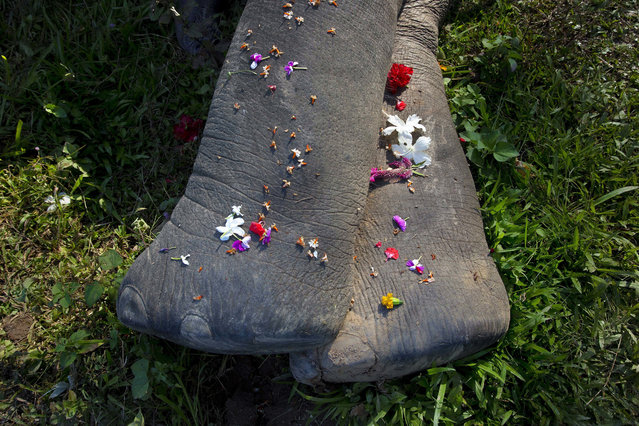
Villagers offer flowers to a wild tusker, laying dead in a field in Panbari villagein Panbari village on the outskirts of Gauhati, India, Thursday, November 2, 2017. According to a veterinarian the tusker died of food poisoning. Scarcity of food and illegal encroachment of forest areas have forced these wild elephant to move to populated areas for food. (Photo by Anupam Nath/AP Photo)

Villagers offer flowers to a wild tusker, laying dead in a field in Panbari villagein Panbari village on the outskirts of Gauhati, India, Thursday, November 2, 2017. According to a veterinarian the tusker died of food poisoning. Scarcity of food and illegal encroachment of forest areas have forced these wild elephant to move to populated areas for food. (Photo by Anupam Nath/AP Photo)
Details
10 Nov 2017 08:43:00
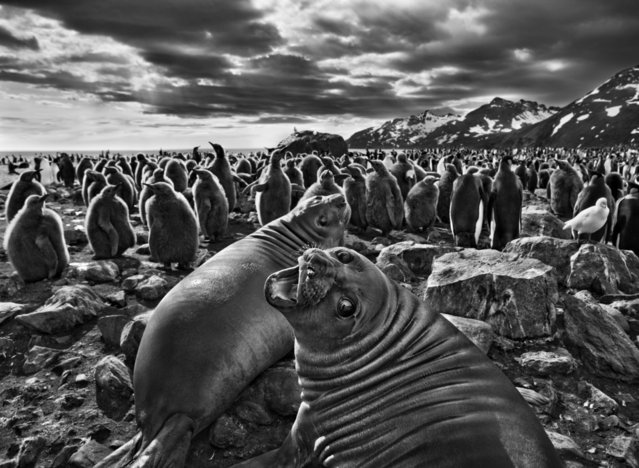
On South Georgia, a barren island in the far South Atlantic, a pair of southern elephant seal calves beckon before a colony of king penguins. “The male seals can grow to almost five tons,” says Salgado, “but these are just babies. This one looked at me with beautiful eyes”. (Photo by Sebastião Salgado/Amazonas/Contact Press Images)

Sebastião Salgado is a Brazilian documentary photographer living in Paris. He has produced several books, and his work has been exhibited extensively around the world. His latest work, «Genesis», premieres at The Natural History Museum in London on April 11, on view through September 8, 2013. Photo: On South Georgia, a barren island in the far South Atlantic, a pair of southern elephant seal calves beckon before a colony of king penguins. “The male seals can grow to almost five tons,” says Salgado, “but these are just babies. This one looked at me with beautiful eyes”. (Photo by Sebastião Salgado/Amazonas/Contact Press Images)
Details
30 Apr 2013 12:17:00