Loading...
Done
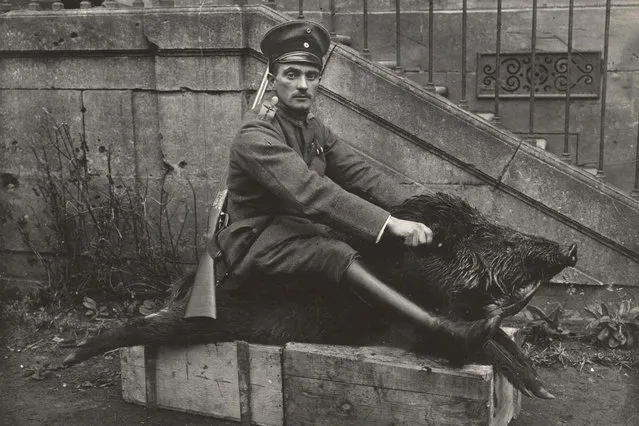
A German Air Force Officer sits astride a dead boar outside a house where he is stationed near the Western Front, in this 1918 handout picture. This picture is part of a previously unpublished set of World War One (WWI) images from a private collection. The pictures offer an unusual view of varied and contrasting aspects of the conflict, from high tech artillery to mobile pigeon lofts, and from officers partying in their headquarters to the grim reality of life and death in the trenches. The year 2014 marks the centenary of the start of the war. (Photo by Reuters/Archive of Modern Conflict London)

A German Air Force Officer sits astride a dead boar outside a house where he is stationed near the Western Front, in this 1918 handout picture. This picture is part of a previously unpublished set of World War One (WWI) images from a private collection. The pictures offer an unusual view of varied and contrasting aspects of the conflict, from high tech artillery to mobile pigeon lofts, and from officers partying in their headquarters to the grim reality of life and death in the trenches. The year 2014 marks the centenary of the start of the war. (Photo by Reuters/Archive of Modern Conflict London)
Details
26 Jun 2014 12:13:00
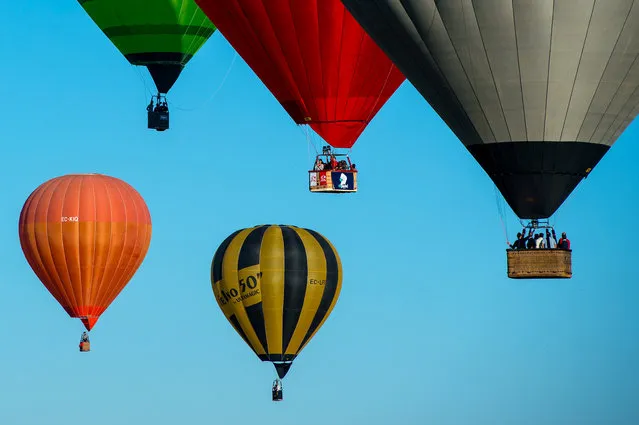
Hot air balloons fly over Igualada during an early flight as part of the European Balloon Festival on July 10, 2014 in Igualada, Spain. The early morning flight of over 30 balloons was shorter than expected due to windy weather. This flight is organised as a curtain raiser for the four-day European Balloon Festival. Now is the 18th year of the most important hot air Balloon event in Spain and one of the biggest in Europe. (Photo by David Ramos/Getty Images)

Hot air balloons fly over Igualada during an early flight as part of the European Balloon Festival on July 10, 2014 in Igualada, Spain. The early morning flight of over 30 balloons was shorter than expected due to windy weather. This flight is organised as a curtain raiser for the four-day European Balloon Festival. Now is the 18th year of the most important hot air Balloon event in Spain and one of the biggest in Europe. (Photo by David Ramos/Getty Images)
Details
11 Jul 2014 11:39:00
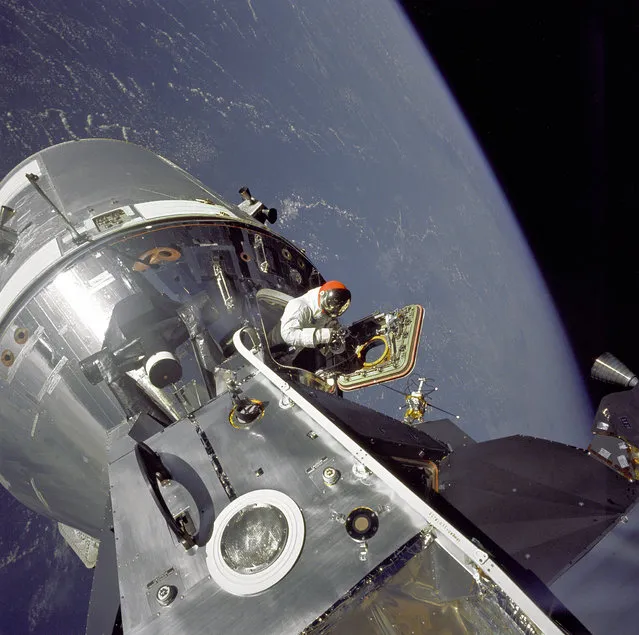
Apollo 9 Command/Service Modules (CSM) nicknamed “Gumdrop” and Lunar Module (LM), nicknamed “Spider” are shown docked together as Command Module pilot David R. Scott stands in the open hatch. Astronaut Russell L. Schweickart, Lunar Module pilot, took this photograph of Scott during his EVA as he stood on the porch outside the Lunar Module. Apollo 9 was an Earth orbital mission designed to test docking procedures between the CSM and LM as well as test fly the Lunar Module in the relative safe confines of Earth orbit. (Photo by NASA)

Apollo 9 Command/Service Modules (CSM) nicknamed “Gumdrop” and Lunar Module (LM), nicknamed “Spider” are shown docked together as Command Module pilot David R. Scott stands in the open hatch. Astronaut Russell L. Schweickart, Lunar Module pilot, took this photograph of Scott during his EVA as he stood on the porch outside the Lunar Module. Apollo 9 was an Earth orbital mission designed to test docking procedures between the CSM and LM as well as test fly the Lunar Module in the relative safe confines of Earth orbit. (Photo by NASA)
Details
20 Jul 2014 11:47:00
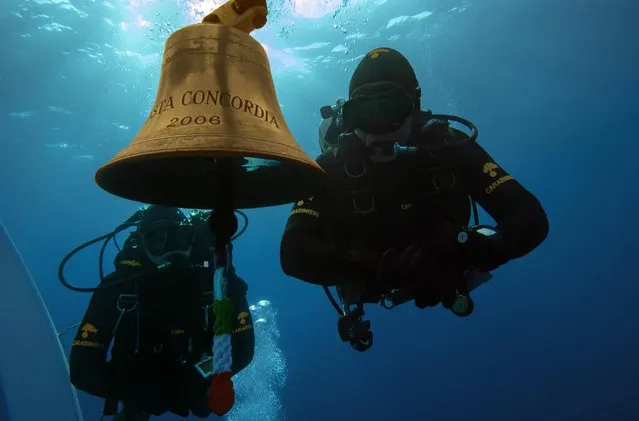
A picture released by the Italian Carabinieri on 03 July 2014 shows Carabinieri divers inspecting the inside of the Costa Concordia cruise ship, at Giglio Island, Italy, in 2012. The Costa Concordia hit a reef and partly capsized on 13 January 2012, after being steered dangerously close to Giglio, in an alleged stunt by captain Francesco Schettino. Thirty-two of the 4,229 people onboard were killed. (Photo by EPA/Carabinieri Press Office)

A picture released by the Italian Carabinieri on 03 July 2014 shows Carabinieri divers inspecting the inside of the Costa Concordia cruise ship, at Giglio Island, Italy, in 2012. The Costa Concordia hit a reef and partly capsized on 13 January 2012, after being steered dangerously close to Giglio, in an alleged stunt by captain Francesco Schettino. Thirty-two of the 4,229 people onboard were killed. (Photo by EPA/Carabinieri Press Office)
Details
22 Jul 2014 11:54:00
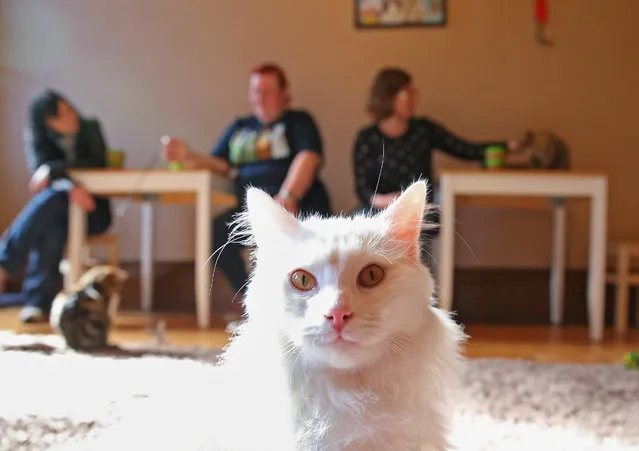
Customers drink a coffee as several cats roam at Cat Cafe Melbourne on July 25, 2014 in Melbourne, Australia. Cat Cafe Melbourne is Australias first cat cafe. The cafe has several cats from rescue shelters which live at the premises. Patrons can watch and play with the cats while enjoying a coffee. Cat Cafes are becoming known world wide, the first opening in Taiwan in 1998. (Photo by Scott Barbour/Getty Images)

Customers drink a coffee as several cats roam at Cat Cafe Melbourne on July 25, 2014 in Melbourne, Australia. Cat Cafe Melbourne is Australias first cat cafe. The cafe has several cats from rescue shelters which live at the premises. Patrons can watch and play with the cats while enjoying a coffee. Cat Cafes are becoming known world wide, the first opening in Taiwan in 1998. (Photo by Scott Barbour/Getty Images)
Details
27 Jul 2014 11:24:00
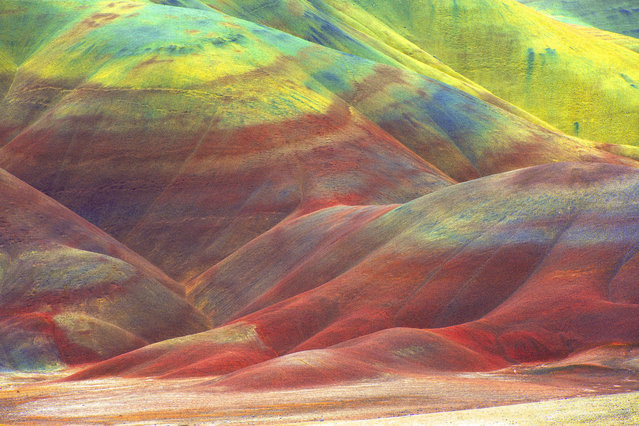
Layers of breathtaking colour streak the rolling hills of this vast desert, making the landscape appear as though it has been tie-dyed. The natural phenomenon, nicknamed the “Painted Desert”, was formed when the area was once a river floodplain. (Photo by Mark Brodkin/Solent News/SIPA Press)

Layers of breathtaking colour streak the rolling hills of this vast desert, making the landscape appear as though it has been tie-dyed. The natural phenomenon, nicknamed the “Painted Desert”, was formed when the area was once a river floodplain. Each colour corresponds to a different underground geological feature – rocks which have seemingly dyed the layers of earth above. Formed from volcanic activity, the hills at the John Day Fossil Beds National Monument in East Central Oregon, USA, are almost bursting with colour. Pictured: The colourful hills at the John Day Fossil Beds National Monument in East Central Oregon, USA. (Photo by Mark Brodkin/Solent News/SIPA Press)
Details
30 Jul 2014 11:00:00
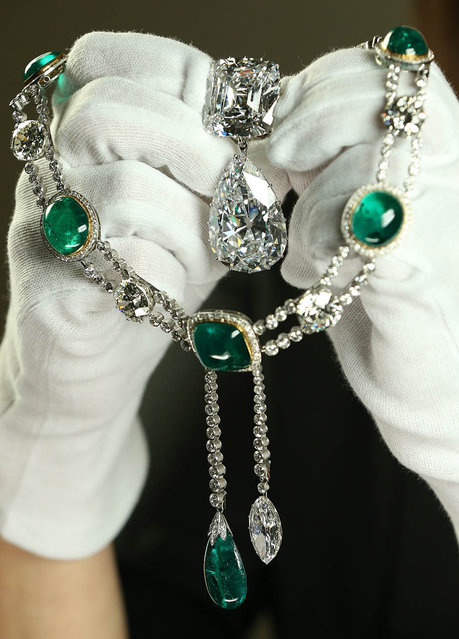
Caroline de Guitaut, Curator of Royal Collections, holds the Cullinan III and IV Broach and the Cullinan VII Delhi Durbar Necklace and Cullinan Pendant at The Queen's Gallery, Buckingham Palace

“A dazzling exhibition featuring jewelry made with the world’s largest diamond will be part of the celebrations marking the 60th anniversary of Queen Elizabeth II’s reign. The jewelry was made with a 3,106-carat diamond discovered in 1905 at the Cullinan Diamond Mine near Pretoria, the capital of South Africa. The diamond was so large that miners initially thought it was a worthless crystal and almost threw it away”... – Vidya Kauri via News.nationalpost.com

Photo: Caroline de Guitaut, Curator of Royal Collections, holds the Cullinan III and IV Broach and the Cullinan VII Delhi Durbar Necklace and Cullinan Pendant at The Queen's Gallery, Buckingham Palace on May 15, 2012 in London, England. (Photo by Peter Macdiarmid)
Details
17 May 2012 10:59:00
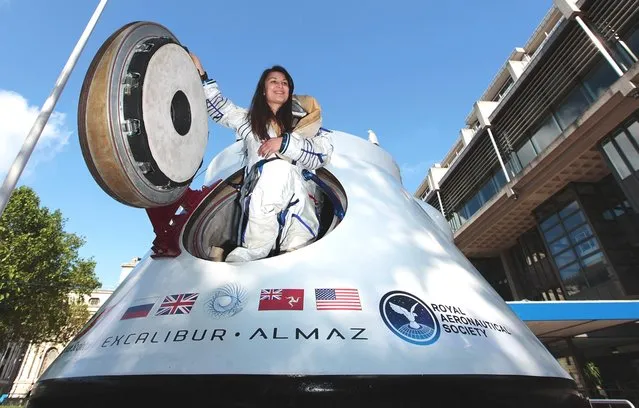
Jenn Sander from Red Robin PR, wearing a spacesuit once worn by US Astronaut Peggy Whitson, sits inside a re-entry capsule owned by Excalibur Almaz

A British space-exploration company has revealed its aim to fly the public to the moon from 2015 – providing they have £100m for a ticket.

Photo: Jenn Sander from Red Robin PR, wearing a spacesuit once worn by US Astronaut Peggy Whitson, sits inside a re-entry capsule owned by Excalibur Almaz outside the Queen Elizabeth II Centre on June 19, 2012 in London, England. The company today announced their plan to fly people to the moon on what is the 40th anniversary year of the Apollo 17 moon landing. (Photo by Rosie Hallam)
Details
20 Jun 2012 10:07:00