Loading...
Done
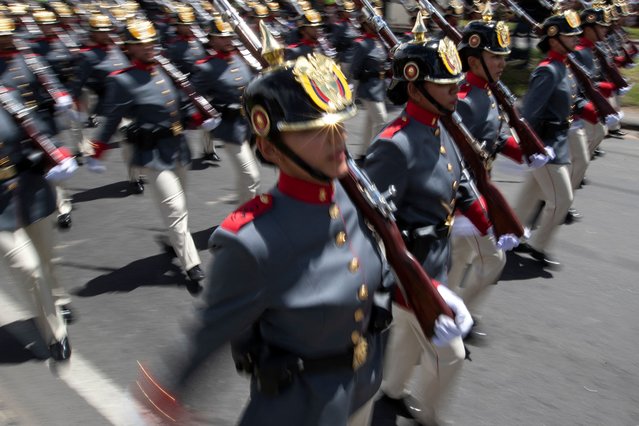
Female members of the Colombian Army take part in the military parade to commemorate Colombia's Independence Day in Bogota on July 20, 2024. (Photo by Alejandro Martinez/AFP Photo)

Female members of the Colombian Army take part in the military parade to commemorate Colombia's Independence Day in Bogota on July 20, 2024. (Photo by Alejandro Martinez/AFP Photo)
Details
01 Dec 2025 05:32:00
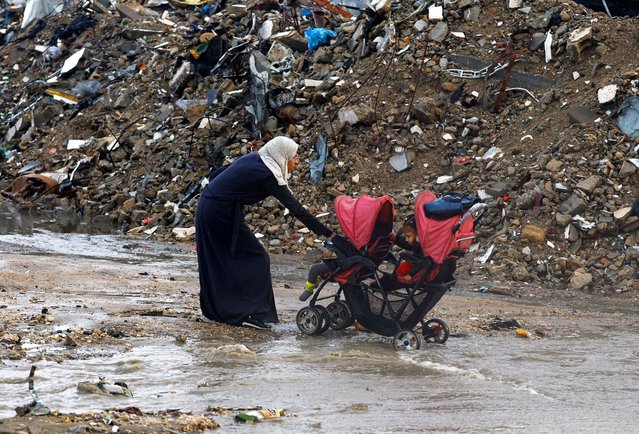
A Palestinian woman pulls a stroller with children, next to piles of rubble, during a rainy day in Gaza City,on  November 25, 2025. (Photo by Mahmoud Issa/Reuters)

A Palestinian woman pulls a stroller with children, next to piles of rubble, during a rainy day in Gaza City,on November 25, 2025. (Photo by Mahmoud Issa/Reuters)
Details
02 Dec 2025 05:36:00
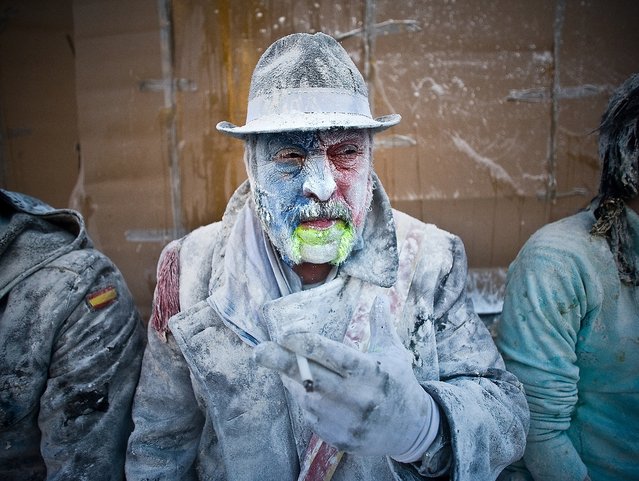
A Reveller smokes during the battle of “Enfarinats”, a flour fight in celebration of the Els Enfarinats festival. (Photo by David Ramos)

It’s a classic tale of dictatorship gone wrong and the fight for freedom. Like in any good battle, there’s fire, albeit from firecrackers, but the ammunition in this one is – flour. It takes place in a Hemingway-esque Spanish village. The battle of “Enfarinats” in celebration of the Els Enfarinats festival, rages on on December 28, 2012 in Ibi, Spain. Citizens of Ibi annually celebrate the festival with a fight using flour, eggs and firecrackers. The battle takes place between two groups, a group of married men called “Els Enfarinats” who take the control of the village for one day pronouncing a number of ridiculous laws and fining the citizens that infringe them and a group called “La Oposicio” who try to restore order. At the end of the day the money collected from the fines is donated to charitable causes in the village. The festival has been celebrated since 1981 after the town of Ibi recovered the tradition but the origins remain unknown.

Photo: A Reveller smokes during the battle of “Enfarinats”, a flour fight in celebration of the Els Enfarinats festival. (Photo by David Ramos)
Details
30 Dec 2012 10:28:00
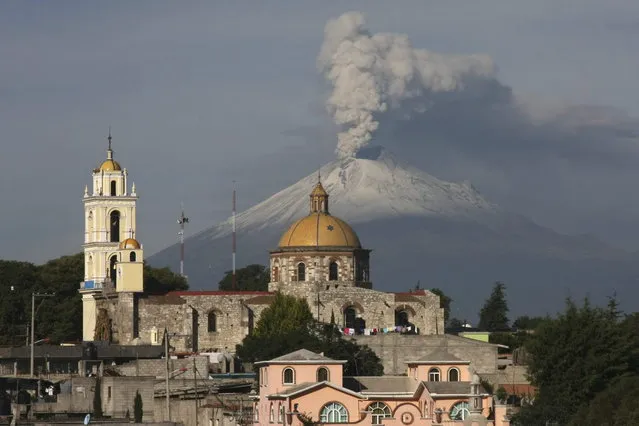
The main church in the town of San Damian Texoloc, Mexico stands in front of the Popocatepetl volcano as is spews ash and vapor early Tuesday, July 9, 2013. Last Saturday, Mexico's National Center for Disaster Prevention raised the volcano alert from Stage 2 Yellow to Stage 3 Yellow, the final step before a Red alert, when possible evacuations could be ordered after the Popocatepetl volcano spit out a cloud of ash and vapor 2 miles (3 kilometers) high over several days of eruptions. (Photo by J. Guadalupe Perez/AP Photo)

The main church in the town of San Damian Texoloc, Mexico stands in front of the Popocatepetl volcano as is spews ash and vapor early Tuesday, July 9, 2013. Last Saturday, Mexico's National Center for Disaster Prevention raised the volcano alert from Stage 2 Yellow to Stage 3 Yellow, the final step before a Red alert, when possible evacuations could be ordered after the Popocatepetl volcano spit out a cloud of ash and vapor 2 miles (3 kilometers) high over several days of eruptions. (Photo by J. Guadalupe Perez/AP Photo)
Details
10 Jul 2013 08:45:00
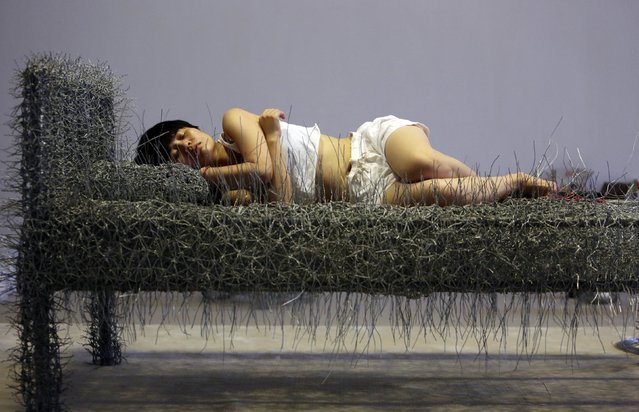
Chinese artist Zhou Jie takes a nap on an unfinished iron wire bed, one of her sculpture works, after lunch at Beijing Now Art Gallery, in Beijing August 11, 2014. Zhou started her art project titled “36 Days” on August 9, in which she would live inside an exhibition hall with an unfinished iron wire bed, some iron wire sculptures in the shape of stuffed animal dolls, a certain amount of food and her mobile phone, for 36 days. (Photo by Jason Lee/Reuters)

Chinese artist Zhou Jie takes a nap on an unfinished iron wire bed, one of her sculpture works, after lunch at Beijing Now Art Gallery, in Beijing August 11, 2014. Zhou started her art project titled “36 Days” on August 9, in which she would live inside an exhibition hall with an unfinished iron wire bed, some iron wire sculptures in the shape of stuffed animal dolls, a certain amount of food and her mobile phone, for 36 days. The entire process is open to visitors and she may also interact with them, according to Zhou. (Photo by Jason Lee/Reuters)
Details
22 Aug 2014 12:04:00
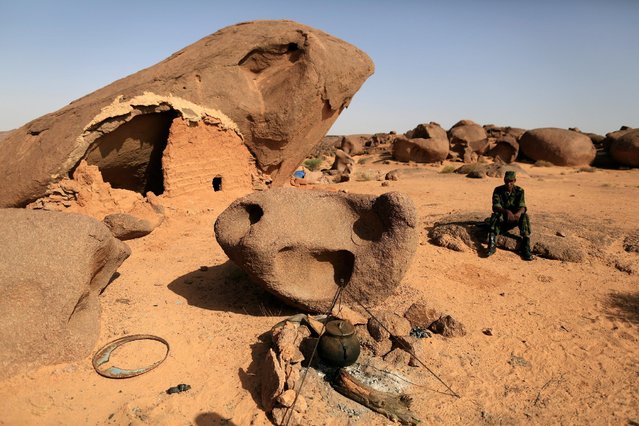
A Polisario fighter sits on a rock at a forward base on the outskirts of Tifariti, Western Sahara, September 9, 2016. At a rocky outpost in Western Sahara, a new generation of soldiers who have never known war are mobilising as tensions resurface in one of Africa's oldest disputes after a quarter century of uneasy peace. Young Sahrawi troops man new desert posts for the Polisario Front, which for more than 40 years has sought independence for the vast desert region - first in a guerrilla war against Morocco and then politically since a ceasefire deal in 1991. Now a standoff with Morocco, which controls the majority of Western Sahara, is renewing pressure for a diplomatic solution to ensure foot soldiers don't return to fighting as the last generation of commanders once did. The standoff since August has brought Moroccan and Polisario forces within 200 metres of each other in a narrow strip of land near the Mauritanian border. Rich in phosphate, Western Sahara has been contested since 1975 when Spanish colonial powers left. Morocco claimed the territory and fought the 16-year war with Polisario. (Photo by Zohra Bensemra/Reuters)

A Polisario fighter sits on a rock at a forward base on the outskirts of Tifariti, Western Sahara, September 9, 2016. At a rocky outpost in Western Sahara, a new generation of soldiers who have never known war are mobilising as tensions resurface in one of Africa's oldest disputes after a quarter century of uneasy peace. (Photo by Zohra Bensemra/Reuters)
Details
04 Nov 2016 12:09:00
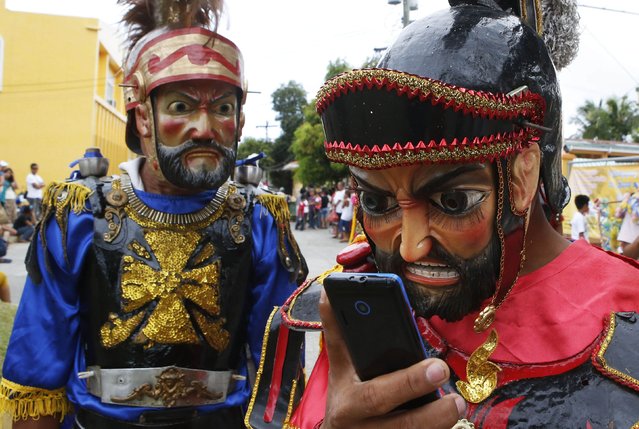
A penitent called “Morion” checks his mobile phone in Mogpog town on Marinduque island in central Philippines April 14, 2014. During the annual festival, masked and costumed penitents called “Moriones” dress in attire that is the local interpretation of what Roman soldiers wore during biblical times. Holy Week is celebrated in many Christian traditions during the week before Easter. (Photo by Erik De Castro/Reuters)

A penitent called “Morion” checks his mobile phone in Mogpog town on Marinduque island in central Philippines April 14, 2014. During the annual festival, masked and costumed penitents called “Moriones” dress in attire that is the local interpretation of what Roman soldiers wore during biblical times. Holy Week is celebrated in many Christian traditions during the week before Easter. (Photo by Erik De Castro/Reuters)
Details
19 Apr 2014 11:52:00
Revellers continue to party and dance through the night and day during the second day of the San Fermin Running Of The Bulls festival, on July 7, 2014 in Pamplona, Spain. The annual Fiesta de San Fermin, made famous by the 1926 novel of US writer Ernest Hemmingway “The Sun Also Rises”, involves the running of the bulls through the historic heart of Pamplona. (Photo by Christopher Furlong/Getty Images)

Revellers continue to party and dance through the night and day during the second day of the San Fermin Running Of The Bulls festival, on July 7, 2014 in Pamplona, Spain. The annual Fiesta de San Fermin, made famous by the 1926 novel of US writer Ernest Hemmingway “The Sun Also Rises”, involves the running of the bulls through the historic heart of Pamplona. (Photo by Christopher Furlong/Getty Images)
Details
08 Jul 2014 13:44:00