Loading...
Done
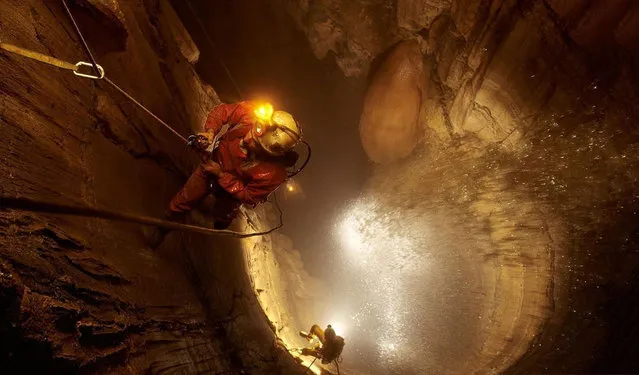
Krubera Cave Gerogia

Krubera Cave is the deepest known cave on Earth. It is located in the Arabika Massif of the Gagrinsky Range of the Western Caucasus, in the Gagra district of Abkhazia, a breakaway region of Georgia.
Details
06 Jul 2014 20:33:00


Over the past few weeks we have seen a massive popularity spike in “small space” architecture and design. The latest project to come across our desks is this beautiful Hus-1 Residence. The tiny dwelling is just 270 square feet and was both built and designed by the Swedish architect Torsten Ottesjö. ...

Details
20 Jul 2012 09:34:00


Indonesian activists covered with sludge from the mud volcano hold a protest during five year anniversary of the Sidoarjo mud eruption on May 29, 2011 in the subdistrict of Porong in Sidoarjo, East Java, Indonesia. (Photo by Ulet Ifansasti/Getty Images)
Details
30 May 2011 07:18:00
Humanoid robot bartender “Carl” interacts with guests at the Robots Bar and Lounge in the eastern German town of Ilmenau, July 26, 2013. “Carl”, developed and built by mechatronics engineer Ben Schaefer who runs a company for humanoid robots, prepares spirits for the mixing of cocktails and is able to interact with customers in small conversations. (Photo by Fabrizio Bensch/Reuters)

Humanoid robot bartender “Carl” interacts with guests at the Robots Bar and Lounge in the eastern German town of Ilmenau, July 26, 2013. “Carl”, developed and built by mechatronics engineer Ben Schaefer who runs a company for humanoid robots, prepares spirits for the mixing of cocktails and is able to interact with customers in small conversations. (Photo by Fabrizio Bensch/Reuters)
Details
22 Oct 2013 09:04:00
A man makes traditional candy “Matang” in preparation for the upcoming Chinese Lunar New Year in Yuqing County, Zunyi, Guizhou Province, China, January 18, 2016. (Photo by Reuters/China Daily)

A man makes traditional candy “Matang” in preparation for the upcoming Chinese Lunar New Year in Yuqing County, Zunyi, Guizhou Province, China, January 18, 2016. (Photo by Reuters/China Daily)
Details
21 Jan 2016 08:06:00
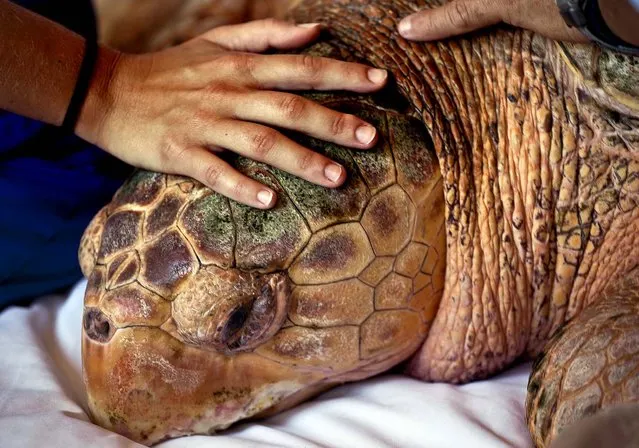
Kahuna is kept calm and steady on the gurney by staff and volunteers

Kahuna, an injured loggerhead turtle, returns to the ocean after years of rehabilitation. It has been two years since Kahuna, a 209-pond loggerhead turtle, was rescued from the wild by biologists at FPL’s St. Lucie Power. Half of one of her flippers had been sliced off, and the other flipper was badly injured. On top of that, she had severe bone infection doctors tried for months to cure with antibiotics, only to have it come back once they stopped the medicine.

Photo: Kahuna is kept calm and steady on the gurney by staff and volunteers.
Details
14 Jul 2012 09:24:00
The Queen Elizabeth Tower (Big Ben) is reflected in a puddle as a cyclist rides by in London, on 27 June 2016. Britain began preparations to leave the European Union on Monday but said it would not be rushed into a quick exit, as markets plunged in the wake of a seismic referendum despite attempts to calm jitters. (Photo by Leon Neal/AFP Photo)

The Queen Elizabeth Tower (Big Ben) is reflected in a puddle as a cyclist rides by in London, on 27 June 2016. Britain began preparations to leave the European Union on Monday but said it would not be rushed into a quick exit, as markets plunged in the wake of a seismic referendum despite attempts to calm jitters. (Photo by Leon Neal/AFP Photo)
Details
02 Aug 2016 08:01:00
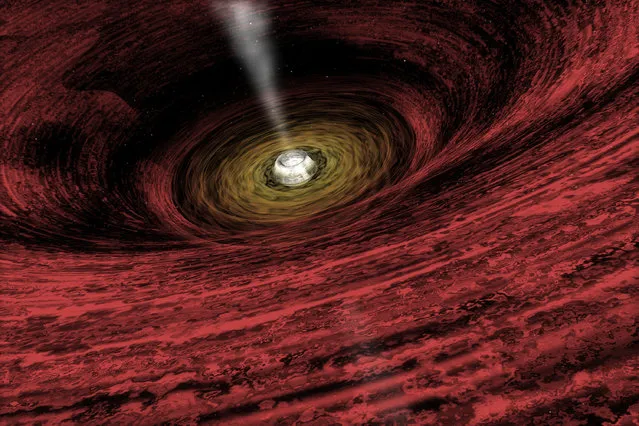
An artist's impression of a growing supermassive black hole located in the early Universe is seen in this NASA handout illustration released on June 15, 2011. Using the deepest X-ray image ever taken, astronomers found the first direct evidence that massive black holes were common in the early universe. This discovery from NASA's Chandra X-Ray Observatory shows that very young black holes grew more aggressively than previously thought, in tandem with the growth of their host galaxies. (Photo by Reuters/NASA/Chandra X-Ray Observatory/A.Hobart)

An artist's impression of a growing supermassive black hole located in the early Universe is seen in this NASA handout illustration released on June 15, 2011. Using the deepest X-ray image ever taken, astronomers found the first direct evidence that massive black holes were common in the early universe. This discovery from NASA's Chandra X-Ray Observatory shows that very young black holes grew more aggressively than previously thought, in tandem with the growth of their host galaxies. (Photo by Reuters/NASA/Chandra X-Ray Observatory/A.Hobart)
Details
11 Feb 2016 12:57:00