Loading...
Done
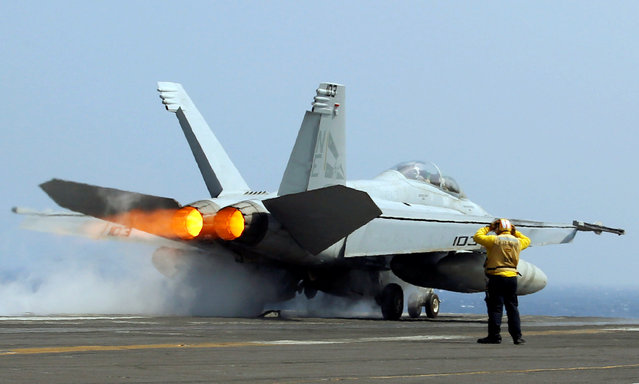
A U.S. Navy F18 fighter jet takes off from aircraft carrier USS Carl Vinson during a FONOPS (Freedom of Navigation Operation Patrol) in South China Sea, March 3, 2017. (Photo by Erik De Castro/Reuters)

A U.S. Navy F18 fighter jet takes off from aircraft carrier USS Carl Vinson during a FONOPS (Freedom of Navigation Operation Patrol) in South China Sea, March 3, 2017. The U.S. military took journalists Friday to the carrier on routine patrol off the disputed South China Sea, sending a signal to China and American allies of its resolve to ensure freedom of navigation and overflight in one of the world's security hotspots. (Photo by Erik De Castro/Reuters)
Details
06 Mar 2017 00:01:00
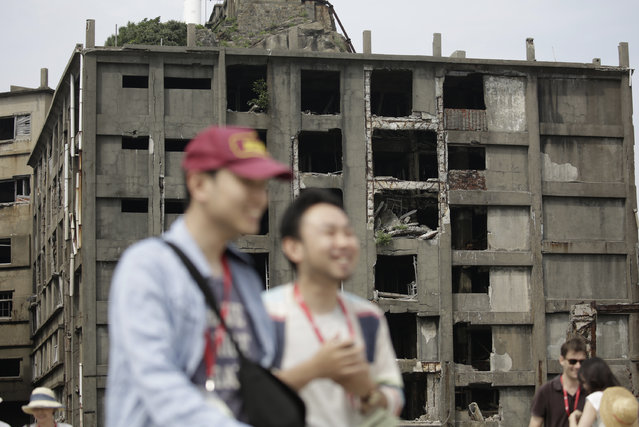
In this June 29, 2015 photo, forlorn buildings are seen at Hashima Island, commonly known as Gunkanjima, which means “Battleship Island”, off Nagasaki, Nagasaki Prefecture, southern Japan. (Photo by Eugene Hoshiko/AP Photo)

In this June 29, 2015 photo, forlorn buildings are seen at Hashima Island, commonly known as Gunkanjima, which means “Battleship Island”, off Nagasaki, Nagasaki Prefecture, southern Japan. The island is one of 23 old industrial facilities seeking UNESCO's recognition as world heritage “Sites of Japan's Meiji Industrial Revolution” meant to illustrate Japan's rapid transformation from a feudal farming society into an industrial power at the end of the 19th century. UNESCO's World Heritage Committee is expected to approve the proposal during a meeting being held in Bonn, Germany, through July 9. (Photo by Eugene Hoshiko/AP Photo)
Details
01 Jul 2015 13:41:00
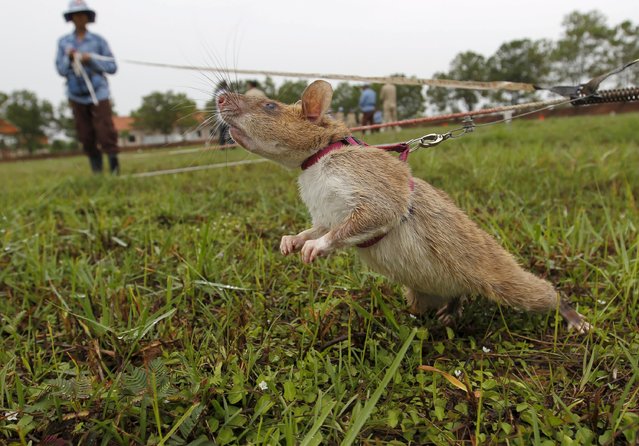
A rat being trained by the Cambodian Mine Action Centre (CMAC) is pictured on an inactive landmine field in Siem Reap province July 9, 2015. Gambian pouched rats were deployed to Cambodia from Tanzania in April by a Belgian non-profit organization, APOPO, to help clear mines. (Photo by Samrang Pring/Reuters)

A rat being trained by the Cambodian Mine Action Centre (CMAC) is pictured on an inactive landmine field in Siem Reap province July 9, 2015. Gambian pouched rats were deployed to Cambodia from Tanzania in April by a Belgian non-profit organization, APOPO, to help clear mines. They've been trained since they were 4 weeks old. Cambodia is still littered with landmines after emerging from decades of civil war, including the 1970s Khmer Rough “Killing Fields” genocide, leaving it with one of the world's highest disability rates. APOPO has used the rodents for mine-clearing projects in several countries, including Angola, Mozambique, Thailand, Laos, and Vietnam. (Photo by Samrang Pring/Reuters)
Details
14 Jul 2015 13:35:00
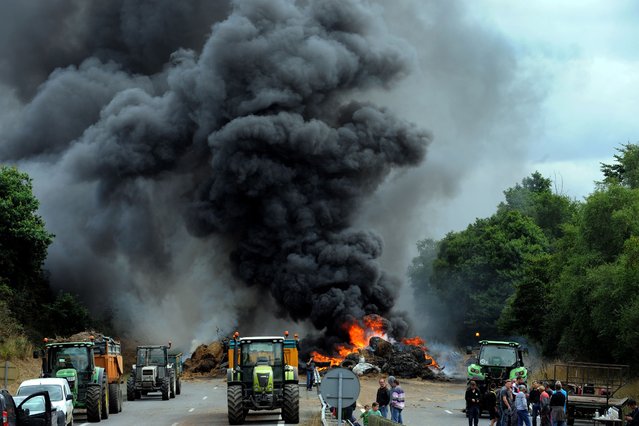
Farmers use tractors and burn tires, hay and manure as they block the highway between Morlaix and Brest during a demonstration against the market prices of their product, on July 22, 2015 in Morlaix, western of France. French farmers protesting over falling food prices threatened to step up blockades of cities, roads and tourist sites, as the government prepared to unveil emergency aid for them. (Photo by Fred Tanneau/AFP Photo)

Farmers use tractors and burn tires, hay and manure as they block the highway between Morlaix and Brest during a demonstration against the market prices of their product, on July 22, 2015 in Morlaix, western of France. French farmers protesting over falling food prices threatened to step up blockades of cities, roads and tourist sites, as the government prepared to unveil emergency aid for them. Farmers have dumped manure in cities, blocked access roads and motorways and hindered tourists from reaching Mont St-Michel in northern France, one of France's most visited sites. (Photo by Fred Tanneau/AFP Photo)
Details
23 Jul 2015 10:39:00
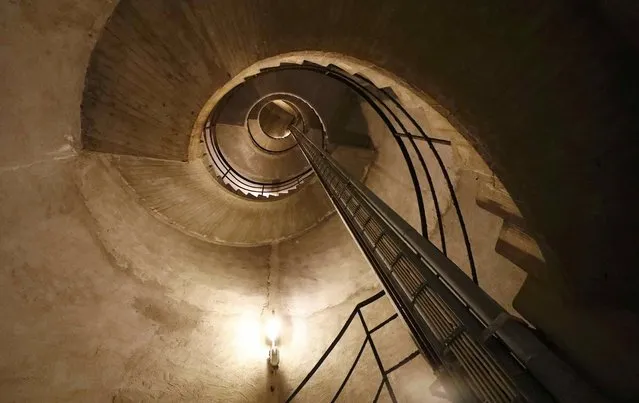
A 20 metre high spiral staircase in a tower used as an emergency exit, is seen inside a Federal Reserve bank (Bundesbank) bunker, prior to the bunker's official opening to the public in Cochem, Germany, March 18, 2016. (Photo by Kai Pfaffenbach/Reuters)

A 20 metre high spiral staircase in a tower used as an emergency exit, is seen inside a Federal Reserve bank (Bundesbank) bunker, prior to the bunker's official opening to the public in Cochem, Germany, March 18, 2016. West Germany's Central Bank (Deutsche Bundesbank) stored some 20 billion German marks of emergency notes in two underground bunkers, one in Frankfurt the other in Cochem, between 1964-1988 during the cold war. (Photo by Kai Pfaffenbach/Reuters)
Details
19 Mar 2016 12:36:00
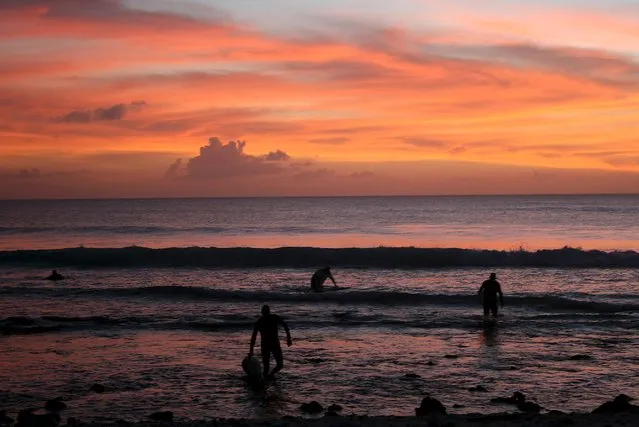
Surfers walk out of the water at sunset after surfing along the coast of Kiritimati Island, part of the Pacific Island nation of Kiribati, April 5, 2016. (Photo by Lincoln Feast/Reuters)


Kiritimati is a far-flung outpost of the Republic of Kiribati. The world's largest coral atoll, Kiritimati has just one flight a week to either Fiji or Hawaii, four-and-a-half hours in either direction. Tarawa, the capital of Kiribati lies nearly 3,300 km (2,000 miles) to the west – about three weeks by boat. No lawyers are based on Kiritimati and the High Court only comes once or twice a year to clear a backlog of the most serious cases, bringing a public lawyer for defendants who can't afford their own. (Photo by Lincoln Feast/Reuters)
Details
28 Apr 2016 12:01:00
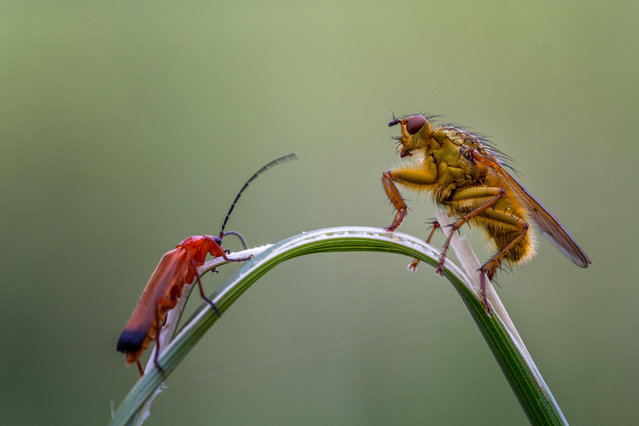
A hogweed bonking beetle and yellow dung fly in a stalk standoff (the fly gave in), in Burley-in-Wharfedale, Yorkshire, England. (Photo by Rebecca Cole/Alamy Stock Photo)

A hogweed bonking beetle and yellow dung fly in a stalk standoff (the fly gave in), in Burley-in-Wharfedale, Yorkshire, England. (Photo by Rebecca Cole/Alamy Stock Photo)
Details
19 Aug 2017 08:44:00


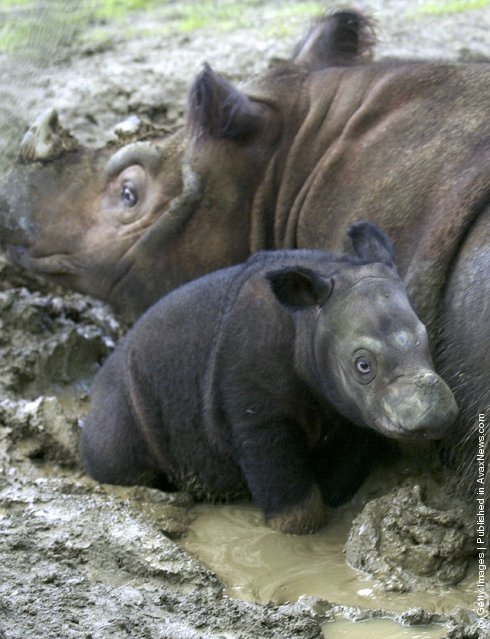
“The Sumatran Rhinoceros (Dicerorhinus sumatrensis) is a member of the family Rhinocerotidae and one of five extant rhinoceroses. It is the only extant species of the genus Dicerorhinus. It is the smallest rhinoceros, standing about 120–145 centimetres (3.9–4.76 ft) high at the shoulder, with a body length of 250 centimetres (8.2 ft) and weight of 500–800 kilograms (1,100–1,800 lb). Like the African species, it has two horns; the larger is the nasal horn, typically 15–25 centimetres (5.9–9.8 in), while the other horn is typically a stub. A coat of reddish-brown hair covers most of the Sumatran Rhino's body”. – Wikipedia

Photo: Emi, a Sumatran rhinoceros lies in the mud with her three-week-old female calf at the Cincinnati Zoo and Botanical Garden August 19, 2004 in Cincinnati, Ohio. Emi made history by becoming the first Sumatran rhino to produce two calves in captivity. (Photo by Mike Simons/Getty Images)
Details
22 Jun 2011 12:37:00