Txai Suruí, Amazonian Activist, during the opening night of Web Summit Rio 2023 at Riocentro in Rio de Janeiro, Brazil. (Photo By Stephen McCarthy/Sportsfile for Web Summit Rio via Getty Images)
Daniel Sheridan, a council worker from Poole, Dorset, runs a side hustle snapping dogs living their best lives in the second decade of December 2024. (Photo by Daniel Sheridan/South West News Service)
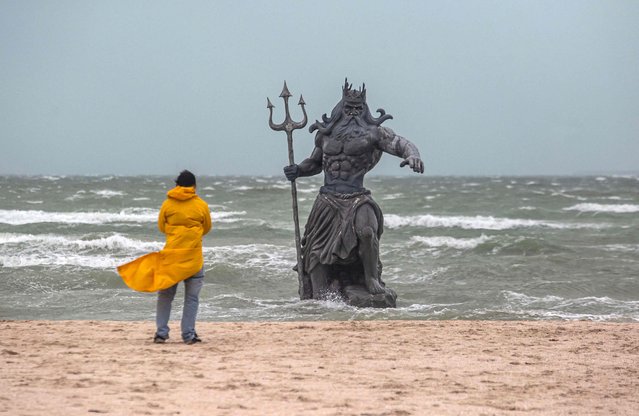
A man looks at a statue of the Greek god Poseidon on a beach during the passage of tropical storm Beryl in Progreso, on the Yucatan Peninsula, Mexico, on July 5, 2024. Beryl weakened to a tropical storm Friday after hitting Mexico as a Category 2 hurricane, with fierce winds causing material damage but no injuries along the tourist-rich Yucatan Peninsula. (Photo by Hugo Borges/AFP Photo)
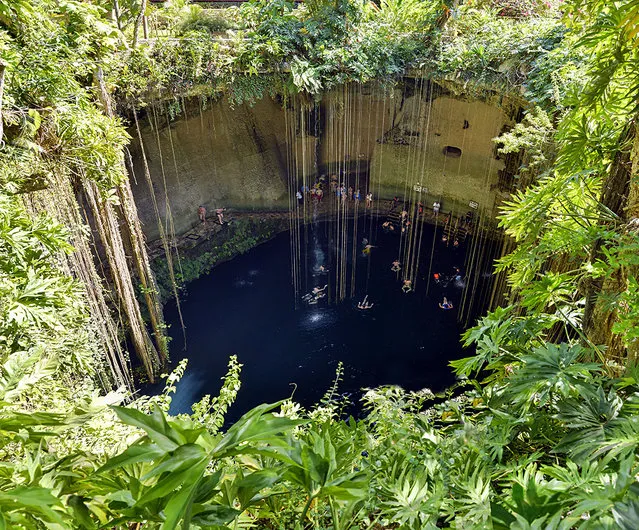
A cenote is a natural phenomenon, a sinkhole in the Earth’s surface. The Yucatan Peninsula in Mexico has an estimated 7,000 cenotes because it is primarily made up of porous limestone. For millions of years, rainfall slowly ate away at the limestone and a huge system of underground caves and caverns was formed. Many filled with water from rain or from the underground water table. When the roof of a water filled cave collapses, a cenote is born. The water found in a cenote may be fresh water, salt water, or both. Structurally it may be completely open, like a lake, almost completely closed with just a small opening at the top, or somewhere in between.
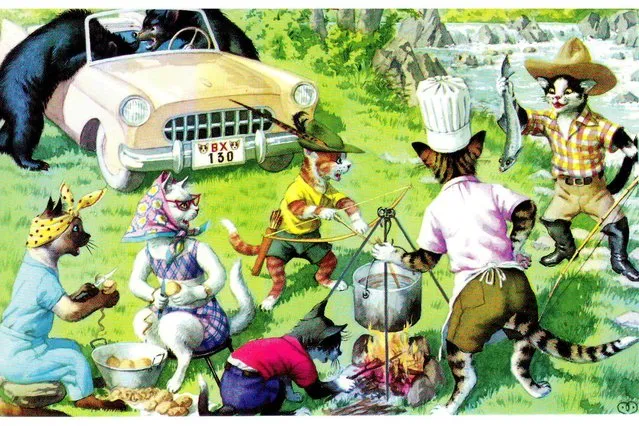
From the 1940s through the 1960s, the Alfred Mainzer Company of Long Island City, NY published a series of linen and photochrome humorous cat postcards illustrated by Eugen Hartung (or Hurtong) (1897–1973), sometimes referred to as “Mainzer Cats”. These postcards normally illustrate settings that are filled with action, often with a minor disaster just about to occur. While the dressed cats were by far the most popular and most plentiful cards, Hartung also painted other dressed animals – primarily mice, dogs, and hedgehogs.
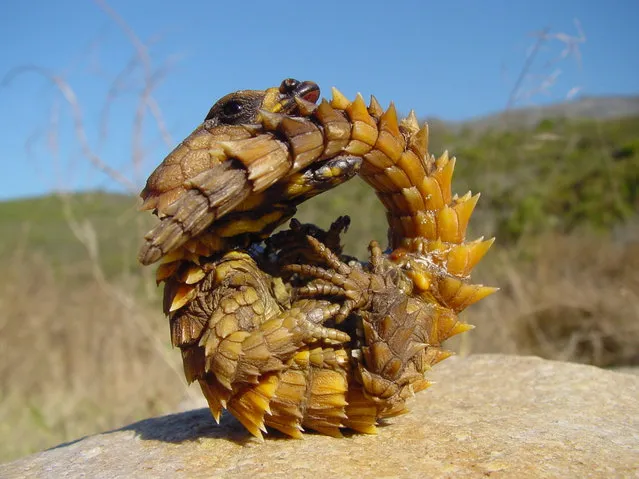
The armadillo girdled lizard, Ouroborus cataphractus, is a lizard endemic to desert areas of southern Africa. It is also commonly known as typical girdled lizard, armadillo lizard, golden armadillo lizard, and armadillo spiny-tailed lizard.
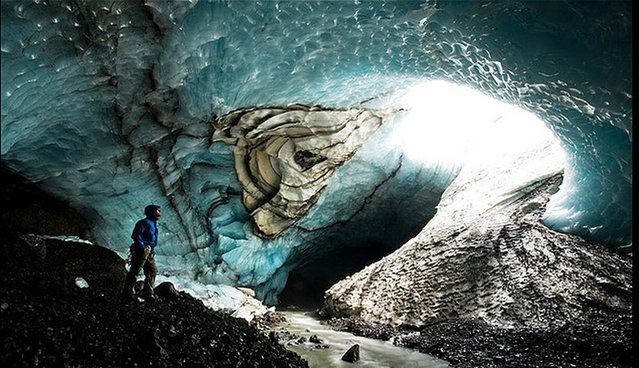
Vatnajökull (meaning Glacier of Rivers), also known as the Vatna Glacier, is the largest and most voluminous Icelandic glacier, and one of the largest in area in Europe. It is located in the south-east of the island, covering more than 8 percent of the country.