Loading...
Done
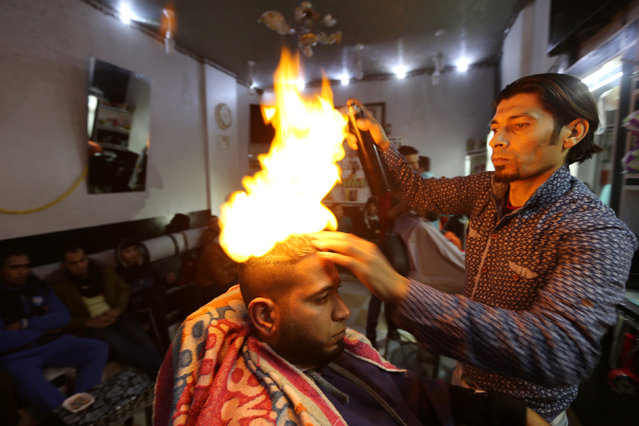
Palestinian barber Ramadan Odwan styles and straightens the hair of a customer with fire at his salon in Rafah, in the southern Gaza Strip February 2, 2017. In Ramadan Odwan's barbershop in Gaza, hair isn't just blow-dried, it's blowtorch-dried. “People have gone crazy about it, many people are curious to go through the experience and they are not afraid”, he told Reuters. “People here love adventures”. Odwan, 37, is not the first stylist in the world to use flame to straighten hair, but his craft is unique in the Gaza Strip. In his salon in the southern Gaza town of Rafah, Odwan applied what he described as a protective liquid coating to a customer's hair – he declined to disclose its contents – before aiming for the head and pressing the button on a small blowtorch. “I control how long I apply fire, I keep it on and off for 10 seconds or 15 seconds. It is completely safe and I have not encountered any accident since I started it two months ago”, Odwan added. Odwan charges 20 shekels ($5.20) for a haircut and fire-straightening. A barber for the past 18 years, he said part of the reason he uses the technique is to show that Palestinian barbers are as “professional as those out there around the world”. (Photo by Ibraheem Abu Mustafa/Reuters)

Palestinian barber Ramadan Odwan styles and straightens the hair of a customer with fire at his salon in Rafah, in the southern Gaza Strip February 2, 2017. In Ramadan Odwan's barbershop in Gaza, hair isn't just blow-dried, it's blowtorch-dried. “People have gone crazy about it, many people are curious to go through the experience and they are not afraid”, he told Reuters. “People here love adventures”. (Photo by Ibraheem Abu Mustafa/Reuters)
Details
11 Feb 2017 00:05:00
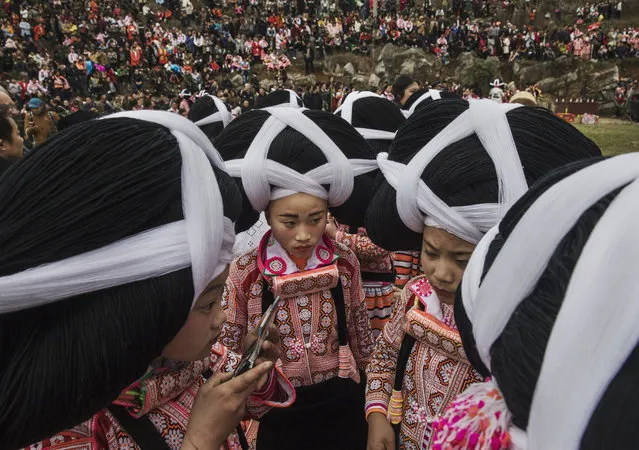
Girls of the Long Horn Miao ethnic minority group wear headdresses as they prepare gather for Tiaohua or Flower Festival as part of the Lunar New Year on February 6, 2017 in Longga village, Guizhou province, southern China. The Long Horn Miao are recognized for their declining practice of wrapping a blend of linen, wool, and the hair of their ancestors around animal horns or a wooden clip to make headdresses. Many young women say they now wear the headdresses only for special occasions and festivals, as the ornaments, which are attached by the horns to their real hair, have proved impractical for modern daily life in a fast changing world. China officially recognizes 56 different ethnic minorities, and statistics show over 7 million Chinese identifying themselves as Miao. But the small Long Horn Miao community counts only around 5000 people living in 12 villages, whose age-old traditions, language, and culture are fading. It is increasingly difficult in a modernizing China, as young people are drawn from remote rural villages to opportunities in bigger cities amongst wide-scale urbanization. Farming and labour remain the mainstays of life for the Long Horn Miao, leaving the area relatively poor in comparison with many parts of China. The government has invested significant amounts into local infrastructure and the tourism industry to try to bolster the local economy. (Photo by Kevin Frayer/Getty Images)

Girls of the Long Horn Miao ethnic minority group wear headdresses as they prepare gather for Tiaohua or Flower Festival as part of the Lunar New Year on February 6, 2017 in Longga village, Guizhou province, southern China. (Photo by Kevin Frayer/Getty Images)
Details
13 Feb 2017 00:01:00
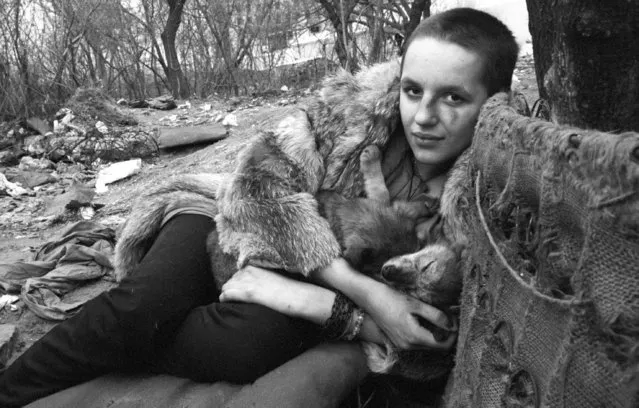
Suffering from a broken nose and bruised ribs Natasha Dzhuley, 16, relaxes after inhaling glue for the first time – something she swore she would never do, 2002. She was beaten by her pimps men in what Ruslana believes was a warning to other prostitutes to stay in line. Though another child believes her pimp had her beaten because she was pregnant. Less than a week after this picture of Natasha was taken she was dragged away by six men. She has not been heard or seen since. (Photo by Kurt Vinion /Getty Images)

Suffering from a broken nose and bruised ribs Natasha Dzhuley, 16, relaxes after inhaling glue for the first time – something she swore she would never do, 2002. She was beaten by her pimps men in what Ruslana believes was a warning to other prostitutes to stay in line. Though another child believes her pimp had her beaten because she was pregnant. Less than a week after this picture of Natasha was taken she was dragged away by six men. She has not been heard or seen since. (Photo by Kurt Vinion /Getty Images)
Details
18 Feb 2017 00:05:00
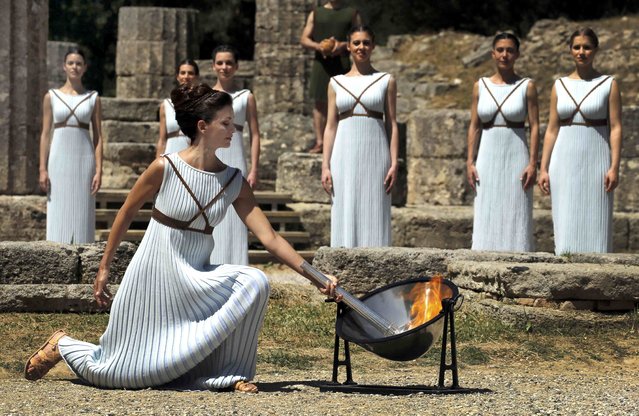
Greek actress Katerina Lehou , playing the role of High Priestess, lights a torch during the dress rehearsal for the Olympic flame lighting ceremony for the Rio 2016  Olympic Games at the site of ancient Olympia in Greece, April 20, 2016. Fire spurted from the concave mirror as a priestess, kneeling in her long, pleated dress before a ruined Greek temple, focused the blazing sun's rays on her metal torch. Come rain or shine on Thursday's official lighting ceremony, Rio de Janeiro has now secured its Olympic flame, which will burn in the main Olympic stadium throughout the Aug. 5-21 games. (Photo by Yannis Behrakis/Reuters)

Greek actress Katerina Lehou, playing the role of High Priestess, lights a torch during the dress rehearsal for the Olympic flame lighting ceremony for the Rio 2016 Olympic Games at the site of ancient Olympia in Greece, April 20, 2016. Fire spurted from the concave mirror as a priestess, kneeling in her long, pleated dress before a ruined Greek temple, focused the blazing sun's rays on her metal torch. Come rain or shine on Thursday's official lighting ceremony, Rio de Janeiro has now secured its Olympic flame, which will burn in the main Olympic stadium throughout the Aug. 5-21 games. (Photo by Yannis Behrakis/Reuters)
Details
21 Apr 2016 12:08:00
A woman looks at traditional Ukrainian Easter eggs “Pysanka”, installed as part of the upcoming celebrations of Easter, in central Kiev, Ukraine, April 29, 2016. A pysanka is a Ukrainian Easter egg, decorated with traditional Ukrainian folk designs using a wax-resist (batik) method. The word pysanka comes from the verb pysaty, “to write”, as the designs are not painted on, but written with beeswax. Many other eastern European ethnic groups decorate eggs using wax resist for Easter. These include the Belarusians, Bulgarians, Croats, Czechs, Hungarians, Lithuanians, Poles, Romanians, Serbs, Slovaks, Slovenes and Sorbs. (Photo by Valentyn Ogirenko/Reuters)

A woman looks at traditional Ukrainian Easter eggs “Pysanka”, installed as part of the upcoming celebrations of Easter, in central Kiev, Ukraine, April 29, 2016. A pysanka is a Ukrainian Easter egg, decorated with traditional Ukrainian folk designs using a wax-resist (batik) method. The word pysanka comes from the verb pysaty, “to write”, as the designs are not painted on, but written with beeswax. Many other eastern European ethnic groups decorate eggs using wax resist for Easter. These include the Belarusians, Bulgarians, Croats, Czechs, Hungarians, Lithuanians, Poles, Romanians, Serbs, Slovaks, Slovenes and Sorbs. (Photo by Valentyn Ogirenko/Reuters)
Details
30 Apr 2016 09:00:00


In this handout image provided by the National Oceanic and Atmospheric Administration (NOAA), model runs from the Center for Tsunami Research at the NOAA Pacific Marine Environmental Laboratory show the expected wave heights of the tsunami as it travels across the Pacific basin March 11, 2011. The largest wave heights are expected near the earthquake epicenter, off Japan. The wave will decrease in height as it travels across the deep Pacific but grow taller as it nears coastal areas. In general, as the energy of the wave decreases with distance, the near shore heights will also decrease (e.g., coastal Hawaii will not expect heights of that encountered in coastal Japan). (Photo by NOAA via Getty Images)
Details
13 Mar 2011 14:29:00


A Galapagos Tortoise shell is used as a foot rest at Heathrow Airport's Animal Reception Centre on January 25, 2011 in London, England. Many animals pass through the centre's doors ranging from exotic animals such as snow leopards and elephants, snakes and crocodiles, to the more common such as cats and dogs. In 2010 alone the centre processed approximately 10,500 cats and dogs, 1,300 birds, 105,000 day old chicks, 246,000 reptiles, 230 horses and 29 million fish. Most animals are part of zoo transfer schemes, the pet trade, or are pets in transit. (Photo by Dan Kitwood/Getty Images)
Details
21 Mar 2011 12:30:00


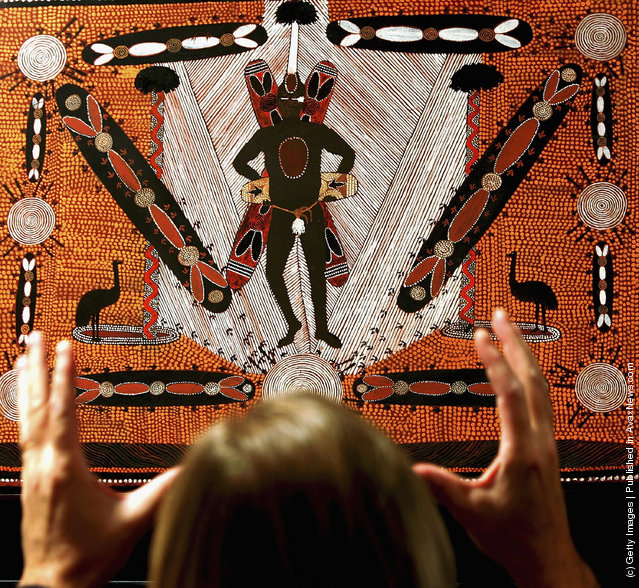
Tim Klingender, Director of Aboriginal Art at Sotheby's hangs the painting “Emu Corroboree Man” by Clifford Possum Tjapaltjarri before a record auction of Aboriginal Art July 14, 2005 in Sydney, Australia. The painting is expected to fetch AUD 150,000 – 250,000 (USD 120,000 – 200,000). Sotheby's unveiled a selection of Aboriginal art and artifacts after a tour of New York and London, which will go to auction in Melbourne July 25 2005. The total pre-sales estimate of the collection is AUD 6 million – 8.5 million (USD 5 million – 7 million). (Photo by Ian Waldie/Getty Images)
Details
01 Apr 2011 09:09:00