Loading...
Done
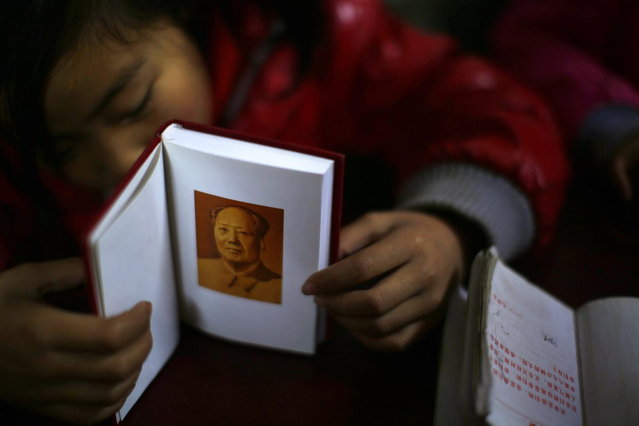
A student falls asleep as she holds a book containing a portrait of China's late chairman Mao Zedong during a lesson at the Democracy Elementary and Middle School in Sitong town, Henan province December 3, 2013. (Photo by Carlos Barria/Reuters)

A student falls asleep as she holds a book containing a portrait of China's late chairman Mao Zedong during a lesson at the Democracy Elementary and Middle School in Sitong town, Henan province December 3, 2013. In a remote part of central China, the day starts at the Democracy Elementary and Middle School with a pre-dawn jog, some revolutionary songs and then an activity long since forgotten at other schools: reciting quotations from Mao Zedong's famed “Little Red Book”. While the ruling Communist Party that Mao led continues to hold him in esteem as the leader of the Communist Revolution, his radical policies and teachings have been largely shelved since his death in 1976 in favour of a pro-market approach that has turned China from a backwater into the world's second biggest economy. The 120th anniversary of Mao's birth is on December 26, 2013. (Photo by Carlos Barria/Reuters)
Details
19 Dec 2013 09:40:00
A truffle is seen on a table in Alba, north-western Italy November 11, 2013. Located in the heart of the Langhe – the hilly southern area of Italy's northwestern Piedmont region – Alba is the country's capital of white truffles, a variety of the prized fungus which grows underground. Truffles are found two to eight inches (5-20cm) below the ground near the roots of trees. (Photo by Stefano Rellandini/Reuters)

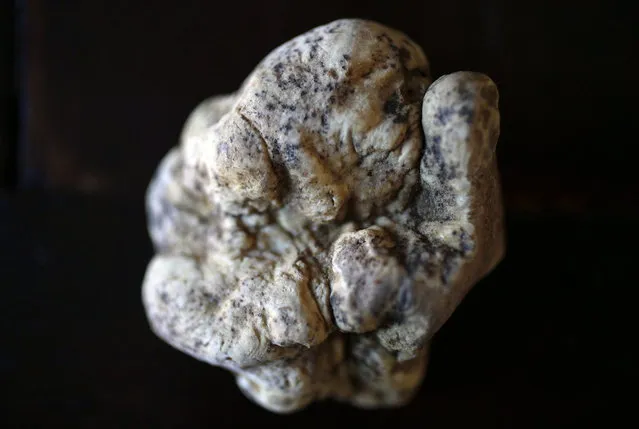
A truffle is seen on a table in Alba, north-western Italy November 11, 2013. Located in the heart of the Langhe – the hilly southern area of Italy's northwestern Piedmont region – Alba is the country's capital of white truffles, a variety of the prized fungus which grows underground. Truffles are found two to eight inches (5-20cm) below the ground near the roots of trees. They give off an odour which lasts for a limited period of time and can be detected with the assistance of well-trained dogs and experienced hunters. Output of white truffles, which are not cultivated and only grow naturally in forests, has fallen in Italy over the past few years, largely because climate change has brought a damaging mix of drought and torrential rains. (Photo by Stefano Rellandini/Reuters)
Details
31 Dec 2013 11:22:00


“The saguaro (scientific name Carnegiea gigantea) is a large, tree-sized cactus species in the monotypic genus Carnegiea. It is native to the Sonoran Desert in the U.S. state of Arizona, the Mexican state of Sonora, a small part of Baja California in the San Felipe Desert and an extremely small area of California, U.S. The saguaro blossom is the State Wildflower of Arizona”. – Wikipedia

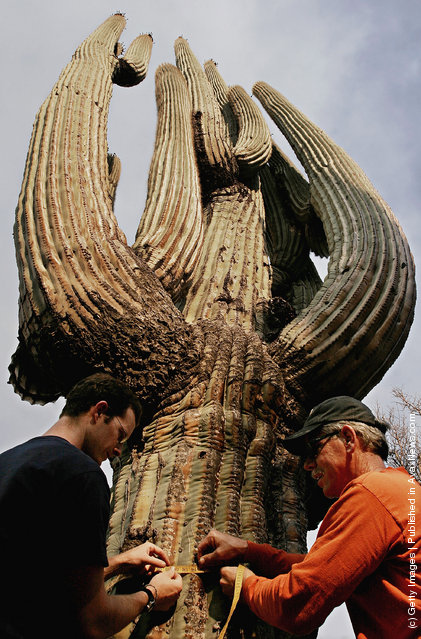
Photo: Daniel Appel (L), a firefighter with Engine 84 from the Lassen National Forest in California and Mike Hallen, (R), Arizona representative of the National Register of Big Trees, measure the circumference of this Saguaro cactus called the "Grand One," in the Tonto National Forest on July 1, 2005 35 miles north of Phoenix, near Carefree, Arizona. The cactus, estimated to be more than 200 years old, measures a circumference of 7 feet, 10 inches (2.4 meters) and stands 46 feet high (14 meters). The cactus was burned in the Cave Creek Complex fire and may not survive. It was once the largest Saguaro in the world, two others have been found recently that have tied it's measurements. The fire has burned more than 214,000 acres of the Sonoran desert. (Photo by Jeff Topping/Getty Images)
Details
26 Jul 2011 12:27:00
A pro-Russian armed man secures crash site wreckage of the Malaysia Airlines Boeing 777 plane (flight MH17) at the site of the plane crash near the settlement of Grabovo in the Donetsk region November 16, 2014. Local emergency services have begun collecting parts of the wreckage from its crash site in the middle of the conflict zone, Dutch air accident investigators said on Sunday. (Photo by Antonio Bronic/Reuters)

A pro-Russian armed man secures crash site wreckage of the Malaysia Airlines Boeing 777 plane (flight MH17) at the site of the plane crash near the settlement of Grabovo in the Donetsk region November 16, 2014. Local emergency services have begun collecting parts of the wreckage from its crash site in the middle of the conflict zone, Dutch air accident investigators said on Sunday. Dutch inspectors had hoped to collect the parts themselves, following the downing of the flight on July 17 that killed 298 people, two thirds of them Dutch citizens. But they remain concerned about the safety of their staff in the rebel-held conflict zone, and so have decided to work with local services following an initial focus on finding human remains and belongings. (Photo by Antonio Bronic/Reuters)
Details
17 Nov 2014 12:47:00
Gymnast Ahmad al-Sawas performs gymnastic moves near damaged buildings in the rebel-held Bustan al-Qasr neighbourhood of Aleppo, Syria March 26, 2016. As Syrian gymnast Ahmad al-Sawas watched his country fall apart, his Olympic dream collapsed too. The last national champion before the fighting began, he knew that supporting the anti-government side in the five-year-old civil war would prevent him from being selected for the Rio Games. “I chose to be an athlete who participates in the revolution”, said Ahmad, who trains where he can for two hours a day – be it on a mattress on a soccer field, in a local hall or somersaulting off a wall. (Photo by Abdalrhman Ismail/Reuters)

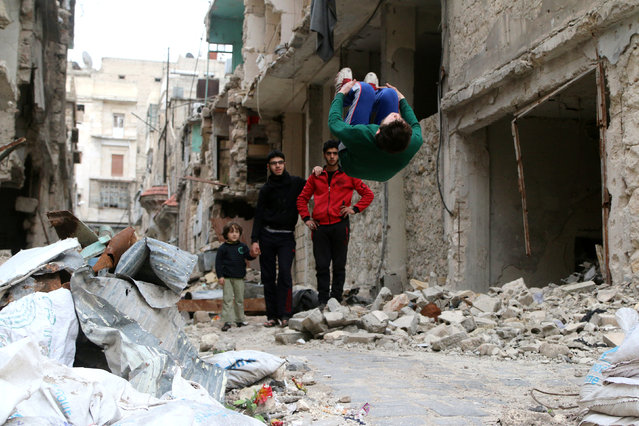
Gymnast Ahmad al-Sawas performs gymnastic moves near damaged buildings in the rebel-held Bustan al-Qasr neighbourhood of Aleppo, Syria March 26, 2016. As Syrian gymnast Ahmad al-Sawas watched his country fall apart, his Olympic dream collapsed too. The last national champion before the fighting began, he knew that supporting the anti-government side in the five-year-old civil war would prevent him from being selected for the Rio Games. (Photo by Abdalrhman Ismail/Reuters)
Details
05 Aug 2016 13:25:00
The Wadi al-Salam cemetery, Arabic for “Peace Valley”, is seen in Najaf, south of Baghdad, Iraq August 3, 2016. The world's largest cemetery, in Iraq's Shi'ite holy city of Najaf, is expanding at double its usual rate as Shi'ite militias bury their dead from the war against Islamic State. The Wadi al-Salam cemetery, Arabic for “Peace Valley” has a special place in the hearts of Shi'ite Muslims as it surrounds the Mausoleum of their first imam, Ali Bin Abi Talib, a cousin and son-in-law of Prophet Mohammad. (Photo by Alaa Al-Marjani/Reuters)

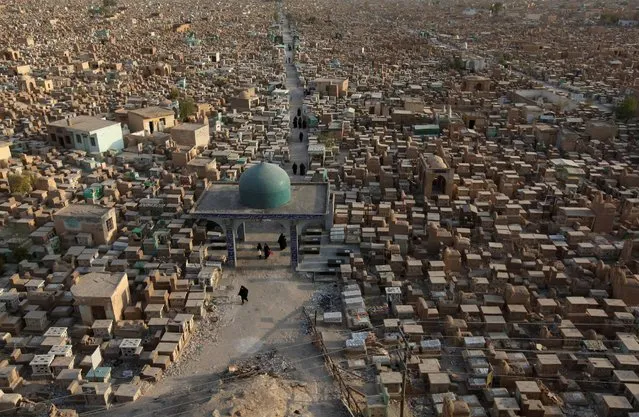
The Wadi al-Salam cemetery, Arabic for “Peace Valley”, is seen in Najaf, south of Baghdad, Iraq August 3, 2016. The world's largest cemetery, in Iraq's Shi'ite holy city of Najaf, is expanding at double its usual rate as Shi'ite militias bury their dead from the war against Islamic State. The Wadi al-Salam cemetery, Arabic for “Peace Valley” has a special place in the hearts of Shi'ite Muslims as it surrounds the Mausoleum of their first imam, Ali Bin Abi Talib, a cousin and son-in-law of Prophet Mohammad. (Photo by Alaa Al-Marjani/Reuters)
Details
24 Aug 2016 11:38:00
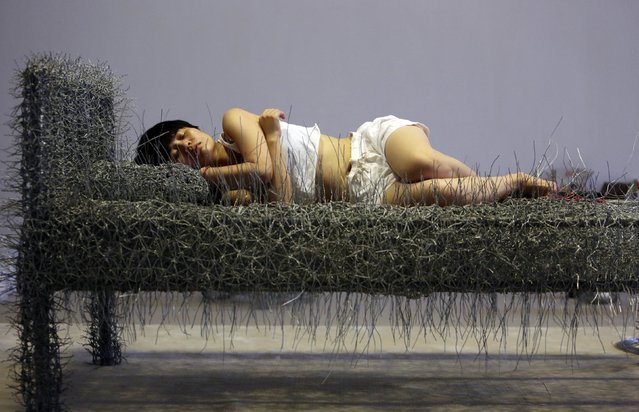
Chinese artist Zhou Jie takes a nap on an unfinished iron wire bed, one of her sculpture works, after lunch at Beijing Now Art Gallery, in Beijing August 11, 2014. Zhou started her art project titled “36 Days” on August 9, in which she would live inside an exhibition hall with an unfinished iron wire bed, some iron wire sculptures in the shape of stuffed animal dolls, a certain amount of food and her mobile phone, for 36 days. (Photo by Jason Lee/Reuters)

Chinese artist Zhou Jie takes a nap on an unfinished iron wire bed, one of her sculpture works, after lunch at Beijing Now Art Gallery, in Beijing August 11, 2014. Zhou started her art project titled “36 Days” on August 9, in which she would live inside an exhibition hall with an unfinished iron wire bed, some iron wire sculptures in the shape of stuffed animal dolls, a certain amount of food and her mobile phone, for 36 days. The entire process is open to visitors and she may also interact with them, according to Zhou. (Photo by Jason Lee/Reuters)
Details
22 Aug 2014 12:04:00
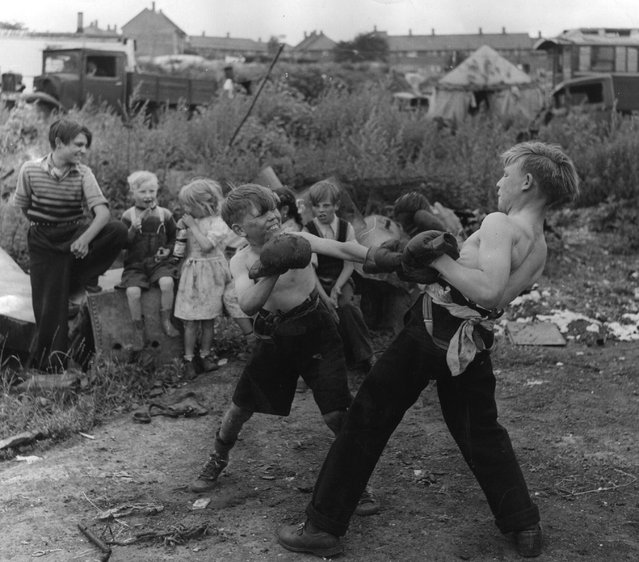
The unromantic gypsies. Children boxing in a gypsy camp in Kent, England on July 1, 1951. Like all boys these gypsy lads like to try their hand at boxing. Encouraged by their friends they fight it out on Corke's Meadow. Few Romanies now live a life of wandering romance. Most are like the three hundred squatters of Corke's Meadow, Kent, which is part of a “gypsy problem” that involves about 100,000 today. Of those about 25,000 can be rightly called gypsies, the rest are Mumpers and Posh-rats and Hobos. Corke's Meadow has both kinds. “Picture Post” cameraman Bert Hardy photographs the Corke's Meadow gypsies in their encampment. (Photo by Hulton-Deutsch Collection/Corbis via Getty Images)

The unromantic gypsies. Children boxing in a gypsy camp in Kent, England on July 1, 1951. Like all boys these gypsy lads like to try their hand at boxing. Encouraged by their friends they fight it out on Corke's Meadow. Few Romanies now live a life of wandering romance. Most are like the three hundred squatters of Corke's Meadow, Kent, which is part of a “gypsy problem” that involves about 100,000 today. Of those about 25,000 can be rightly called gypsies, the rest are Mumpers and Posh-rats and Hobos. Corke's Meadow has both kinds. “Picture Post” cameraman Bert Hardy photographs the Corke's Meadow gypsies in their encampment. (Photo by Hulton-Deutsch Collection/Corbis via Getty Images)
Details
12 Mar 2017 00:01:00