Loading...
Done
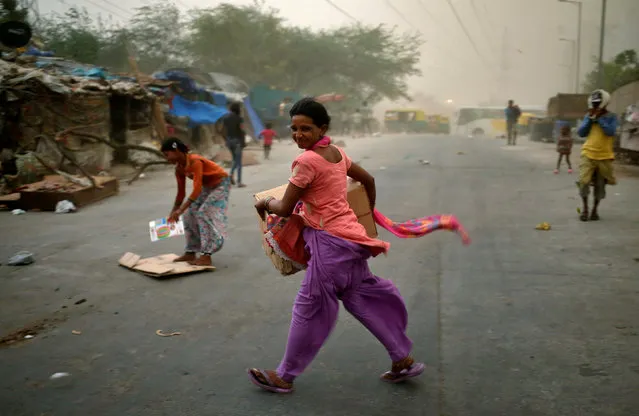
People are caught in a dust storm in New Delhi, India May 23, 2016. (Photo by Anindito Mukherjee/Reuters)

People are caught in a dust storm in New Delhi, India May 23, 2016. (Photo by Anindito Mukherjee/Reuters)
Details
25 May 2016 12:52:00
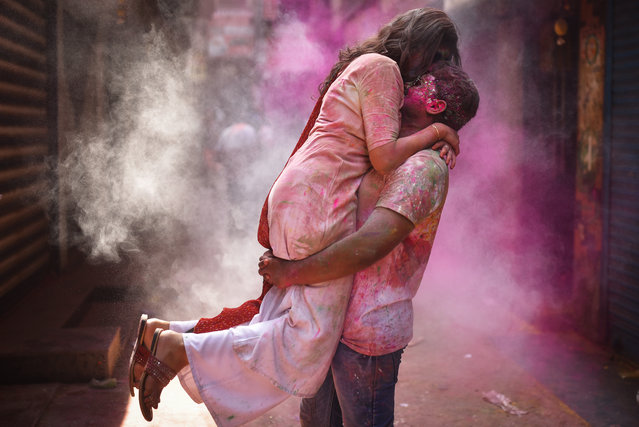
An Indian couple stained with colored powder enjoys a loving moment during the Holi festival celebrations in Chennai, India, 18 March 2022. Holi, also known as the “Festival Of Colors” is an ancient Indian Hindu festival symbolizing the victory of good over evil and marking the arrival of spring. It is held with joyful gatherings during which revelers cover each other in colored powders. (Photo by Idrees Mohammed/EPA/EFE)

An Indian couple stained with colored powder enjoys a loving moment during the Holi festival celebrations in Chennai, India, 18 March 2022. Holi, also known as the “Festival Of Colors” is an ancient Indian Hindu festival symbolizing the victory of good over evil and marking the arrival of spring. It is held with joyful gatherings during which revelers cover each other in colored powders. (Photo by Idrees Mohammed/EPA/EFE)
Details
23 Mar 2022 05:53:00
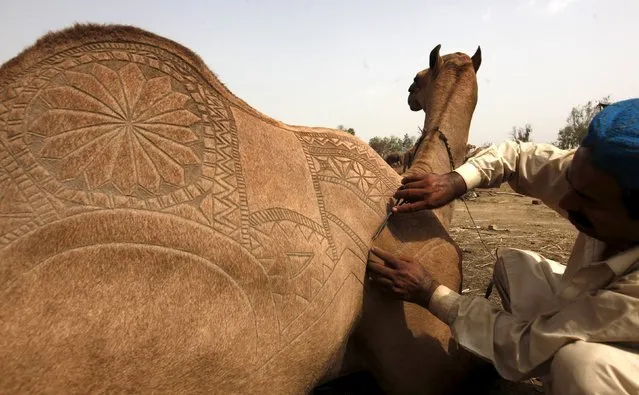
A sacrificial camel gets a haircut with patterns at the animal market on the outskirts of Karachi, Pakistan September 22, 2015. (Photo by Akhtar Soomro/Reuters)

A sacrificial camel gets a haircut with patterns at the animal market on the outskirts of Karachi, Pakistan September 22, 2015. Muslims across the world are preparing to celebrate the annual festival of Eid al-Adha or the Feast of the Sacrifice, which marks the end of the annual haj pilgrimage, by slaughtering goats, sheep, cows and camels in commemoration of the Prophet Abraham's readiness to sacrifice his son to show obedience to Allah. Eid al-Adha in India falls on September 25. (Photo by Akhtar Soomro/Reuters)
Details
24 Sep 2015 08:05:00


People help a woman overwhelmed by emotion and the heat during the mass funeral, attended by tens of thousands of mourners, of 613 coffins of newly-identified victims of the 1995 Srebrenica massacre at the Potocari cemetery and memorial near Srebrenica on July 11, 2011 in Potocari, Bosnia and Herzegovina. (Photo by Sean Gallup/Getty Images)
Details
12 Jul 2011 11:53:00
Marianne Brauns jumping a breakwater on the beach

Marianne Brauns jumping a breakwater on the beach, wearing a structured blue swimsuit with white trim. (Photo by Carl Sutton/Hulton Archive/Getty Images). Circa 1950
Details
09 Aug 2011 10:30:00
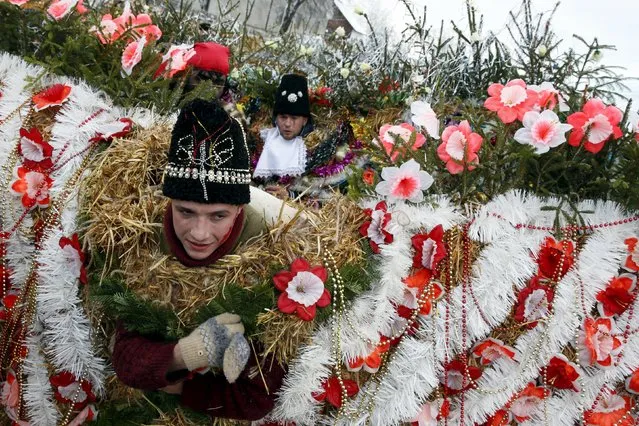
Local residents dressed in costumes perform during celebrations for the Malanka holiday in the village of Krasnoilsk in the Chernivtsi region of Ukraine, January 14, 2016. The Malanka traditional holiday is more popular in the western regions of the country and is also known as the Old New Year celebrated on January 13 and 14 - St. Basil's and St. Melania's Day, according to the old Julian calendar. During the celebrations, youngsters and adults wear traditional carnival costumes and masks, and visit local houses while singing carols, playing pranks or performing short plays. (Photo by Valentyn Ogirenko/Reuters)

Local residents dressed in costumes perform during celebrations for the Malanka holiday in the village of Krasnoilsk in the Chernivtsi region of Ukraine, January 14, 2016. The Malanka traditional holiday is more popular in the western regions of the country and is also known as the Old New Year celebrated on January 13 and 14 – St. Basil's and St. Melania's Day, according to the old Julian calendar. During the celebrations, youngsters and adults wear traditional carnival costumes and masks, and visit local houses while singing carols, playing pranks or performing short plays. (Photo by Valentyn Ogirenko/Reuters)
Details
16 Jan 2016 08:04:00
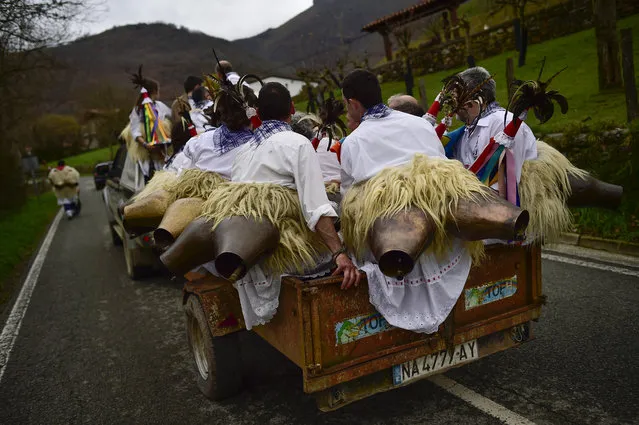
Joaldunaks return in a trailer to their town at the end of Carnival between of the Pyrenees villages of Ituren and Zubieta, northern Spain, Monday, February 1, 2016. In one of the most ancient carnivals in Europe, dating from before the Roman empire, companies of Joaldunak (cowbells) made up of residents of two towns, Ituren and Zubieta, parade the streets costumed in sandals, lace petticoats, sheepskins around the waist and shoulders, coloured neckerchiefs, conical caps with ribbons and a hyssop of horsehair in their right hands and cowbells hung across their lower back. (Photo by Alvaro Barrientos/AP Photo)

Joaldunaks return in a trailer to their town at the end of Carnival between of the Pyrenees villages of Ituren and Zubieta, northern Spain, Monday, February 1, 2016. In one of the most ancient carnivals in Europe, dating from before the Roman empire, companies of Joaldunak (cowbells) made up of residents of two towns, Ituren and Zubieta, parade the streets costumed in sandals, lace petticoats, sheepskins around the waist and shoulders, coloured neckerchiefs, conical caps with ribbons and a hyssop of horsehair in their right hands and cowbells hung across their lower back. (Photo by Alvaro Barrientos/AP Photo)
Details
02 Feb 2016 13:07:00
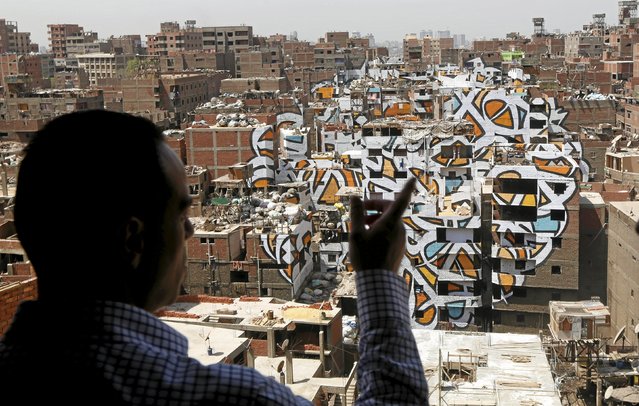
A man looks at a mural painted on the walls of houses in Zaraeeb, created by French-Tunisian artist El Seed, in the shanty area known also as Zabaleen or “Garbage City” on the Mokattam Hills in eastern Cairo, Egypt, April 4, 2016. (Photo by Amr Abdallah Dalsh/Reuters)

A man looks at a mural painted on the walls of houses in Zaraeeb, created by French-Tunisian artist El Seed, in the shanty area known also as Zabaleen or “Garbage City” on the Mokattam Hills in eastern Cairo, Egypt, April 4, 2016. (Photo by Amr Abdallah Dalsh/Reuters)
Details
15 Apr 2016 11:01:00