Loading...
Done
Cosplayers dressed as a Battle Sister and an Ultramarine from Warhammer 40,000 pose during Los Angeles Comic Con at Los Angeles Convention Center on December 03, 2023 in Los Angeles, California. (Photo by Chelsea Guglielmino/Getty Images)

Cosplayers dressed as a Battle Sister and an Ultramarine from Warhammer 40,000 pose during Los Angeles Comic Con at Los Angeles Convention Center on December 03, 2023 in Los Angeles, California. (Photo by Chelsea Guglielmino/Getty Images)
Details
14 Dec 2023 00:08:00
A toque macaque is eating flowers in the water at the pilgrimage site in Polonnaruwa, Sri Lanka, on January 13, 2024. The toque macaque (Macaca sinica), a reddish-brown-colored Old World monkey, is endemic to Sri Lanka, where it is known as the rilewa or rilawa. It is named for the whorl of hair at the crown of its head, which resembles a brimless toque cap. (Photo by Thilina Kaluthotage/NurPhoto/Rex Features/Shutterstock)

A toque macaque is eating flowers in the water at the pilgrimage site in Polonnaruwa, Sri Lanka, on January 13, 2024. The toque macaque (Macaca sinica), a reddish-brown-colored Old World monkey, is endemic to Sri Lanka, where it is known as the rilewa or rilawa. It is named for the whorl of hair at the crown of its head, which resembles a brimless toque cap. (Photo by Thilina Kaluthotage/NurPhoto/Rex Features/Shutterstock)
Details
10 Feb 2024 09:30:00
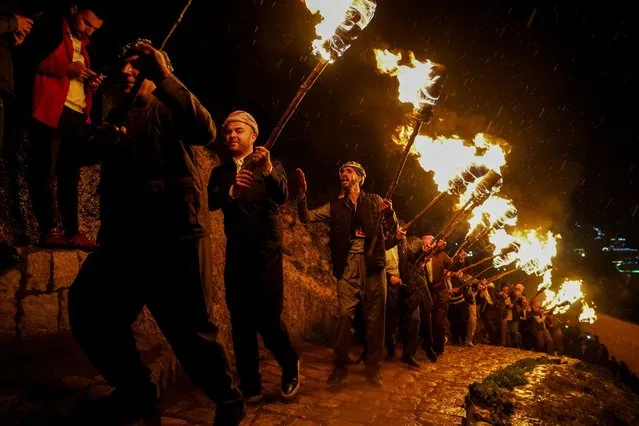
Iraqi Kurds carry fire torches as they celebrate Nowruz Day, a festival marking the first day of spring, Kurdish and Persian New Year in Akre, Iraq on March 20, 2024. Newroz or Nowruz means “new day” in Persian, and is celebrated to mark the arrival of spring and the first day of the Iranian calendar. It is widely celebrated in Persian and neighboring regions and is recognized on UNESCO's Intangible Cultural Heritage of Human List. (Photo by Ismael Adnan/SOPA Images/Rex Features/Shutterstock)

Iraqi Kurds carry fire torches as they celebrate Nowruz Day, a festival marking the first day of spring, Kurdish and Persian New Year in Akre, Iraq on March 20, 2024. Newroz or Nowruz means “new day” in Persian, and is celebrated to mark the arrival of spring and the first day of the Iranian calendar. It is widely celebrated in Persian and neighboring regions and is recognized on UNESCO's Intangible Cultural Heritage of Human List. (Photo by Ismael Adnan/SOPA Images/Rex Features/Shutterstock)
Details
29 Mar 2024 05:30:00
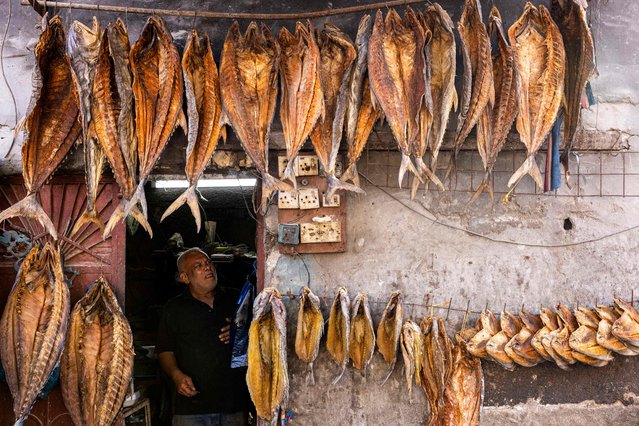
An Iraqi man sells dried fish ahead of Eid al-Fitr, which marks the end of the Muslim holy fasting month of Ramadan, in Basra on April 8, 2024. (Photo by Hussein Faleh/AFP Photo)

An Iraqi man sells dried fish ahead of Eid al-Fitr, which marks the end of the Muslim holy fasting month of Ramadan, in Basra on April 8, 2024. (Photo by Hussein Faleh/AFP Photo)
Details
18 May 2024 00:07:00
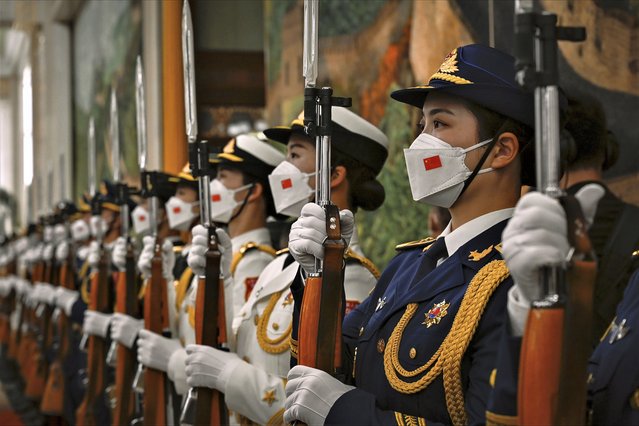
Chinese honor guards prepare for the arrival of Palestinian President Mahmoud Abbas and China's President Xi Jinping at the Great Hall of the People in Beijing Wednesday, June 14, 2023. (Photo by Jade Gao/Pool Photo via AP Photo)

Chinese honor guards prepare for the arrival of Palestinian President Mahmoud Abbas and China's President Xi Jinping at the Great Hall of the People in Beijing Wednesday, June 14, 2023. (Photo by Jade Gao/Pool Photo via AP Photo)
Details
13 Sep 2024 04:55:00
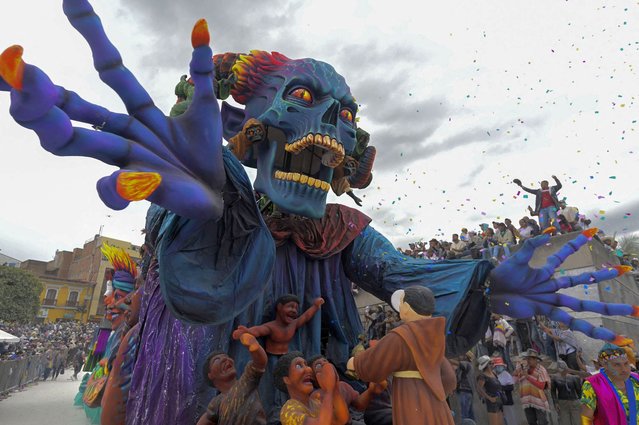
Picture of a float taking part in the “White Day” parade during the Carnival of Blacks and Whites in Pasto, Colombia on January 6, 2024. The Blacks and Whites carnival has its origins in a mix of Andean, Amazonian and Pacific cultural expressions, and it celebrates the ethnic diversity in the region and was proclaimed by UNESCO as intangible cultural heritage in 2009. (Photo by Joaquín Sarmiento/AFP Photo)

Picture of a float taking part in the “White Day” parade during the Carnival of Blacks and Whites in Pasto, Colombia on January 6, 2024. The Blacks and Whites carnival has its origins in a mix of Andean, Amazonian and Pacific cultural expressions, and it celebrates the ethnic diversity in the region and was proclaimed by UNESCO as intangible cultural heritage in 2009. (Photo by Joaquín Sarmiento/AFP Photo)
Details
17 Mar 2025 03:56:00
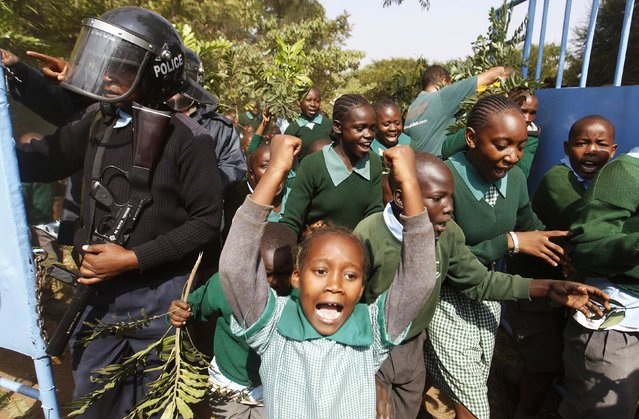
Students from Langata primary school run past riot police as they protest against a perimeter wall illegally erected by a private developer around their school playground in Kenya's capital Nairobi January 19, 2015. (Photo by Thomas Mukoya/Reuters)

Students from Langata primary school run past riot police as they protest against a perimeter wall illegally erected by a private developer around their school playground in Kenya's capital Nairobi January 19, 2015. Riot police used teargas to disperse students at a school in Nairobi as the children protested against the potential loss of their playground. The playground was fenced off in December, during the school holidays, by a prominent developer who also claims ownership of the land. The title to the contested site is said to be in the name of Airport View Housing Limited, according to local media, with plans to use the space to build a parking lot for a hotel. (Photo by Thomas Mukoya/Reuters)
Details
20 Jan 2015 13:04:00
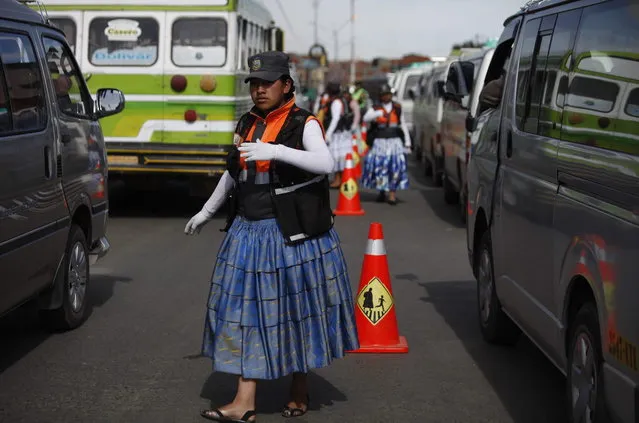
In this December 3, 2013 photo, an Aymara woman cops directs traffic on the streets of El Alto, Bolivia. The women wear the bright petticoats and shawls of indigenous women in the Andes, called cholitas in Bolivian slang, the main difference being that instead of bowler hats they wear khaki green police-style caps. Some don fluorescent traffic vests. (Photo by Juan Karita/AP Photo)

“This city in Bolivia's highlands has hired Aymara women dressed in traditional multilayered Andean skirts and brightly embroidered vests to work as traffic cops and bring order to its road chaos. About 20 of the “traffic cholitas” have been trained to direct cars and buses in El Alto, a teeming, impoverished sister city of La Paz in Bolivia's Andes mountains”. – El Alto via Associated Press. Photo: In this December 3, 2013 photo, an Aymara woman cops directs traffic on the streets of El Alto, Bolivia. The women wear the bright petticoats and shawls of indigenous women in the Andes, called cholitas in Bolivian slang, the main difference being that instead of bowler hats they wear khaki green police-style caps. Some don fluorescent traffic vests. (Photo by Juan Karita/AP Photo)
Details
25 Dec 2013 10:48:00