Loading...
Done
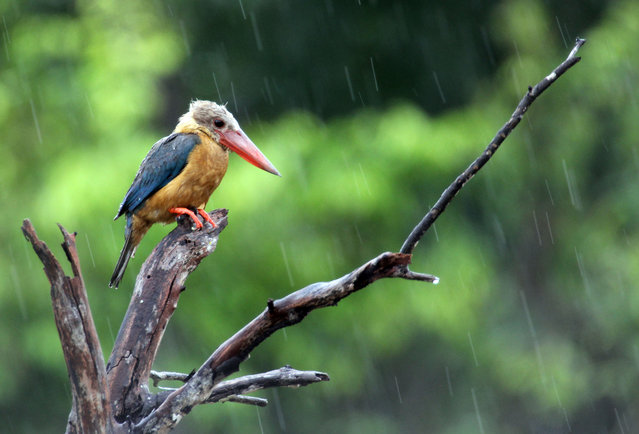
Stork-billed kingfisher during rain in Bintan, Indonesia. The tree species is sparsely distributed in the tropical Indian subcontinent and south-east Asia, from India to Indonesia. (Photo by Sijori Images/Barcroft Images)

A stork-billed kingfisher (Pelargopsis capensis) is seen perched on a tree during monsoon rain on July 25, 2016 in Bintan, Indonesia. The stork-billed kingfisher is a tree species which is widely but sparsely distributed in the tropical Indian subcontinent and Southeast Asia, from India to Indonesia. This kingfisher is resident throughout its range. It is very large, measuring 35 to 38 cm (14 to 15 in) in length. The adult has a green back, blue wings and tail, and grey head. (Photo by Sijori Images/Barcroft Images)
Details
27 May 2017 07:47:00
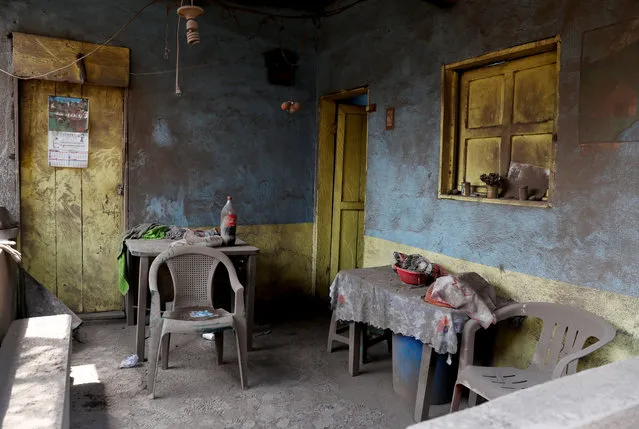
A terrace of a house is covered with ash after the eruption of the Fuego volcano at San Miguel Los Lotes in Escuintla, Guatemala, June 6, 2018. (Photo by Carlos Jasso/Reuters)

A terrace of a house is covered with ash after the eruption of the Fuego volcano at San Miguel Los Lotes in Escuintla, Guatemala, June 6, 2018. (Photo by Carlos Jasso/Reuters)
Details
15 Jun 2018 00:03:00
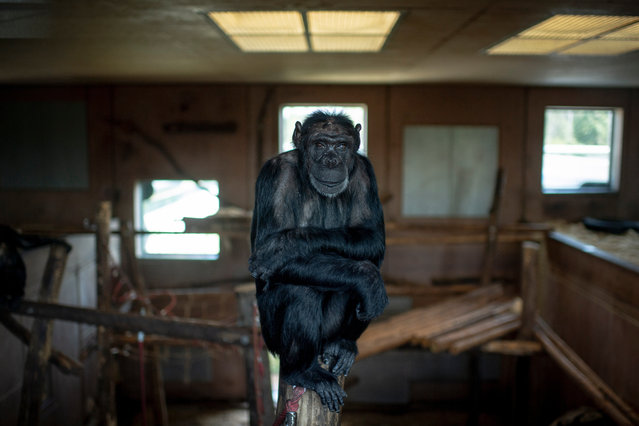
A chimpanzee looks in the direction of a camera at the Gut Aiderbichl Sanctuary for Traumatized Chimpanzees and other Primates in Gaenserndorf, near Vienna, 17 September 2018. 34 former laboratory chimpanzees of former Austrian pharmaceutical company Immuno AG spend their lives at the Gut Aiderbichl Sanctuary for Traumatized Chimpanzees and other Primates since 2009. U.S.-based Baxter International Inc. took over the Immuno AG in 1996, banned experiments with primates and rebuilt a former safari park for the Gut Aiderbichl Sanctuary for Traumatized Chimpanzees and other Primates. After three decades in captivity in too small cages, the chimpanzees, most of them came from Sierra Leone as cubs, have species-appropriate indoor and outdoor enclosures. The financial support by Baxter International Inc. and Austrian officials will end by 2019. (Photo by Christian Bruna/EPA/EFE)

A chimpanzee looks in the direction of a camera at the Gut Aiderbichl Sanctuary for Traumatized Chimpanzees and other Primates in Gaenserndorf, near Vienna, 17 September 2018. 34 former laboratory chimpanzees of former Austrian pharmaceutical company Immuno AG spend their lives at the Gut Aiderbichl Sanctuary for Traumatized Chimpanzees and other Primates since 2009. (Photo by Christian Bruna/EPA/EFE)
Details
23 Sep 2018 00:03:00
A peformance artist attends an election rally for Cameroon presidential candidate for the opposition Univers party, Cabral Libii in Yaounde, Cameroon 06 October 2018. Africa's oldest president Paul Biya who has been in power since 1982 is up against eight candidates when voters go to the polls 07 October 2018. 6.9 million registered voters will head to the polls but marginalised anglophone separatists in the North West and South West of the country threaten to disrupt the elections. (Photo by Nic Bothma/EPA/EFE)

A peformance artist attends an election rally for Cameroon presidential candidate for the opposition Univers party, Cabral Libii in Yaounde, Cameroon 06 October 2018. Africa's oldest president Paul Biya who has been in power since 1982 is up against eight candidates when voters go to the polls 07 October 2018. 6.9 million registered voters will head to the polls but marginalised anglophone separatists in the North West and South West of the country threaten to disrupt the elections. (Photo by Nic Bothma/EPA/EFE)
Details
12 Nov 2018 00:03:00
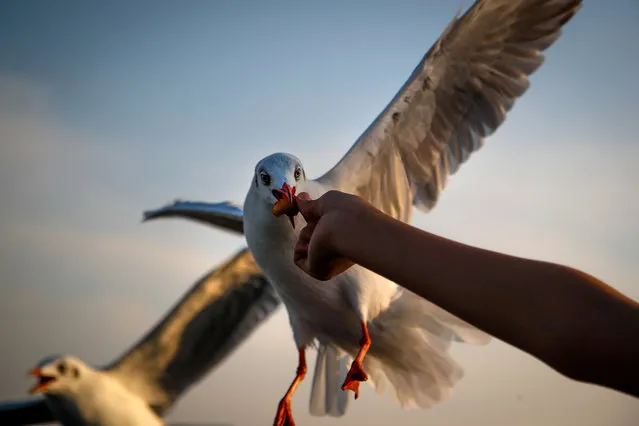
A seagull eats a piece of dried fish of a man's hand during sunset at Bang Pu seaside resort in Samut Prakan province on the outskirts of Bangkok, Thailand, 13 January 2019. Every year during the cold winter months between October to March thousands of seagulls migrate to Bang Pu seaside from Siberia to escape the harsh winter. (Photo by Diego Azubel/EPA/EFE)

A seagull eats a piece of dried fish of a man's hand during sunset at Bang Pu seaside resort in Samut Prakan province on the outskirts of Bangkok, Thailand, 13 January 2019. Every year during the cold winter months between October to March thousands of seagulls migrate to Bang Pu seaside from Siberia to escape the harsh winter. (Photo by Diego Azubel/EPA/EFE)
Details
27 Jan 2019 00:03:00
Trees in a park are illuminated with a red light as a part of an art project in Timmendorfer Strand, northern Germany Wednesday, October 26, 2016. (Photo by Michael Probst/AP Photo)

Trees in a park are illuminated with a red light as a part of an art project in Timmendorfer Strand, northern Germany Wednesday, October 26, 2016. (Photo by Michael Probst/AP Photo)
Details
29 Oct 2016 12:00:00
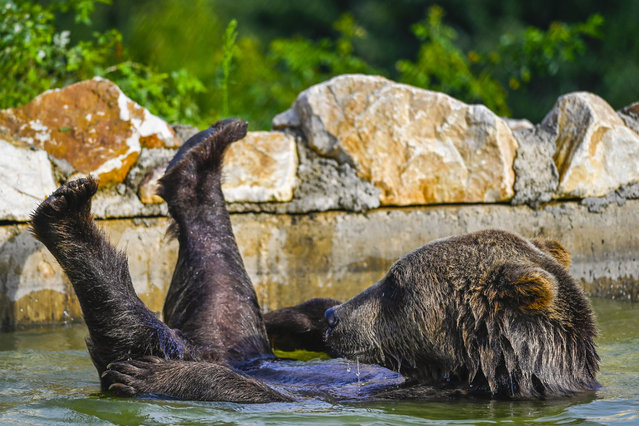
A brown bears cools off in a pool at the bear sanctuary near the village of Mramor, on August 18, 2020. The bear sanctuary was closed for visitors on August 18, as part of safety measures to curb the spread of the COVID-19 (novel coronavirus) disease. (Photo by Armend Nimani/AFP Photo)

A brown bears cools off in a pool at the bear sanctuary near the village of Mramor, on August 18, 2020. The bear sanctuary was closed for visitors on August 18, as part of safety measures to curb the spread of the COVID-19 (novel coronavirus) disease. (Photo by Armend Nimani/AFP Photo)
Details
23 Aug 2020 00:03:00
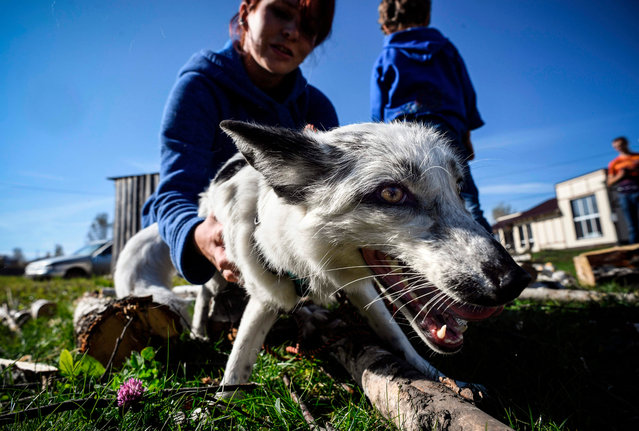
Tatyana Abramova, 33, plays with her home fox Plombir at her countryside house outside Siberian city of Novosibirsk on September 12, 2020. The official start of the Soviet experiment to better understand the domestication of animals by humans began in 1959, and was initiated by geneticists Dmitri Beliaiev and Lioudmila Trout on a farm in Akademgorodok, the scientific center of excellence in Siberia. Their primary objective was to domesticate foxes, to understand how the ancestor of wolves, another canine, evolved into a loyal and loving dog. And understand what this domestication tells us about the genetic evolution of species. (Photo by Alexander Nemenov/AFP Photo)

Tatyana Abramova, 33, plays with her home fox Plombir at her countryside house outside Siberian city of Novosibirsk on September 12, 2020. The official start of the Soviet experiment to better understand the domestication of animals by humans began in 1959, and was initiated by geneticists Dmitri Beliaiev and Lioudmila Trout on a farm in Akademgorodok, the scientific center of excellence in Siberia. Their primary objective was to domesticate foxes, to understand how the ancestor of wolves, another canine, evolved into a loyal and loving dog. And understand what this domestication tells us about the genetic evolution of species. (Photo by Alexander Nemenov/AFP Photo)
Details
25 Oct 2020 00:05:00