A woman holds a sign that reads in Spanish “Sеx education to decide, contraceptives to avoid abortion”, as she jumps with another woman as part of the Global Day of Action for access to legal, safe and free abortion, outside the parliament in Caracas, Venezuela, Tuesday, September 28, 2021. (Photo by Ariana Cubillos/AP Photo)
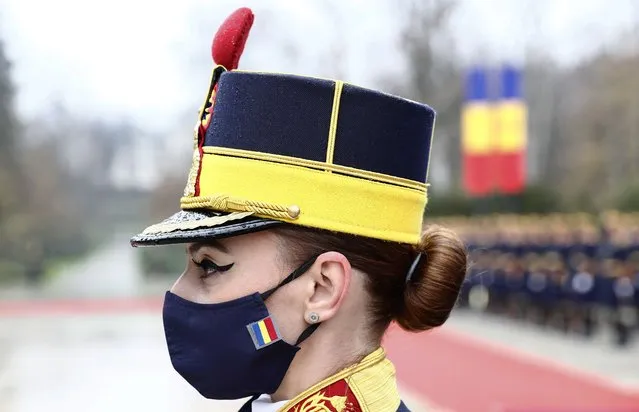
A Romanian honor guard soldier waits before the arrival of Moldovan President at Cotroceni Presidential Palace, in Bucharest, Romania, 23 November 2021. Maia Sandu is on a one-day official visit to Romania. (Photo by Robert Ghement/EPA/EFE)
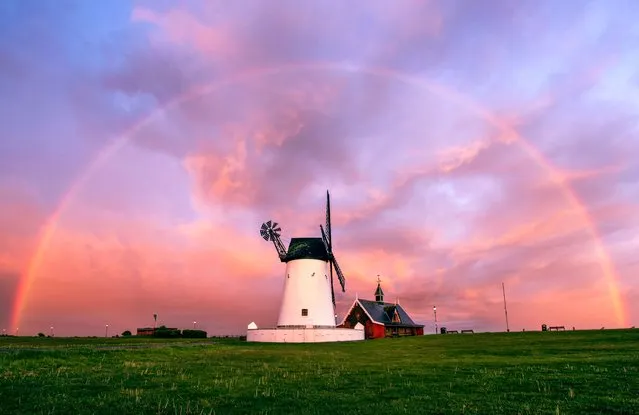
A rainbow over the windmill in Lytham, Lancashire on May 17, 2022 at sunset after rain hit the region last night after the hottest day of the year. (Photo by Gregg Wolstenholme/Bav Media)
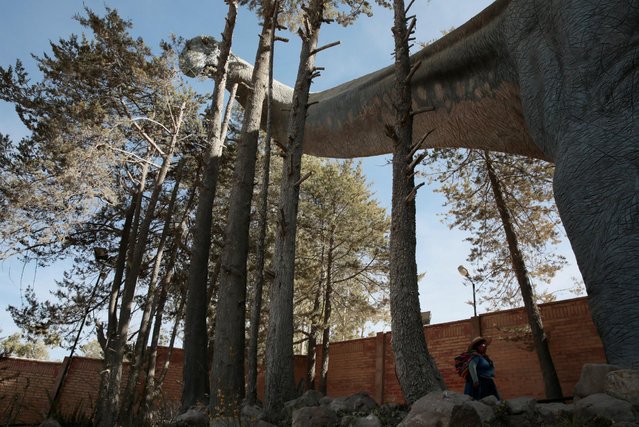
A visitor walks underneath a replica of a Titanosaur at the Cretaceous park in Cal Orcko, on the outskirts of Sucre, Bolivia, July 22, 2016. A footprint measuring over a meter wide that was made by a meat-eating predator some 80 million years ago has been discovered in Bolivia, one of the largest of its kind ever found. (Photo by David Mercado/Reuters)
In this June 20, 2015 photo, Niberta Galvez uses the bottom half of his shirt to collect coca leaves in Samugari, Peru. Coca farmers were among the locals who, in 1984, formed citizen militias to help the military beat back Shining Path rebels, reducing them to a small group of fewer than 500 who now are deeply involved in drug trafficking. (Photo by Rodrigo Abd/AP Photo)
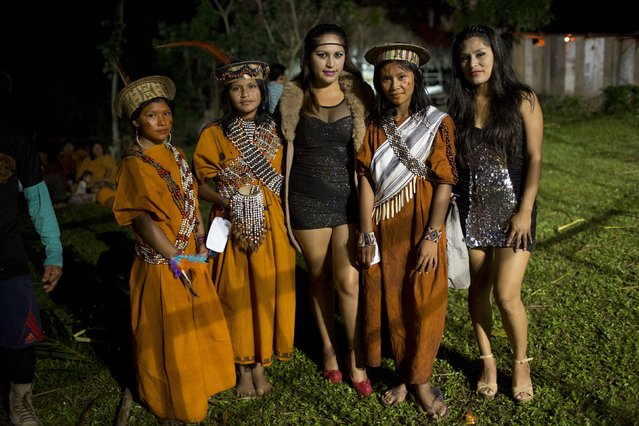
In this June 23, 2015 photo, Ashaninka Indian beauty contestants pose for a photo with members of a visiting music group, hired to perform during the annual founding anniversary festivities, in Otari Nativo, Pichari, Peru. The contestants wear the simple brown dresses of the Ashaninka woman, their faces dotted in a traditional design with a red dye extracted from a spice called achiote. (Photo by Rodrigo Abd/AP Photo)
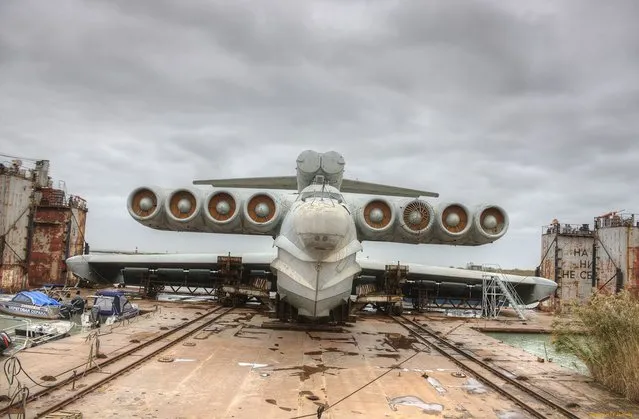
“The Lun-class ekranoplan (NATO reporting name Duck) was a ground effect vehicle (GEV) designed by Rostislav Evgenievich Alexeev and used by the Soviet and Russian navies from 1987 until sometime in the late 1990s. It “flew” using the lift generated by the ground effect of its large wings when close to the surface of the water – about four metres or less. Although they might look similar and/or have related technical characteristics, ekranoplans like the Lun are not aircraft, seaplanes, hovercraft, or hydrofoils – ground effect is a separate technology altogether. The International Maritime Organization classifies these vehicles as maritime ships. The name Lun comes from the Russian for harrier”. – Wikipedia (Photo by Igor113)