Loading...
Done
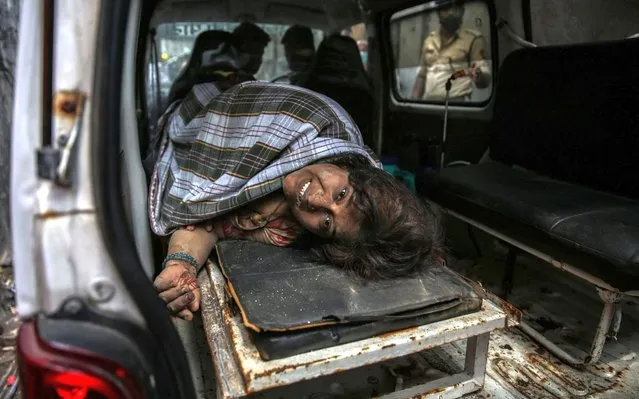
A survivor of a residential building's collapse lays in an ambulance in Bhiwandi, outskirts of Mumbai, India, 21 September 2020. According to reports, at least 10 people died and several are feared to be trapped under the rubble of the three-storey residential building. (Photo by Divyakant Solanki/EPA/EFE/Rex Features/Shutterstock)

A survivor of a residential building's collapse lays in an ambulance in Bhiwandi, outskirts of Mumbai, India, 21 September 2020. According to reports, at least 10 people died and several are feared to be trapped under the rubble of the three-storey residential building. (Photo by Divyakant Solanki/EPA/EFE/Rex Features/Shutterstock)
Details
29 Sep 2020 00:05:00
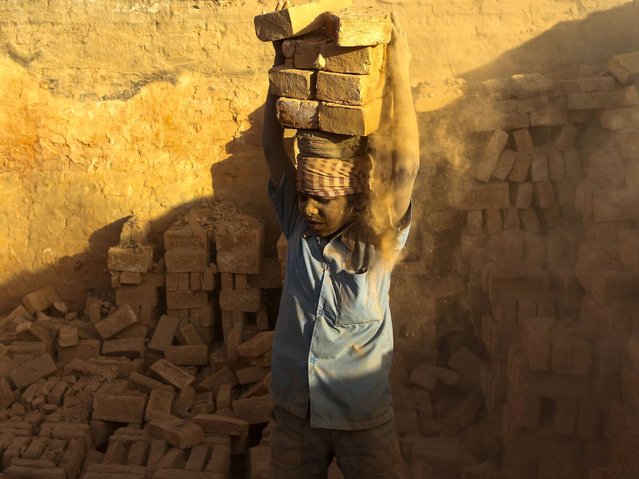
A young boy lifts heavy bricks as he works at brick factory around Kathmandu valley. (Photo by Narendra Shrestha/EPA)

A young boy lifts heavy bricks as he works at brick factory around Kathmandu valley. (Photo by Narendra Shrestha/EPA)
Details
12 Feb 2014 08:28:00
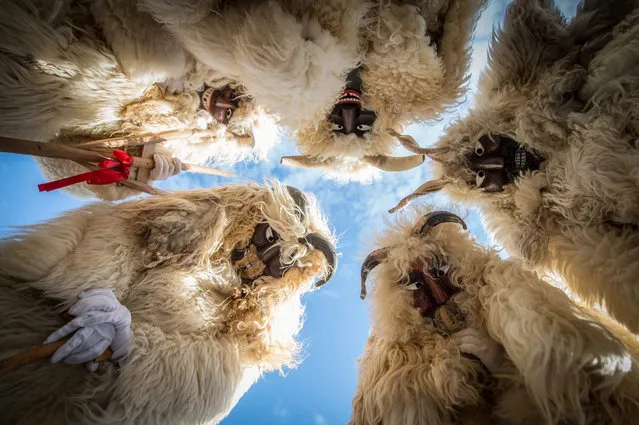
Participants wearing costumes and masks take part in the first day of the traditional carnival parade in Mohacs, Hungary, 23 February 2017. The carnival parade of so-called busos, dressed in costumes with frightening wooden masks and using various noisy wooden rattlers, is traditionally held on the seventh weekend before Easter to drive away winter. (Photo by Sandor Ujvari/EPA)

Participants wearing costumes and masks take part in the first day of the traditional carnival parade in Mohacs, Hungary, 23 February 2017. The carnival parade of so-called busos, dressed in costumes with frightening wooden masks and using various noisy wooden rattlers, is traditionally held on the seventh weekend before Easter to drive away winter. (Photo by Sandor Ujvari/EPA)
Details
25 Feb 2017 10:35:00
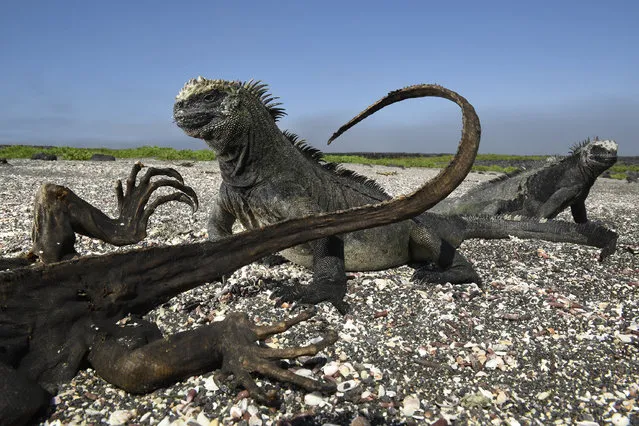
Galapagos – Rocking the Cradle: Four major ocean currents converge along the Galapagos archipelago, creating the conditions for an extraordinary diversity of animal life, April 25, 2016. The islands are home to at least 7,000 flora and fauna species, of which 97 percent of the reptiles, 80 percent of the land birds, 50 percent of the insects and 30 percent of the plants are endemic. The local ecosystem is highly sensitive to the changes in temperature, rainfall and ocean currents that characterize the climatic events known as El Niño and La Niña. These changes cause marked fluctuations in weather and food availability. Many scientists expect the frequency of El Niño and La Niña to increase as a result of climate change, making the Galapagos a possible early-warning location for its effects. (Photo by Thomas P. Peschak for National Geographic/World Press Photo)

Galapagos – Rocking the Cradle: Four major ocean currents converge along the Galapagos archipelago, creating the conditions for an extraordinary diversity of animal life, April 25, 2016. The islands are home to at least 7,000 flora and fauna species, of which 97 percent of the reptiles, 80 percent of the land birds, 50 percent of the insects and 30 percent of the plants are endemic. (Photo by Thomas P. Peschak for National Geographic/World Press Photo)
Details
16 Apr 2018 00:01:00
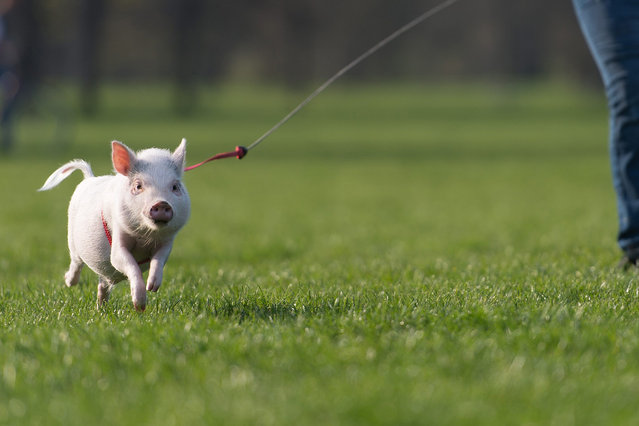
Miniature pig “Nueffel” is walked in a park in Hanover, Germany, 14 April 2016. (Photo by Sebastian Gollnow/EPA)

Miniature pig “Nueffel” is walked in a park in Hanover, Germany, 14 April 2016. (Photo by Sebastian Gollnow/EPA)
Details
17 Apr 2016 10:02:00
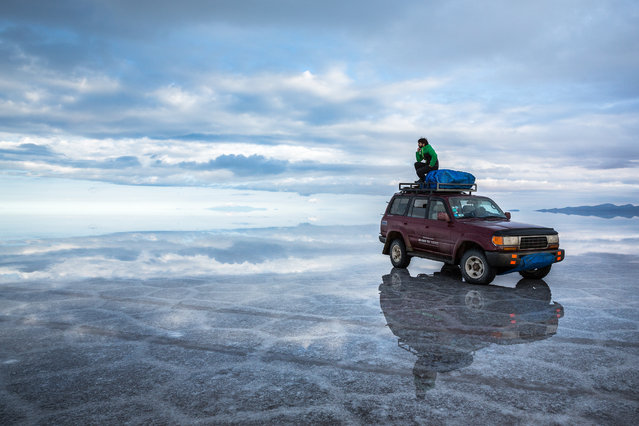
At 10,582 square kilometres, the Bolivian salt flats – otherwise known as Salar de Uyuni – are the largest on the planet and contain between 50 and 70% of the world’s lithium reserves. After exploring Chile and Argentina, photographer Joel Santos decided to travel to Bolivia in January 2017 to check the salt flats off his bucket list. With an electrical storm rolling in, Joel and his two travelling companions were the only souls left on the vast flats and captured the eerie flats without a person in sight. (Photo by Joel Santos/Barcroft Images)

At 10,582 square kilometres, the Bolivian salt flats – otherwise known as Salar de Uyuni – are the largest on the planet and contain between 50 and 70% of the world’s lithium reserves. After exploring Chile and Argentina, photographer Joel Santos decided to travel to Bolivia in January 2017 to check the salt flats off his bucket list. With an electrical storm rolling in, Joel and his two travelling companions were the only souls left on the vast flats and captured the eerie flats without a person in sight. (Photo by Joel Santos/Barcroft Images)
Details
12 Aug 2019 00:03:00
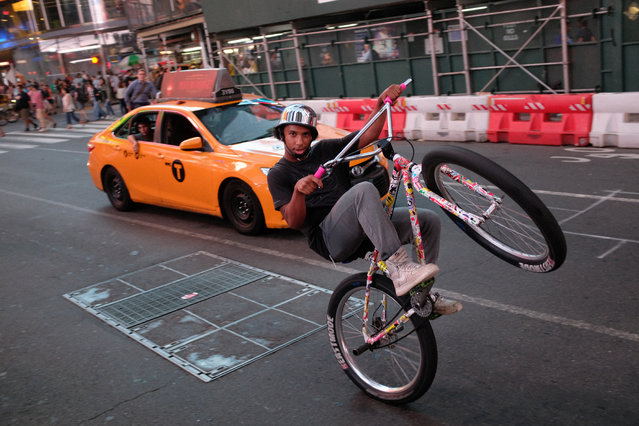
A youth rides his bicycle at Times Square, in New York City, U.S., August 14, 2019. (Photo by Lucas Landau/Reuters)

A youth rides his bicycle at Times Square, in New York City, U.S., August 14, 2019. (Photo by Lucas Landau/Reuters)
Details
19 Aug 2019 00:03:00
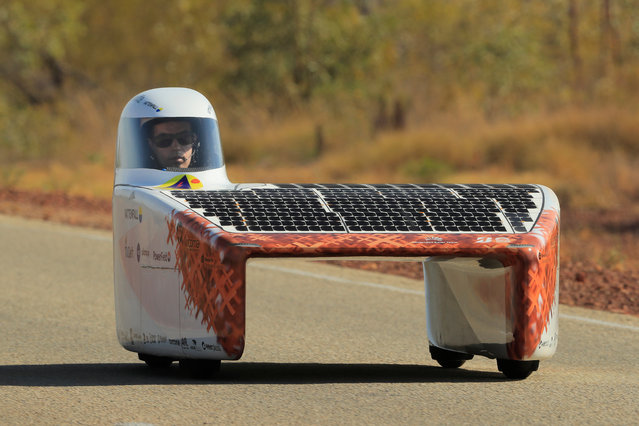
The Vattenfall Solar Team car “Nuna” from the Netherlands competes in the Challenger class on Day 2 of the 2019 Bridgestone World Solar Challenge at Elliott on October 14, 2019 in Elliott Australia. Teams from across the globe are competing in the 2019 World Solar Challenge – a 3000 km solar-powered vehicle race between Darwin and Adelaide. The race starts on the 13th of October in Darwin in the Northern Territory and travels the Stuart Highway to Port Augusta and then via Highway 1 to finish in the City of Adelaide in South Australia. (Photo by Mark Evans/Getty Images for SATC)

The Vattenfall Solar Team car “Nuna” from the Netherlands competes in the Challenger class on Day 2 of the 2019 Bridgestone World Solar Challenge at Elliott on October 14, 2019 in Elliott Australia. Teams from across the globe are competing in the 2019 World Solar Challenge – a 3000 km solar-powered vehicle race between Darwin and Adelaide. The race starts on the 13th of October in Darwin in the Northern Territory and travels the Stuart Highway to Port Augusta and then via Highway 1 to finish in the City of Adelaide in South Australia. (Photo by Mark Evans/Getty Images for SATC)
Details
17 Oct 2019 00:07:00