Loading...
Done
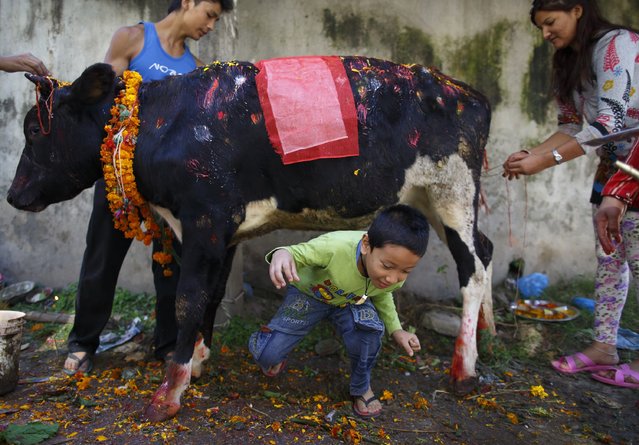
A boy crawls under a cow during a religious ceremony celebrating the Tihar festival, also called Diwali, in Kathmandu, October 23, 2014. Hindus all over Nepal are celebrating the festival during which they worship cows, which are considered a maternal figure, and other animals. Also known as the festival of lights, devotees worship the goddess of wealth Laxmi by illuminating and decorating their homes using garlands, oil lamps, candles and colourful light bulbs. (Photo by Navesh Chitrakar/Reuters)

A boy crawls under a cow during a religious ceremony celebrating the Tihar festival, also called Diwali, in Kathmandu, October 23, 2014. Hindus all over Nepal are celebrating the festival during which they worship cows, which are considered a maternal figure, and other animals. Also known as the festival of lights, devotees worship the goddess of wealth Laxmi by illuminating and decorating their homes using garlands, oil lamps, candles and colourful light bulbs. (Photo by Navesh Chitrakar/Reuters)
Details
25 Oct 2014 13:23:00
Cyclists compete during the UCI BMX World Championships Elite Women's Moto Race on May 29, 2016 in Medellin, Antioquia department, Colombia. (Photo by Raul Arboleda/AFP Photo)

Cyclists compete during the UCI BMX World Championships Elite Women's Moto Race on May 29, 2016 in Medellin, Antioquia department, Colombia. (Photo by Raul Arboleda/AFP Photo)
Details
31 May 2016 11:59:00


“Kumbh Mela is a mass Hindu pilgrimage in which Hindus gather at the Ganges river. The normal Kumbh Mela is celebrated every 3 years, the Ardh (half) Kumbh Mela is celebrated every six years at Haridwar and Prayag, the Purna (complete) Kumbh takes place every twelve years, at four places (Prayag (Allahabad), Haridwar, Ujjain, and Nashik). The Maha (great) Kumbh Mela which comes after 12 “Purna Kumbh Melas”, or 144 years, is held at Allahabad.

The last Ardh Kumbh Mela was held over a period of 45 days beginning in January 2007, more than 70 million Hindu pilgrims took part in the Ardh Kumbh Mela at Prayag, and on January 15, the most auspicious day of the festival of Makar Sankranti, more than 5 million participated. The previous Maha Kumbh Mela, held in 2001, was attended by around 60 million people, making it at the time the largest gathering anywhere in the world in recorded history”. – Wikipedia

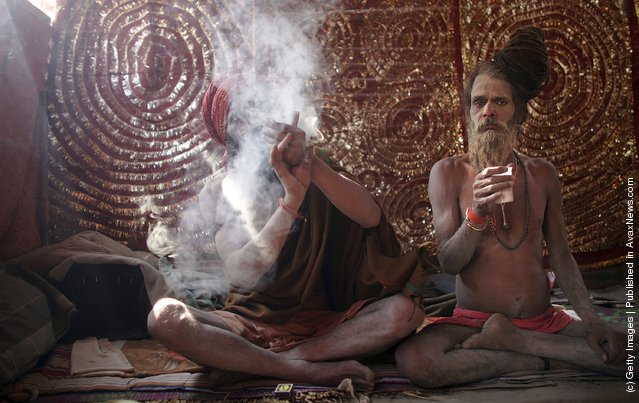
Photo: Sadhus (holy men) smoke at their camp near the ritual site at Sangam, the confluence of the Ganges, Yamuna and mythical Saraswati rivers during the Ardh Kumbh Mela festival (Half Pitcher festival) January 18, 2007 in Allahabad, India. Millions of Hindu pilgrims have flocked to the largest religious gathering in the world which lasts for 45 days in northern India. The festival commemorates the mythical conflict between gods and demons over a pitcher filled with the “nectar of immortality”. Devotees believe that taking a holy dip in the Ganges at this time washes away their sins and paves the path to salvation. (Photo by Mario Tama/Getty Images)

Details
30 Jun 2011 10:27:00
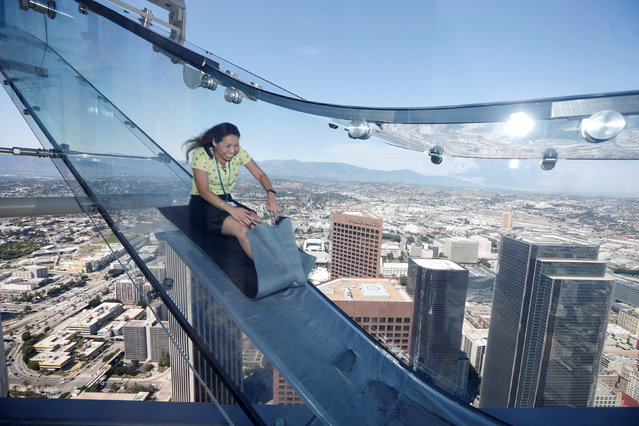
Sandra Brown, 40, rides the Skyslide on the 69th and 70th floors of the U.S. Bank Tower which is attached to the OUE Skyspace LA observation deck in downtown Los Angeles, California, U.S. June 20, 2016. (Photo by Lucy Nicholson/Reuters)

Sandra Brown, 40, rides the Skyslide on the 69th and 70th floors of the U.S. Bank Tower which is attached to the OUE Skyspace LA observation deck in downtown Los Angeles, California, U.S. June 20, 2016. (Photo by Lucy Nicholson/Reuters)
Details
22 Jun 2016 13:27:00
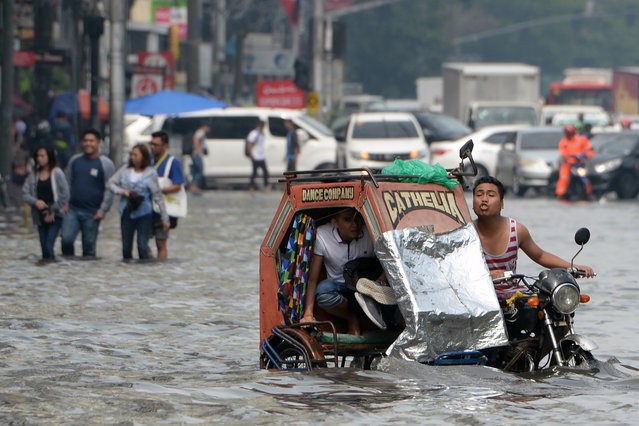
A commuter holding his shoes rides on a tricyle through a flooded street, caused by a heavy downpour brought about by the southwest moonson, in Manila on August 2, 2019. (Photo by Ted Aljibe/AFP Photo)

A commuter holding his shoes rides on a tricyle through a flooded street, caused by a heavy downpour brought about by the southwest moonson, in Manila, Philippines on August 2, 2019. (Photo by Ted Aljibe/AFP Photo)
Details
27 Aug 2019 00:03:00
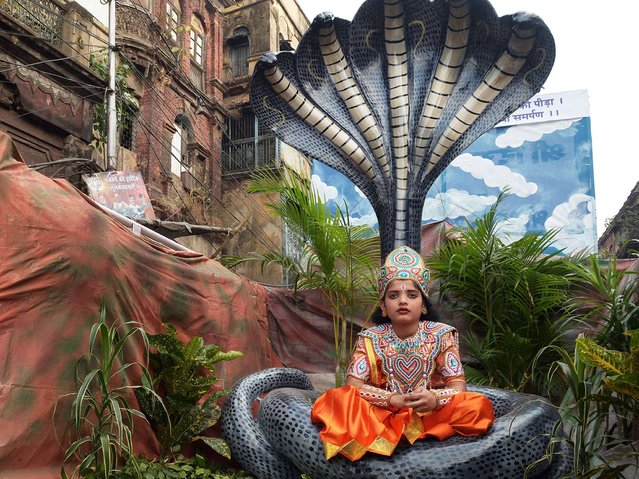
An young Indian Jain devotee dressed as Lord Krishna participates in a religious rally organised on the occasion of Mahavir Jayanti in Kolkata on April 2, 2015. The most important religious holiday in Jainism, Mahavir Jayanti celebrates the birth of Mahavira, the last Tirthankara, which is generally accepted as 599 BCE. (Photo by Dibyangshu Sarkar/AFP Photo)

An young Indian Jain devotee dressed as Lord Krishna participates in a religious rally organised on the occasion of Mahavir Jayanti in Kolkata on April 2, 2015. The most important religious holiday in Jainism, Mahavir Jayanti celebrates the birth of Mahavira, the last Tirthankara, which is generally accepted as 599 BCE. (Photo by Dibyangshu Sarkar/AFP Photo)
Details
04 Apr 2015 11:03:00
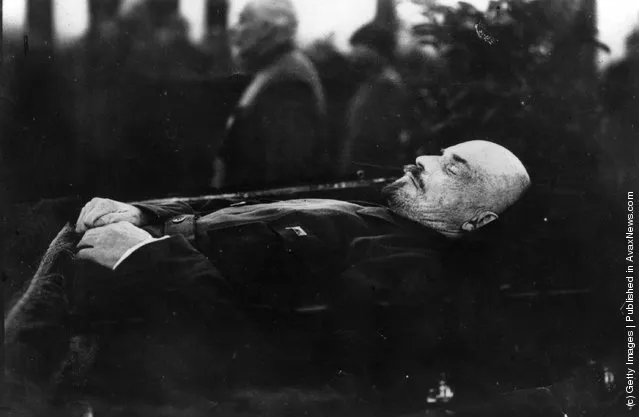
1924:  Vladimir Ilyich Lenin lying in state in the Kremlin

Photo: Vladimir Ilyich Lenin (1870 – 1924) lying in state in the Kremlin. (Photo by Hulton Archive/Getty Images). 1924

Important! For the same article in Russian language click here.

Something quite intriguing is happening within Russian-speaking internet during the last few – should you type a fully academic inquiry (at least, according to Russian academic requirements) in national search engines for "Lenin's mausoleum" – the first thing you get (even in top 10 searches) is website pages talking about black magic and occult. Website authors view this construction differently, but unconditionally agree on one thing: the mausoleum of the "leader of the world proletariat” – the essence of a magical artifact, a sort of “energy vampire”. It was built with a certain purpose: to drain the energy out of miserable Soviet citizens on one hand; and to poison the anthroposphere of one-sixth part of the earth with its vibes (the exact territory that was occupied by the former Soviet Union), depriving the Russian people of will to resist on the other hand. Complete nonsense? No doubt. Nevertheless, an intriguing one. Well, probably because some oddities do exist in mausoleum's history. These oddities are the thing we are going to discuss this time. First, let me refresh you memory on the subject.
Details
16 Oct 2011 11:27:00
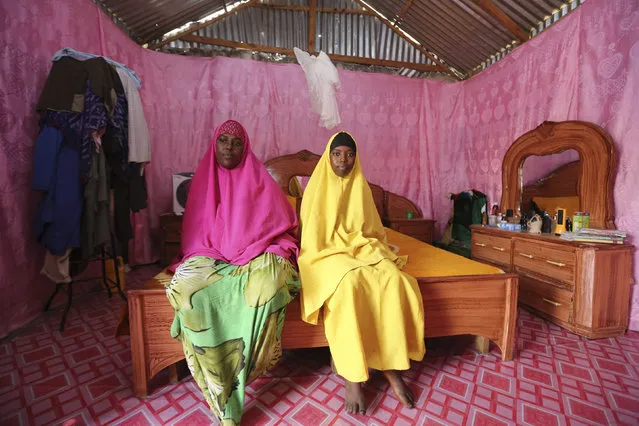
Saciido Sheik Yacquub, 34, poses for a picture with her daughter Faadumo Subeer Mohamed, 13, at their home in Hodan district IDP camp in Mogadishu February 11, 2014. Saciido, who runs a small business, wanted to be a business woman when she was a child. She studied until she was 20. She hopes that Faadumo will become a doctor. Faadumo will finish school in 2017 and hopes to be a doctor when she grows up. (Photo by Feisal Omar/Reuters)

“On March 8th activists celebrate International Women’s Day, which dates back to the early 20th century and has been observed by the United Nations since 1975. In the run-up to the event, Reuters photographers in countries around the globe took a series of portraits of women and their daughters. They asked each mother what her profession was, at what age she had finished education, and what she wanted her daughter to become when she grew up. They also asked each daughter at what age she would finish education and what she wanted to do in the future. The series of images offers an insight into the lives of women and girls around the world”. – Reuters. (Photo by Feisal Omar/Reuters)
Details
09 Mar 2014 04:33:00