Loading...
Done
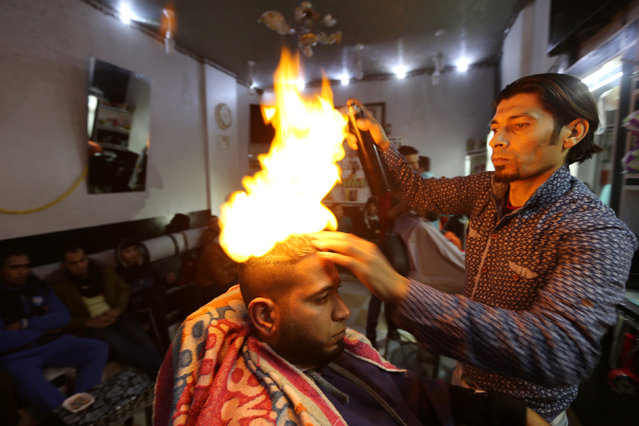
Palestinian barber Ramadan Odwan styles and straightens the hair of a customer with fire at his salon in Rafah, in the southern Gaza Strip February 2, 2017. In Ramadan Odwan's barbershop in Gaza, hair isn't just blow-dried, it's blowtorch-dried. “People have gone crazy about it, many people are curious to go through the experience and they are not afraid”, he told Reuters. “People here love adventures”. Odwan, 37, is not the first stylist in the world to use flame to straighten hair, but his craft is unique in the Gaza Strip. In his salon in the southern Gaza town of Rafah, Odwan applied what he described as a protective liquid coating to a customer's hair – he declined to disclose its contents – before aiming for the head and pressing the button on a small blowtorch. “I control how long I apply fire, I keep it on and off for 10 seconds or 15 seconds. It is completely safe and I have not encountered any accident since I started it two months ago”, Odwan added. Odwan charges 20 shekels ($5.20) for a haircut and fire-straightening. A barber for the past 18 years, he said part of the reason he uses the technique is to show that Palestinian barbers are as “professional as those out there around the world”. (Photo by Ibraheem Abu Mustafa/Reuters)

Palestinian barber Ramadan Odwan styles and straightens the hair of a customer with fire at his salon in Rafah, in the southern Gaza Strip February 2, 2017. In Ramadan Odwan's barbershop in Gaza, hair isn't just blow-dried, it's blowtorch-dried. “People have gone crazy about it, many people are curious to go through the experience and they are not afraid”, he told Reuters. “People here love adventures”. (Photo by Ibraheem Abu Mustafa/Reuters)
Details
11 Feb 2017 00:05:00
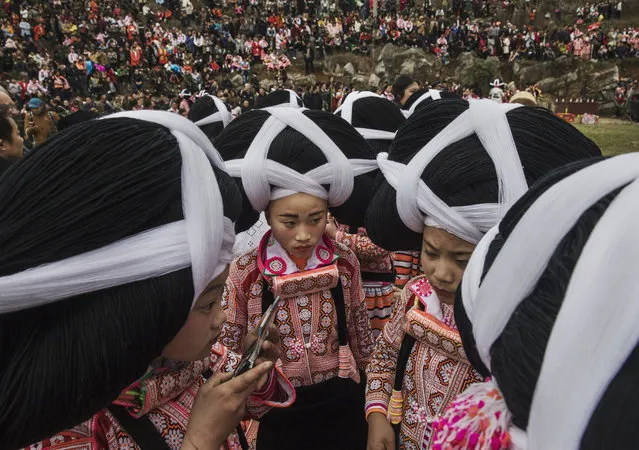
Girls of the Long Horn Miao ethnic minority group wear headdresses as they prepare gather for Tiaohua or Flower Festival as part of the Lunar New Year on February 6, 2017 in Longga village, Guizhou province, southern China. The Long Horn Miao are recognized for their declining practice of wrapping a blend of linen, wool, and the hair of their ancestors around animal horns or a wooden clip to make headdresses. Many young women say they now wear the headdresses only for special occasions and festivals, as the ornaments, which are attached by the horns to their real hair, have proved impractical for modern daily life in a fast changing world. China officially recognizes 56 different ethnic minorities, and statistics show over 7 million Chinese identifying themselves as Miao. But the small Long Horn Miao community counts only around 5000 people living in 12 villages, whose age-old traditions, language, and culture are fading. It is increasingly difficult in a modernizing China, as young people are drawn from remote rural villages to opportunities in bigger cities amongst wide-scale urbanization. Farming and labour remain the mainstays of life for the Long Horn Miao, leaving the area relatively poor in comparison with many parts of China. The government has invested significant amounts into local infrastructure and the tourism industry to try to bolster the local economy. (Photo by Kevin Frayer/Getty Images)

Girls of the Long Horn Miao ethnic minority group wear headdresses as they prepare gather for Tiaohua or Flower Festival as part of the Lunar New Year on February 6, 2017 in Longga village, Guizhou province, southern China. (Photo by Kevin Frayer/Getty Images)
Details
13 Feb 2017 00:01:00
English actress Danielle Harold shot exclusively for the Sun on Sunday, May 7, 2023 in London, United Kingdom. (Photo by Olivia West/News Group Newspapers Ltd via The Sun)

English actress Danielle Harold shot exclusively for the Sun on Sunday, May 7, 2023 in London, United Kingdom. (Photo by Olivia West/News Group Newspapers Ltd via The Sun)
Details
24 May 2023 04:13:00
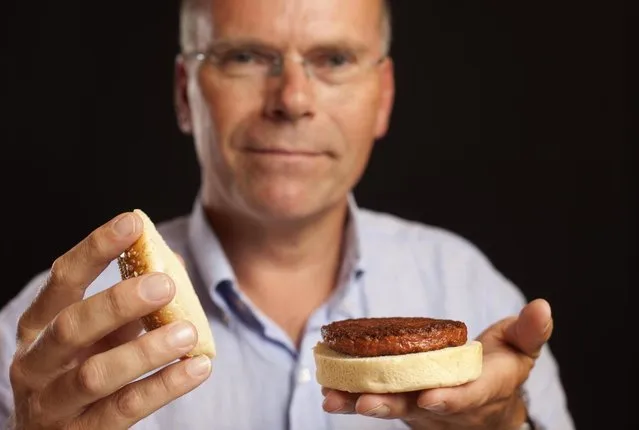
In this handout image provided by Ogilvy, a burger made from cultured beef, which has been developed by Professor Mark Post of Maastricht University in the Netherlands (pictured) is shown to the media during a press conference on August 5, 2013 in London, England. Cultured Beef could help solve the coming food crisis and combat climate change with commercial production of Cultured Beef beginning within ten to twenty years. (Photo by David Parry via Getty Images)

In this handout image provided by Ogilvy, a burger made from cultured beef, which has been developed by Professor Mark Post of Maastricht University in the Netherlands (pictured) is shown to the media during a press conference on August 5, 2013 in London, England. The in-vitro burger, cultured from cattle stem cells, the first example of what its creator says could provide an answer to global food shortages and help combat climate change, was fried in a pan and tasted by two volunteers. The burger is the result of years of research by Dutch scientist Mark Post, a vascular biologist at the University of Maastricht, who is working to show how meat grown in petri dishes might one day be a true alternative to meat from livestock.The meat in the burger has been made by knitting together around 20,000 strands of protein that has been cultured from cattle stem cells in Post's lab. (Photo by David Parry)
Details
06 Aug 2013 08:48:00
English television personality Georgia Harrison is seen attending House of CB Christmas Party at Old Sessions House on November 29, 2023 in London, England. (Photo by Ricky Vigil M/Justin E Palmer/GC Images)

English television personality Georgia Harrison is seen attending House of CB Christmas Party at Old Sessions House on November 29, 2023 in London, England. (Photo by Ricky Vigil M/Justin E Palmer/GC Images)
Details
22 Dec 2024 04:19:00
Brazilian-American model Alessandra Ambrosio and other celebs arrive at the “Vogue Paris Celebrates 100” party at Palais Galliera during spring/summer 2022 Fashion Week in Paris, France on October 1, 2021. (Photo by Best Image/Backgrid USA)

Brazilian-American model Alessandra Ambrosio and other celebs arrive at the “Vogue Paris Celebrates 100” party at Palais Galliera during spring/summer 2022 Fashion Week in Paris, France on October 1, 2021. (Photo by Best Image/Backgrid USA)
Details
10 Oct 2021 07:04:00
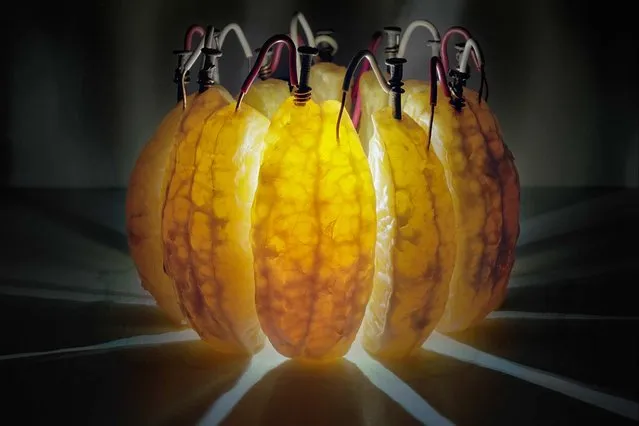
Wedges of an orange generate enough current and electrical juice – 3.5 volts – to power an LED. The fruit’s citric acid helps electrons flow from galvanized nails to copper wire in this 14-hour exposure. This image was published in September’s Visions of Earth, a trio of photos that appear in each issue of National Geographic. (Photo by Caleb Charland/National Geographic)

Wedges of an orange generate enough current and electrical juice – 3.5 volts – to power an LED. The fruit’s citric acid helps electrons flow from galvanized nails to copper wire in this 14-hour exposure. This image was published in September’s Visions of Earth, a trio of photos that appear in each issue of National Geographic. (Photo by Caleb Charland/National Geographic)
Details
06 Jan 2014 12:09:00
A resident walks past big waves spilling over a wall onto a coastal road in the city of Legaspi in Albay province, south of Manila on December 14, 2015, as typhoon Melor approaches the city. More than 700,000 people fled the central Philippines amid threats of giant waves, floods and landslides as powerful Typhoon Melor approached the archipelago nation, officials said December 14. (Photo by Charism Sayat/AFP Photo)

A resident walks past big waves spilling over a wall onto a coastal road in the city of Legaspi in Albay province, south of Manila on December 14, 2015, as typhoon Melor approaches the city. More than 700,000 people fled the central Philippines amid threats of giant waves, floods and landslides as powerful Typhoon Melor approached the archipelago nation, officials said December 14. (Photo by Charism Sayat/AFP Photo)
Details
15 Dec 2015 11:34:00