Loading...
Done
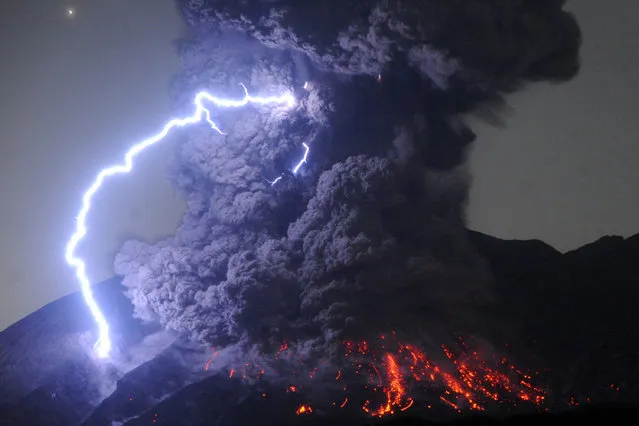
A dirty thunderstorm occurs over Mount Sakurajima as the volcano erupts violently at 12:03 am on July 26, 2016 in Tarumizu, Kagoshima, Japan. The eruption occurred at the mountain's Showa crater. This is the first time that the active volcano in southern Kyushu has spewed out a smokestack that high since an eruption on August 18, 2013, according to the Kagoshima Meteorological Office. (Photo by The Asahi Shimbun via Getty Images)

A dirty thunderstorm occurs over Mount Sakurajima as the volcano erupts violently at 12:03 am on July 26, 2016 in Tarumizu, Kagoshima, Japan. The eruption occurred at the mountain's Showa crater. This is the first time that the active volcano in southern Kyushu has spewed out a smokestack that high since an eruption on August 18, 2013, according to the Kagoshima Meteorological Office. (Photo by The Asahi Shimbun via Getty Images)
Details
24 Dec 2016 09:40:00
Bonobo apes, primates unique to Congo and humankind's closest relative, groom one another at a sanctuary just outside the capital Kinshasa, Congo on October 31, 2006. (Photo by Finbarr O'Reilly/Reuters)

Bonobo apes, primates unique to Congo and humankind's closest relative, groom one another at a sanctuary just outside the capital Kinshasa, Congo on October 31, 2006. (Photo by Finbarr O'Reilly/Reuters)
Details
08 Feb 2017 00:01:00
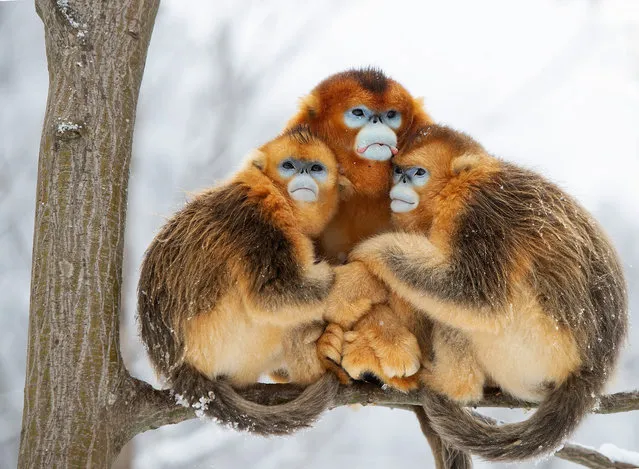
A golden huddle by Minqiang Lu, China. Two females and a male golden snub-nosed monkey huddle together to keep warm in the extreme cold. Threatened by forest loss and fragmentation, this endangered species is confined to central China. Restricted to living high up in the temperate forests, these monkeys – here in the Qinling mountains in Shaanxi province – feed mostly in the trees, on leaves, bark, buds and lichen. In heavy wind and snow, Minqiang walked up the mountain carrying his equipment. He stayed for half an hour in temperatures of –10C opposite the tree where the group was huddled before achieving this eye-level composition. (Photo by Minqiang Lu/Wildlife Photographer of the Year)

A golden huddle by Minqiang Lu, China. Two females and a male golden snub-nosed monkey huddle together to keep warm in the extreme cold. Threatened by forest loss and fragmentation, this endangered species is confined to central China. Restricted to living high up in the temperate forests, these monkeys – here in the Qinling mountains in Shaanxi province – feed mostly in the trees, on leaves, bark, buds and lichen. In heavy wind and snow, Minqiang walked up the mountain carrying his equipment. He stayed for half an hour in temperatures of –10C opposite the tree where the group was huddled before achieving this eye-level composition. (Photo by Minqiang Lu/Wildlife Photographer of the Year)
Details
12 Jan 2023 01:19:00
A resident of the Goodwin House senior living community, looks on as the DC area motown band “The Tribe” plays a social distance concert in their parking lot in Arlington, Virginia, during the coronavirus pandemic on April 14, 2020. (Photo by Andrew Caballero-Reynolds/AFP Photo)

A resident of the Goodwin House senior living community, looks on as the DC area motown band “The Tribe” plays a social distance concert in their parking lot in Arlington, Virginia, during the coronavirus pandemic on April 14, 2020. (Photo by Andrew Caballero-Reynolds/AFP Photo)
Details
20 Apr 2020 00:05:00
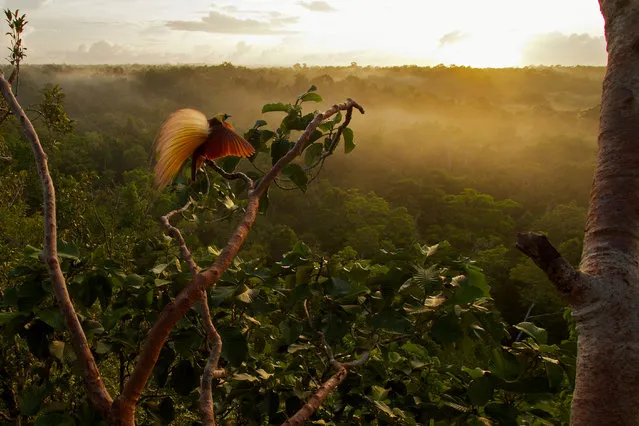
A greater bird of paradise (Paradisaea apoda) displaying in Badigaki Forest, Wokam Island (Aru Islands, Indonesia). Found here in Aru and on adjacent New Guinea, the greater bird of paradise represents about 40 different species of birds of paradise that depend on intact rainforest across the New Guinea region spanning eastern Indonesia and Papua New Guinea. With more than 80% of forest cover still intact, this region represents the largest remaining block of rainforest in the entire Asia-Pacific. (Photo by Tim Laman/naturepl.com/LDY Agency)

A greater bird of paradise (Paradisaea apoda) displaying in Badigaki Forest, Wokam Island (Aru Islands, Indonesia). Found here in Aru and on adjacent New Guinea, the greater bird of paradise represents about 40 different species of birds of paradise that depend on intact rainforest across the New Guinea region spanning eastern Indonesia and Papua New Guinea. With more than 80% of forest cover still intact, this region represents the largest remaining block of rainforest in the entire Asia-Pacific. (Photo by Tim Laman/naturepl.com/LDY Agency)
Details
14 Nov 2021 05:57:00
Two people sit in an ambulance waiting to be treated after a Grad rocket slammed into a shopping mall in Donetsk's Kubishevski district, in the eastern Ukraine,  on October 8, 2014. At least two people were killed, and five were injured after some six Grad rockets hit the area. (Photo by John Macdougall/AFP Photo)

Two people sit in an ambulance waiting to be treated after a Grad rocket slammed into a shopping mall in Donetsk's Kubishevski district, in the eastern Ukraine, on October 8, 2014. At least two people were killed, and five were injured after some six Grad rockets hit the area. (Photo by John Macdougall/AFP Photo)
Details
09 Dec 2019 00:03:00
A woman sits in a cell at the Los Angeles County Women's jail in Lynwood, California April 26, 2013. (Photo by Lucy Nicholson/Reuters)

A woman sits in a cell at the Los Angeles County Women's jail in Lynwood, California April 26, 2013. (Photo by Lucy Nicholson/Reuters)
Details
16 Jul 2015 10:46:00
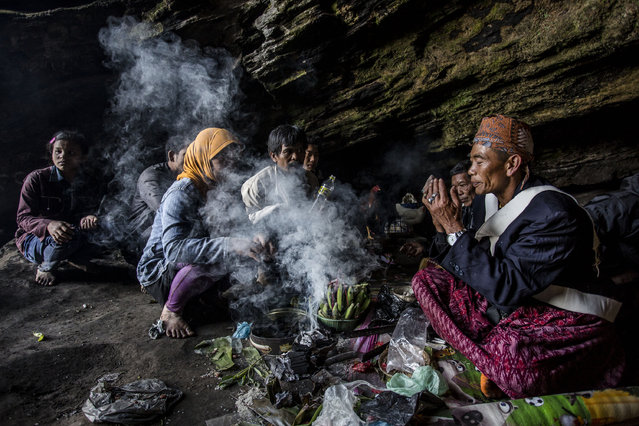
A Tenggerese shaman praying for worshippers at Widodaren cave during the Tenggerese Hindu Yadnya Kasada festival on July 31, 2015 in Probolinggo, East Java, Indonesia. The festival is the main festival of the Tenggerese people and lasts about a month. On the fourteenth day, the Tenggerese make the journey to Mount Bromo to make offerings of rice, fruits, vegetables, flowers and livestock to the mountain gods by throwing them into the volcano's caldera. (Photo by Ulet Ifansasti/Getty Images)

A Tenggerese shaman praying for worshippers at Widodaren cave during the Tenggerese Hindu Yadnya Kasada festival on July 31, 2015 in Probolinggo, East Java, Indonesia. The festival is the main festival of the Tenggerese people and lasts about a month. On the fourteenth day, the Tenggerese make the journey to Mount Bromo to make offerings of rice, fruits, vegetables, flowers and livestock to the mountain gods by throwing them into the volcano's caldera. The origin of the festival lies in the 15th century when a princess named Roro Anteng started the principality of Tengger with her husband Joko Seger, and the childless couple asked the mountain Gods for help in bearing children. The legend says the Gods granted them 24 children but on the provision that the 25th must be tossed into the volcano in sacrifice. The 25th child, Kesuma, was finally sacrificed in this way after initial refusal, and the tradition of throwing sacrifices into the caldera to appease the mountain Gods continues today. (Photo by Ulet Ifansasti/Getty Images)

Details
01 Aug 2015 12:07:00