Loading...
Done
Grumpy Cat in Las Vegas, America on August 5, 2014. Grumpy Cat aka Tardar Sauce has died  on May 14, 2019 at home in Arizona at the age of seven due to complications from a urinary tract infection. Her family's statement said: “Besides being our baby and a cherished member of the family, Grumpy Cat has helped millions of people smile all around the world - even when times were tough. Her spirit will continue to live on through her fans everywhere. Grumpy's Family – Tabatha, Bryan and Chyrstal”. (Photo by Mediapunch/Shutterstock)

Grumpy Cat in Las Vegas, America on August 5, 2014. Grumpy Cat aka Tardar Sauce has died on May 14, 2019 at home in Arizona at the age of seven due to complications from a urinary tract infection. Her family's statement said: “Besides being our baby and a cherished member of the family, Grumpy Cat has helped millions of people smile all around the world – even when times were tough. Her spirit will continue to live on through her fans everywhere. Grumpy's Family – Tabatha, Bryan and Chyrstal”. (Photo by Mediapunch/Shutterstock)
Details
19 May 2019 00:03:00
Tourists take photographs as a wild sika deer eats a bag on June 6, 2019 in Nara, Japan. Nara's free-roaming deer have become a huge attraction for tourists. However, an autopsy on a deer that was recently found dead near one of the city's famous temples discovered 3.2kg of plastic in its stomach and caused concern at the effect of tourism as Japan struggles to cope with a huge increase in domestic and international tourists. Alongside a growing Japanese tendency to holiday domestically, a record 31 million people visited the country in 2018 up 8.7 percent from the previous year, with many people now worrying about the environmental impact caused by such large visitor numbers. (Photo by Carl Court/Getty Images)

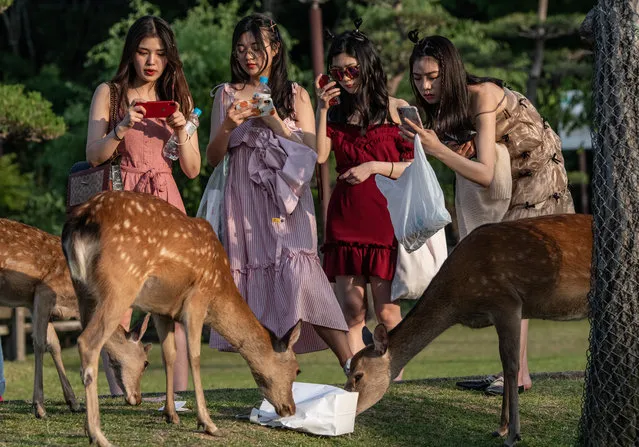
Tourists take photographs as a wild sika deer eats a bag on June 6, 2019 in Nara, Japan. Nara's free-roaming deer have become a huge attraction for tourists. However, an autopsy on a deer that was recently found dead near one of the city's famous temples discovered 3.2kg of plastic in its stomach and caused concern at the effect of tourism as Japan struggles to cope with a huge increase in domestic and international tourists. (Photo by Carl Court/Getty Images)
Details
19 Jun 2019 00:03:00
A koala named Lisa from Pappinbarra recovers from burns at The Port Macquarie Koala Hospital on November 29, 2019 in Port Macquarie, Australia. Volunteers from the Koala Hospital have been working alongside National Parks and Wildlife Service crews searching for koalas following weeks of devastating bushfires across New South Wales and Queensland. Koalas rescued from fire grounds have been brought back to the hospital for treatment. An estimated million hectares of land has been burned by bushfire across Australia following catastrophic fire conditions in recent weeks, killing an estimated 1000 koalas along with other wildlife. (Photo by Nathan Edwards/Getty Images)

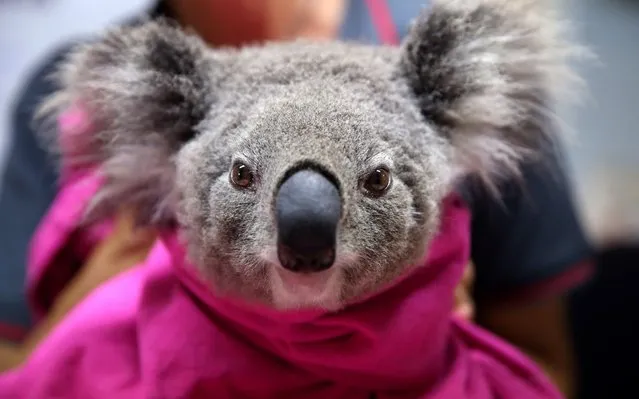
A koala named Lisa from Pappinbarra recovers from burns at The Port Macquarie Koala Hospital on November 29, 2019 in Port Macquarie, Australia. Volunteers from the Koala Hospital have been working alongside National Parks and Wildlife Service crews searching for koalas following weeks of devastating bushfires across New South Wales and Queensland. Koalas rescued from fire grounds have been brought back to the hospital for treatment. An estimated million hectares of land has been burned by bushfire across Australia following catastrophic fire conditions in recent weeks, killing an estimated 1000 koalas along with other wildlife. (Photo by Nathan Edwards/Getty Images)
Details
15 Dec 2019 05:31:00
A relative of a victim of the Ukraine International Airlines PS 752 plane that crashed after taking off from Tehran's Imam Khomeini airport reacts at Boryspil International Airport, outside Kiev, Ukraine on January 8, 2020. (Photo by Serhii Nuzhnenko/Reuters)

A relative of a victim of the Ukraine International Airlines PS 752 plane that crashed after taking off from Tehran's Imam Khomeini airport reacts at Boryspil International Airport, outside Kiev, Ukraine on January 8, 2020. (Photo by Serhii Nuzhnenko/Reuters)
Details
09 Jan 2020 00:01:00
People throw turnips at the Jarramplas as he comes out from the church beating his drum during the Jarramplas Festival on January 20, 2016 in Piornal, Caceres province, Spain. The centuries old Jarramplas festival takes place annually every January 19-20 on Saint Sebastian Day and this year they expect to use more than 20 thousand kilogrames of turnips. Even though the exact origins of the festival are not known, various theories exist including the mythological punishment of Caco by Hercules. (Photo by Pablo Blazquez Dominguez/Getty Images)

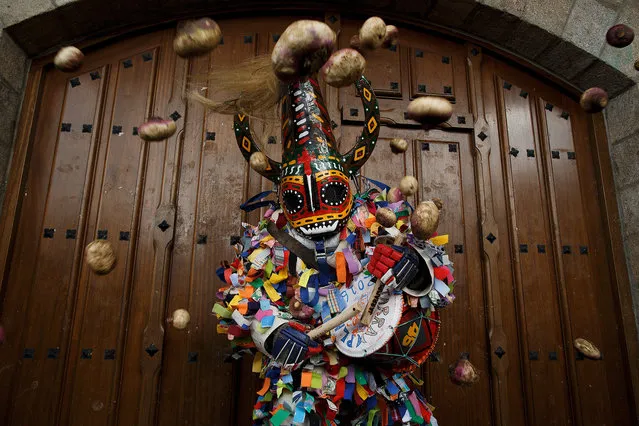
People throw turnips at the Jarramplas as he comes out from the church beating his drum during the Jarramplas Festival on January 20, 2016 in Piornal, Caceres province, Spain. The centuries old Jarramplas festival takes place annually every January 19-20 on Saint Sebastian Day and this year they expect to use more than 20 thousand kilogrames of turnips. Even though the exact origins of the festival are not known, various theories exist including the mythological punishment of Caco by Hercules, a relation to ceremonies celebrated by the American Indians that were seen by the first conquerors, to a cattle thief ridiculed and expelled by his village neighbours. It is generally believed to symbolize the expulsion of everything bad. (Photo by Pablo Blazquez Dominguez/Getty Images)
Details
21 Jan 2016 13:21:00
Spectacular images offering insight into the lives of the Huaorani people in the Ecuadorian Amazon have been revealed showing how they use traditional methods to hunt monkeys for food. The stunning pictures were taken by conservation photographer Pete Oxford from Torquay, Devon in the Ecuadorian Amazon. “The Huaorani Indians are a forest people highly in tune with their environment. Many are now totally acculturated since the 1950s by missionaries”, said Pete. “Today they face radical change to their culture to the proximity of oil exploration within their territory and the Yasuni National Park and Biosphere Reserve, they are vastly changed. Some still live very traditionally and for this shoot, through my Huaorani friend, a direct relative of those photographed he wanted to depict them as close to their original culture as possible. They still largely hunt with blow pipes and spears eating a lot of monkeys and peccaries”. The Huaorani are also known as the Waorani, Waodani or the Waos and are native Amerindians. Their lands are located between the Curaray and Napo rivers and speak the Huaorani language. Pete says that during his visit he was welcomed into the group and hopes that ancient cultures can be saved. Here: The tribe were seen celebrating after a hunter returned to camp with a wild pig. (Photo by Pete Oxford/Mediadrumworld.com)

Spectacular images offering insight into the lives of the Huaorani people in the Ecuadorian Amazon have been revealed showing how they use traditional methods to hunt monkeys for food. The stunning pictures were taken by conservation photographer Pete Oxford from Torquay, Devon in the Ecuadorian Amazon. Here: The tribe were seen celebrating after a hunter returned to camp with a wild pig. (Photo by Pete Oxford/Mediadrumworld.com)
Details
20 Jan 2017 07:58:00
With its huge eyes, comical name and diminutive size, Mark R. Smith’s image of a baby Hawaiian bobtail squid can’t help but raise a smile. A curiously endearing creature, the cephalopod is just 1.5cm across, its mantle cavity bearing more than a passing resemblance to a rather natty shower cap. But it is also a beautiful example of symbiosis – nature’s version of “I’ll scratch your back if you scratch mine” – for on the underside of the squid is a light organ which houses bioluminescent bacteria. The squid offers the bacteria protection and food, while the bacteria emit a glow – a handy trait that the squid uses to offset its silhouette, helping it to evade predators in the depths below. Mark R. Smith’s entry combines several images of a Hawaiian bobtail squid with different focus lengths to create a final picture with greater depth of field than normal. (Photo by Mark R. Smith/Wellcome Images/Macroscopic Solutions)

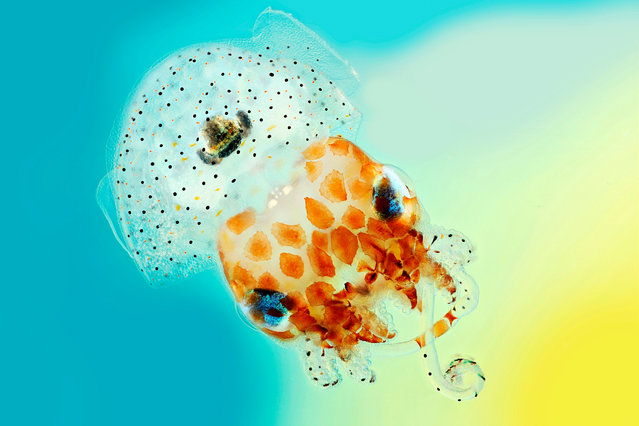
With its huge eyes, comical name and diminutive size, Mark R. Smith’s image of a baby Hawaiian bobtail squid can’t help but raise a smile. A curiously endearing creature, the cephalopod is just 1.5cm across, its mantle cavity bearing more than a passing resemblance to a rather natty shower cap. But it is also a beautiful example of symbiosis – nature’s version of “I’ll scratch your back if you scratch mine” – for on the underside of the squid is a light organ which houses bioluminescent bacteria. The squid offers the bacteria protection and food, while the bacteria emit a glow – a handy trait that the squid uses to offset its silhouette, helping it to evade predators in the depths below. Mark R. Smith’s entry combines several images of a Hawaiian bobtail squid with different focus lengths to create a final picture with greater depth of field than normal. (Photo by Mark R. Smith/Wellcome Images/Macroscopic Solutions)
Details
08 Mar 2017 00:05:00
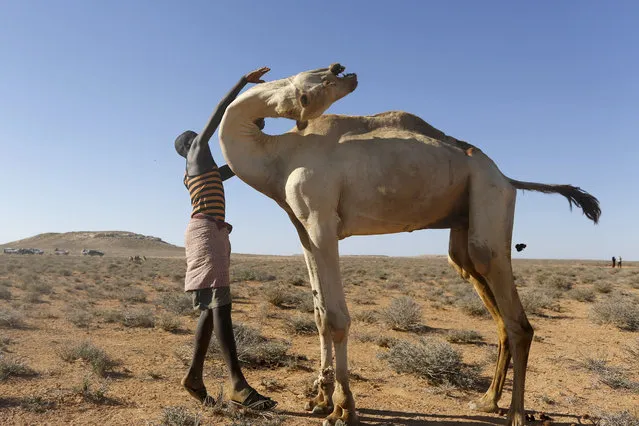
Ali Asair, who has left his family behind and traveled hundreds of kilometers in search for a pasture for his animals, attends to his camel in a pastoralists' settlement in the Bandarbeyla district in Somalia's semi-autonomous region of Puntland, Somalia, 24 March 2017. According to media reports, the United Nations says only 31 percent of 864 million US dollars appeal for a drought-hit Somalia is funded. The UN said the world is facing the largest humanitarian crisis since 1945, adding that more than 20 million people are facing the threat of famine in Somalia, Yemen, South Sudan and Nigeria and 1.4 million children could die from starvation this year. (Photo by Dai Kurokawa/EPA)

Ali Asair, who has left his family behind and traveled hundreds of kilometers in search for a pasture for his animals, attends to his camel in a pastoralists' settlement in the Bandarbeyla district in Somalia's semi-autonomous region of Puntland, Somalia, 24 March 2017. According to media reports, the United Nations says only 31 percent of 864 million US dollars appeal for a drought-hit Somalia is funded. The UN said the world is facing the largest humanitarian crisis since 1945, adding that more than 20 million people are facing the threat of famine in Somalia, Yemen, South Sudan and Nigeria and 1.4 million children could die from starvation this year. (Photo by Dai Kurokawa/EPA)
Details
28 Mar 2017 09:01:00