Loading...
Done
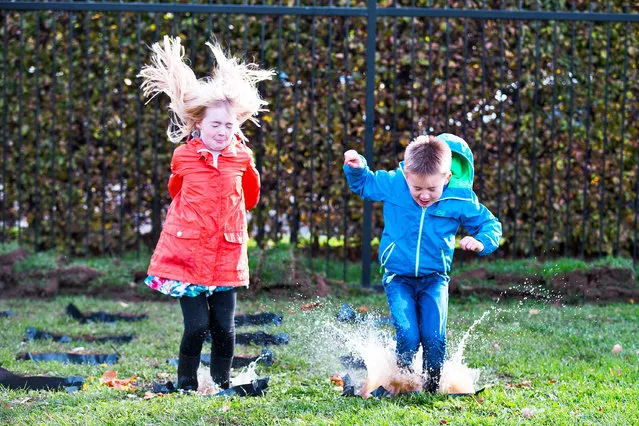
Picture dated October 23rd, 2018 shows brother and sister Henry (7) and Lily Sales (9) getting in some early practice for the World Puddle Jumping Championships at Wicksteed Park in Kettering, Northants, UK. Organisers have made more puddles than ever before in an attempt to make this year's competition the biggest and best yet. They are also hoping competitors will set a new record for the most people jumping in puddles at the same time. Judges will give scores based on the height of the jump, enthusiasm, distance of splash and stickability (the amount of mud which clings to each competitor). (Photo by Geoff Robinson Photography)

Picture dated October 23rd, 2018 shows brother and sister Henry (7) and Lily Sales (9) getting in some early practice for the World Puddle Jumping Championships at Wicksteed Park in Kettering, Northants, UK. Organisers have made more puddles than ever before in an attempt to make this year's competition the biggest and best yet. They are also hoping competitors will set a new record for the most people jumping in puddles at the same time. Judges will give scores based on the height of the jump, enthusiasm, distance of splash and stickability (the amount of mud which clings to each competitor). (Photo by Geoff Robinson Photography)
Details
25 Oct 2018 09:42:00
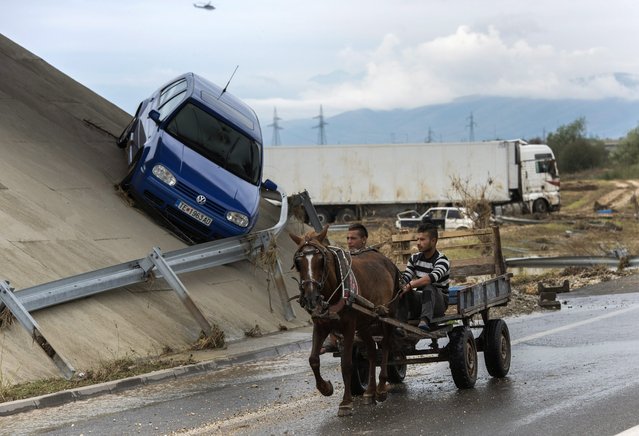
A damaged vehicle is seen next to the ring road, around Skopje, near the village of Stajkovci, Skopje, The Former Yugoslav Republic of Macedonia, 08 August 2016. At least 21 people have died and more than 100 are injured in the heavy rain storm that hit the Macedonian capital Skopje late Saturday night causing severe damage to the roads and house infrastructure. More than 80 vehicles were hit by landslides at Skopje's ring road. The highway remains closed. The government announced a 15-day state of emergency in the Skopje and Tetovo region. (Photo by Georgi Licovski/EPA)

A damaged vehicle is seen next to the ring road, around Skopje, near the village of Stajkovci, Skopje, The Former Yugoslav Republic of Macedonia, 08 August 2016. At least 21 people have died and more than 100 are injured in the heavy rain storm that hit the Macedonian capital Skopje late Saturday night causing severe damage to the roads and house infrastructure. More than 80 vehicles were hit by landslides at Skopje's ring road. The highway remains closed. The government announced a 15-day state of emergency in the Skopje and Tetovo region. (Photo by Georgi Licovski/EPA)
Details
09 Aug 2016 13:00:00
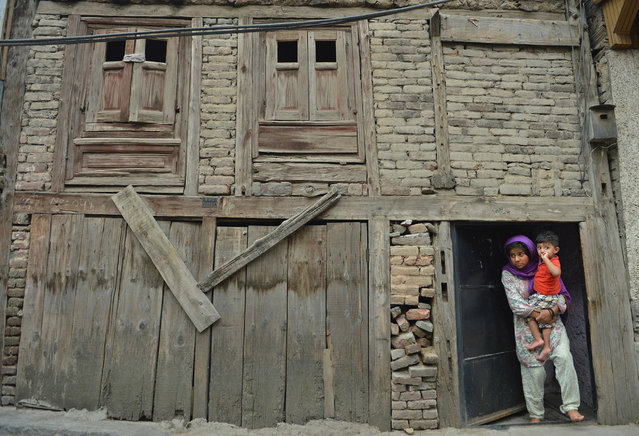
A Kashmiri girl holds her brother in the doorway of their home while watching protesters shout pro-freedom and anti-Indian slogans during  mourning and protests held in downtown Srinagar on August 22, 2016, following the killing of teenager Irfan Ahmed by security forces. Teenager Irfan Ahmed was killed after he was hit in the chest by a teargas canister fired by Indian security forces to quell pro-freedom protests in the Kashmiri capital on August 21. More than 60 civilians have been killed in clashes between protesters and security forces, and thousands more injured in the worst violence to hit the Himalayan region since 201. Indian-administered Kashmir has been in the grip of almost daily anti-India protests and rolling curfews sparked by the killing on July 8 of a popular rebel leader, Burhan Wani, in a gunfight with government forces. (Photo by Tauseef Mustafa/AFP Photo)

A Kashmiri girl holds her brother in the doorway of their home while watching protesters shout pro-freedom and anti-Indian slogans during mourning and protests held in downtown Srinagar on August 22, 2016, following the killing of teenager Irfan Ahmed by security forces. Teenager Irfan Ahmed was killed after he was hit in the chest by a teargas canister fired by Indian security forces to quell pro-freedom protests in the Kashmiri capital on August 21. More than 60 civilians have been killed in clashes between protesters and security forces, and thousands more injured in the worst violence to hit the Himalayan region since 201. Indian-administered Kashmir has been in the grip of almost daily anti-India protests and rolling curfews sparked by the killing on July 8 of a popular rebel leader, Burhan Wani, in a gunfight with government forces. (Photo by Tauseef Mustafa/AFP Photo)
Details
25 Aug 2016 09:48:00
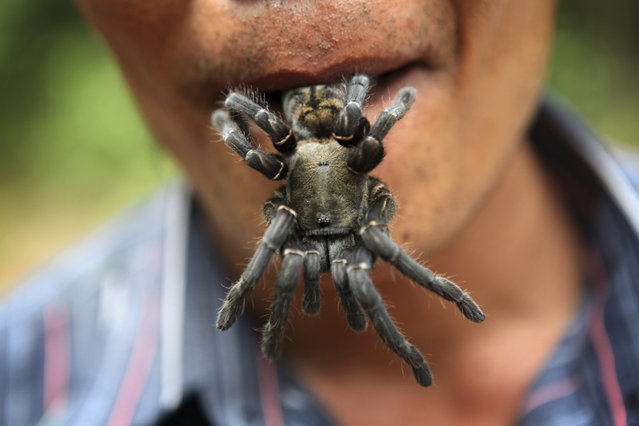
A Cambodian tuk tuk driver and guide with a tarantula in his mouth shortly after is was dug from the ground on June 7, 2010 in Skuon, Kampong Cham Province, Cambodia. The trade for spiders and other insects as food and for medicinal purposes has been in effect since the 1970's in Cambodia but only very recently have tourists been finding a way to see where the spiders are hunted in the nearby countryside. One guide, who can be found in Kampong Cham Town has started offering tours to tourists who can find him. (Photo by Tim Whitby/Getty Images)

A Cambodian tuk tuk driver and guide with a tarantula in his mouth shortly after is was dug from the ground on June 7, 2010 in Skuon, Kampong Cham Province, Cambodia. The trade for spiders and other insects as food and for medicinal purposes has been in effect since the 1970's in Cambodia but only very recently have tourists been finding a way to see where the spiders are hunted in the nearby countryside. One guide, who can be found in Kampong Cham Town has started offering tours to tourists who can find him. (Photo by Tim Whitby/Getty Images)
Details
04 Sep 2016 09:27:00
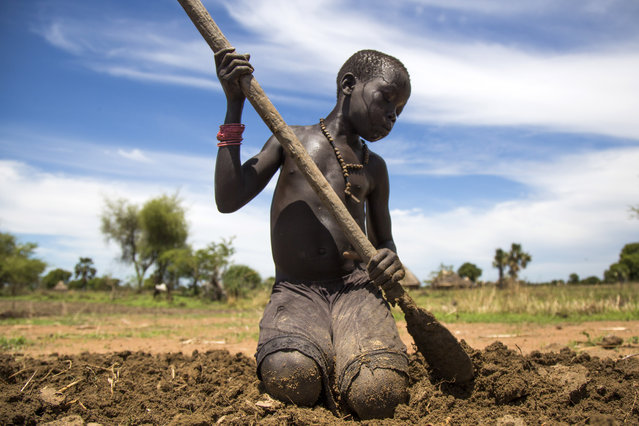
Nyibol Lual, 13 years old, helps her family to prepare the land for cultivation on May 31, 2017, in Panthau, Northern Bahr al Ghazal, South Sudan. The family has a small land where they cultivate sorghum. An estimated 63 per cent of the population in Northern Bahr al Ghazal is experiencing severe food insecurity, according to the latest Integrated Food Security Phase Classification (IPC) report. The situation is particularly bad in Aweil West and Aweil South counties, where the exhaustion of household food stocks and growing dependence on financially inaccessible markets have left the population facing Emergency levels of food insecurity. (Photo by Albert Gonzalez Farran/AFP Photo)

Nyibol Lual, 13 years old, helps her family to prepare the land for cultivation on May 31, 2017, in Panthau, Northern Bahr al Ghazal, South Sudan. The family has a small land where they cultivate sorghum. An estimated 63 per cent of the population in Northern Bahr al Ghazal is experiencing severe food insecurity, according to the latest Integrated Food Security Phase Classification (IPC) report. The situation is particularly bad in Aweil West and Aweil South counties, where the exhaustion of household food stocks and growing dependence on financially inaccessible markets have left the population facing Emergency levels of food insecurity. (Photo by Albert Gonzalez Farran/AFP Photo)
Details
01 Jun 2017 10:10:00
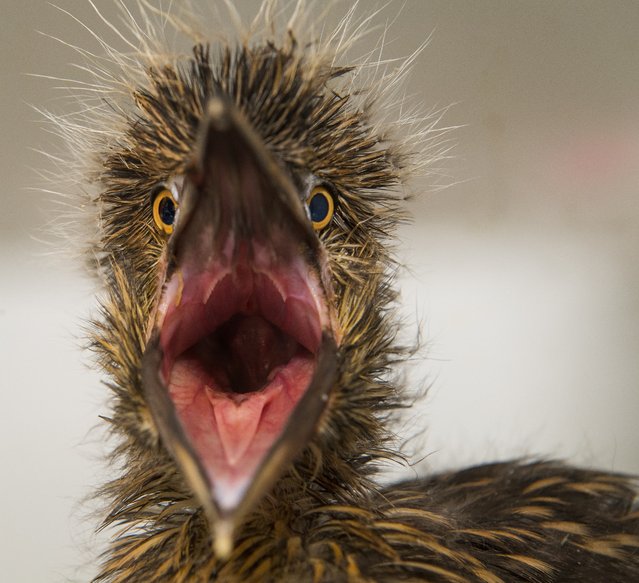
A baby Black-crowned Night Heron squawks in its incubator while being cared for at City Wildlife rescue and rehabilitation center in Washington, DC on May 31, 2017. The heron is one of several that have been brought to CW by the staff at The National Zoo over the past few years. The heron is a native bird and has made an established rookery inside the zoo grounds over a hundred years ago.  Every year at this time, some of the chicks get pushed or fall out of the nest and require human care.  Because the birds are native and not part of the Smithsonian collection, they partnered with CW to rehabilitate the herons for re-release back to the flock inside Zoo. They're reintroduced back to their flock so that they can migrate together in the Fall. The Black-crowned heron usually migrates from the DC area down to southeast North Carolina, some going as far as Jacksonville, FL in winter. The Black-crowned heron is the species of greatest conservation need in the District of Columbia because their numbers are in such rapid decline due to habitat loss. (Photo Linda Davidson/The Washington Post)

A baby Black-crowned Night Heron squawks in its incubator while being cared for at City Wildlife rescue and rehabilitation center in Washington, DC on May 31, 2017. The heron is one of several that have been brought to CW by the staff at The National Zoo over the past few years. (Photo Linda Davidson/The Washington Post)
Details
04 Jun 2017 08:04:00
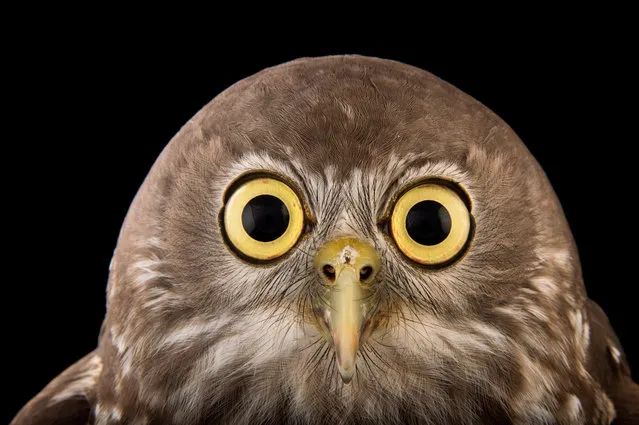
The National Geographic Photo Ark is a travelling exhibition of photographer Joel Sartore’s quest to create a photo archive of biodiversity around the world. So far, Sartore has captured studio portraits of more than 6,000 species – a number that he hopes to double. On 1 July, the ark will open at Melbourne zoo – the first time it has been exhibited in the southern hemisphere. More than 50 portraits will be on display, including many of Australian endangered animals being protected by programs at the zoo itself. These captions have been edited from text supplied by Melbourne zoo. Here: Barking owl. So-named because its call sounds like a barking dog, these birds are native to Australia, Indonesia and Papua New Guinea. In Victoria they are listed as an endangered species, and in 2003 there were estimated to be fewer than 50 breeding pairs. The main threat to the species in Victoria is loss of habitat, especially large trees with hollows in which they can nest and on which many of their prey depend. Apart from a bark, they may utter a chilling scream when they feel threatened. (Photo by Joel Sartore/National Geographic Photo Ark/The Guardian)

The National Geographic Photo Ark is a travelling exhibition of photographer Joel Sartore’s quest to create a photo archive of biodiversity around the world. So far, Sartore has captured studio portraits of more than 6,000 species – a number that he hopes to double. On 1 July, the ark will open at Melbourne zoo – the first time it has been exhibited in the southern hemisphere. More than 50 portraits will be on display, including many of Australian endangered animals being protected by programs at the zoo itself. These captions have been edited from text supplied by Melbourne zoo. Here: Barking owl. (Photo by Joel Sartore/National Geographic Photo Ark/The Guardian)
Details
01 Jul 2017 07:45:00
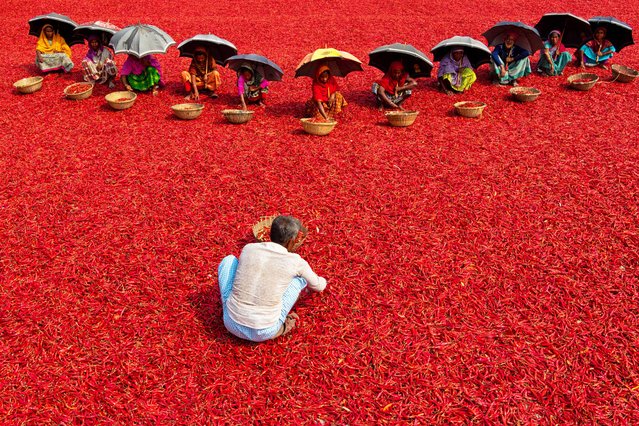
Rows of workers shelter under umbrellas from the scorching heat as they painstakingly sort through a red carpet of millions of chilli peppers in Bogra, Bangladesh on October 3, 2023. They sort the rotten and broken chilli peppers out to separate the poor quality ones which won't sell. In a line, the pickers who are paid less than £3 for a 10-hour shift slowly move forward with their baskets to separate the bad from the good after the chilies have been dried in the sun for a week. The dried & sorted chillies are then packaged and taken to the local market where they are brought mainly by companies to be made into chilli powder. The workers sort them in a warm environment, with temperatures reaching up to 45°C. More than 5,000 people work in almost 100 chilli farms in the Bogra district of Bangladesh to supply local spice companies with chillies for their recipes. Known as “Lal Morich” to the locals, chilli peppers are a major part of Bengali cuisine and are used as part of a combination of spices for various meat dishes, including chicken and beef. (Photo by Joy Saha/Rex Features/Shutterstock)

Rows of workers shelter under umbrellas from the scorching heat as they painstakingly sort through a red carpet of millions of chilli peppers in Bogra, Bangladesh on October 3, 2023. They sort the rotten and broken chilli peppers out to separate the poor quality ones which won't sell. In a line, the pickers who are paid less than £3 for a 10-hour shift slowly move forward with their baskets to separate the bad from the good after the chilies have been dried in the sun for a week. (Photo by Joy Saha/Rex Features/Shutterstock)
Details
21 Oct 2023 04:04:00