Loading...
Done
Historic Hatters of James Lock and Co

Assistant Manager Jayesh Vaghela brushes a vintage silk top hat at Lock & Co. Hatters on March 22, 2011 in London, England. Founded in St. James's in 1676, when Charles II was on the throne, this family owned business has provided hats for Royalty and the gentry for over 300 years. Staff report that sales of formal hats are booming ahead of the wedding of Prince William and Kate Middleton in Westminster Abbey on April 29, 2011.
Details
27 Mar 2011 12:56:00


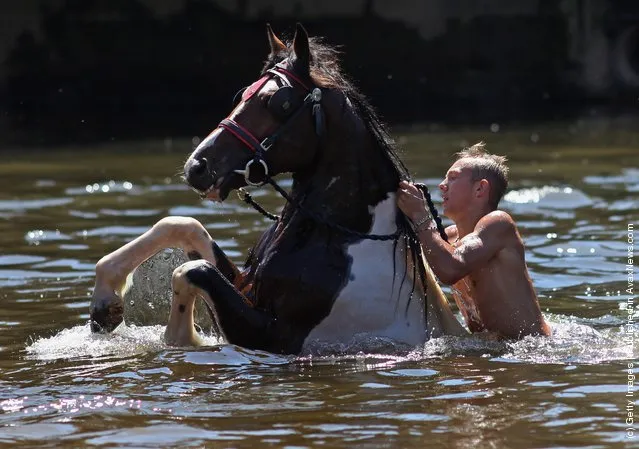
A traveller washes his horse in the River Eden in preparation for selling at the Appleby Horse Fair on June 3, 2011 in Appleby, England. Appleby Horse Fair has existed under the protection of a charter granted by James II since 1685. It is one of the key gathering points for the Romany, gypsy and traveling community. Appleby Horse Fair is attended by about 5,000 travelers who come to buy and sell horses. The animals are washed and groomed before being ridden at high speed along the “mad mile” for the viewing of potential buyers. (Photo by Christopher Furlong/Getty Images)
Details
04 Jun 2011 06:35:00
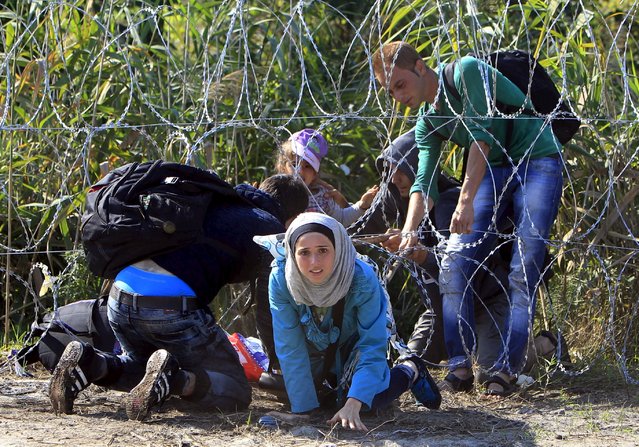
A Syrian migrant family enters Hungary at the border with Serbia near Roszke, Hungary August 28, 2015. (Photo by Bernadett Szabo/Reuters)

A Syrian migrant family enters Hungary at the border with Serbia near Roszke, Hungary August 28, 2015. As Europe struggles with its worst migrant crisis since World War II, Hungary has become, like Italy and Greece, a “frontline” state. So far this year, police say around 141,500 migrants have been intercepted crossing into Hungary, mostly from neighbouring Serbia. (Photo by Bernadett Szabo/Reuters)
Details
29 Aug 2015 11:33:00


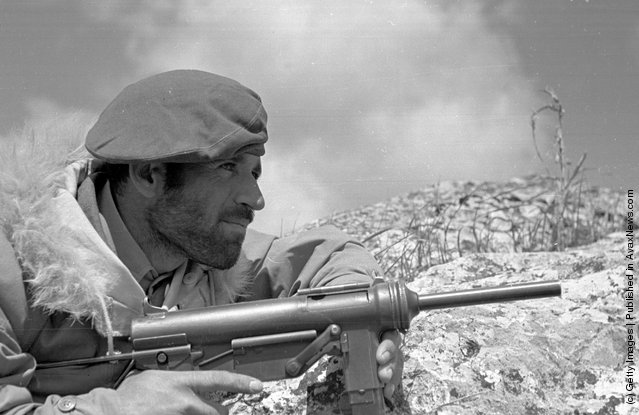
“The Greek Civil War was fought from 1945 to 1949 between the Greek governmental army, backed by the United Kingdom and United States, and the Democratic Army of Greece (ΔΣΕ) (Greek initials DSE), the military branch of the Greek Communist Party (KKE), backed by Bulgaria, Yugoslavia and Albania. It was the result of a highly polarized struggle between leftists and rightists which started in 1943 and targeted the power vacuum that the German-Italian occupation during World War II had created. One of the first conflicts of the Cold War, according to some analysts it represents the first example of a postwar Western interference in the internal politics of a foreign country, and for others, marked the first serious test of the theory of the so-called Churchill-Stalin percentages agreement. The first signs of the civil war occurred in 1942–1944, during the Occupation”. – Wikipedia

Photo: A Greek commando soldier, wearing a fur-collared jacket supplied by the Americans, waits for a guerrilla target to emerge during the Greek Civil War. (Photo by Bert Hardy/Picture Post/Getty Images). 22nd May 1948

Details
15 Aug 2013 15:47:00
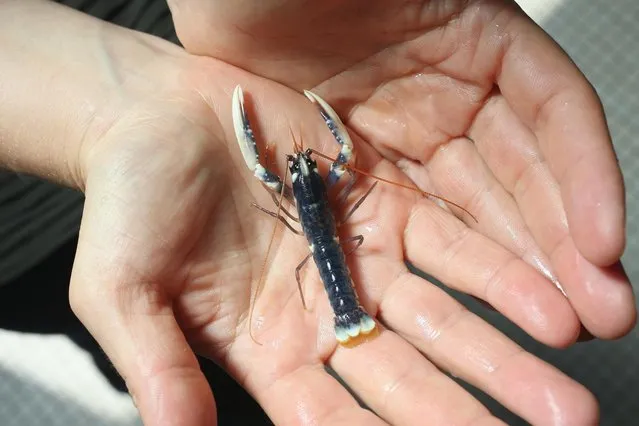
Isabel Schmalenbach, an environmental scientist with the Helgoland Biological Institute (Biologische Anstalt Helgoland), part of the Alfred Wegener Institute for Polar and Marine Research, holds a one-year old baby European lobster (Homarus gammarus) raised at the institute on August 3, 2013 on Helgoland Island, Germany. (Photo by Sean Gallup/Getty Images)

Isabel Schmalenbach, an environmental scientist with the Helgoland Biological Institute (Biologische Anstalt Helgoland), part of the Alfred Wegener Institute for Polar and Marine Research, holds a one-year old baby European lobster (Homarus gammarus) raised at the institute on August 3, 2013 on Helgoland Island, Germany. Later in the day Schmalenbach and her colleagues released a total of 415 one-year old lobsters into the North Sea as part of an effort to repopulate the lobster population around Helgoland (also called Heligoland). In the 19th century local fishermen caught up to 80,000 lobsters a year in the surrounding waters, combined with the heavy allied bombing of the island during and after World War II, as well as other environmental factors, decimated the lobster population. (Photo by Sean Gallup)
Details
05 Aug 2013 08:39:00
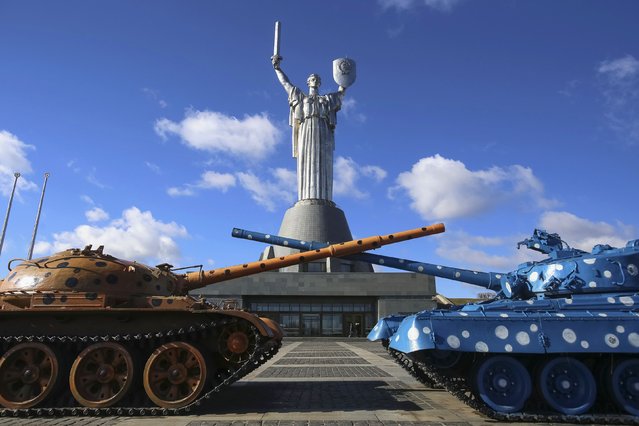
The 100-metre (300-foot), sword-wielding statue of “The Motherland” is seen in the National Museum of the History of the Great Patriotic War in Kiev March 17, 2014. On a blustery day on the banks of the Dnieper, the statue of “The Motherland”, a Soviet hammer and sickle on her shield, towered overhead, a reminder of the common cause Ukrainians and Russians died for side by side in their millions in World War Two and which Russian President Vladimir Putin thinks Ukraine has betrayed by turning to “fascism” and the West. (Photo by Konstantin Grishin/Reuters)

The 100-metre (300-foot), sword-wielding statue of “The Motherland” is seen in the National Museum of the History of the Great Patriotic War in Kiev March 17, 2014. On a blustery day on the banks of the Dnieper, the statue of “The Motherland”, a Soviet hammer and sickle on her shield, towered overhead, a reminder of the common cause Ukrainians and Russians died for side by side in their millions in World War Two and which Russian President Vladimir Putin thinks Ukraine has betrayed by turning to “fascism” and the West. (Photo by Konstantin Grishin/Reuters)
Details
22 Mar 2014 13:47:00
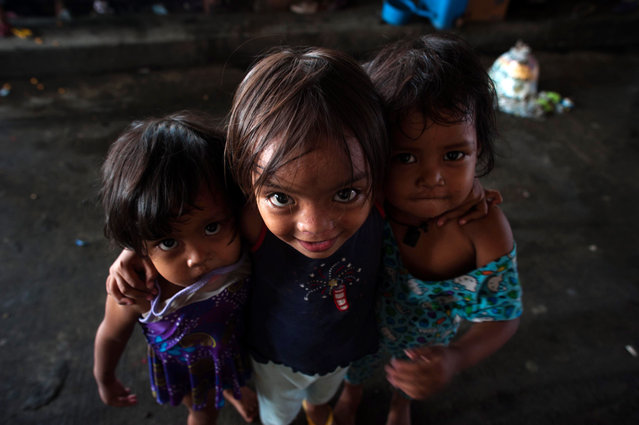
Children beg for alms in a street on August 11, 2014 in Manila, Philippines. The Philippines has one of the fastest growing populations in Southeast Asia with around 100 million people. (Photo by Dondi Tawatao/Getty Images)

Children beg for alms in a street on August 11, 2014 in Manila, Philippines. The Philippines has one of the fastest growing populations in Southeast Asia with around 100 million people. At least 12 million people live in the capital city of Manila alone, making it one of the most densely populated and largest cities in the world. Lack of space and economic opportunities has pushed around four million people to live informally along waterways, bridges and even cemeteries further straining the already weak infrastructure and straining the resources of the city. (Photo by Dondi Tawatao/Getty Images)
Details
12 Aug 2014 12:21:00
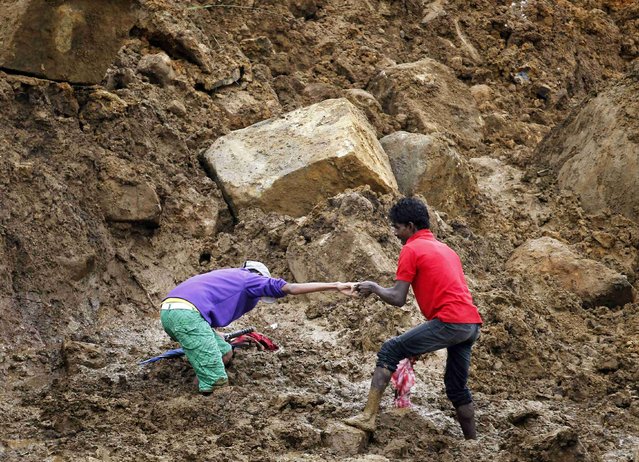
A man helps another make his way through deep mud at the site of a landslide at the Koslanda tea plantation near Haldummulla October 30, 2014. Hopes of finding survivors under the mud and rubble of a landslide in south-central Sri Lanka had run out by first light on Thursday, though a government minister cut the estimated death toll to more than 100 from 300 the previous night. (Photo by Dinuka Liyanawatte/Reuters)

A man helps another make his way through deep mud at the site of a landslide at the Koslanda tea plantation near Haldummulla October 30, 2014. Hopes of finding survivors under the mud and rubble of a landslide in south-central Sri Lanka had run out by first light on Thursday, though a government minister cut the estimated death toll to more than 100 from 300 the previous night. (Photo by Dinuka Liyanawatte/Reuters)
Details
30 Oct 2014 13:32:00