Loading...
Done
A person drags a suitcase as a boy clings to it on a square in front of a railway station ahead of the Chinese Lunar New Year in Qingdao, Shandong province, January 28, 2014. About 3.62 billion trips will be made during the 40-day Spring Festival travel rush, which started from January 16, reported Xinhua News Agency citing a government official. (Photo by Reuters/China Daily)

A person drags a suitcase as a boy clings to it on a square in front of a railway station ahead of the Chinese Lunar New Year in Qingdao, Shandong province, January 28, 2014. About 3.62 billion trips will be made during the 40-day Spring Festival travel rush, which started from January 16, reported Xinhua News Agency citing a government official. (Photo by Reuters/China Daily)
Details
04 Feb 2014 09:06:00
A Judas is carried through the streets. The crowd pretends to kick and beat the Judases to show scorn. (Photo by Oswaldo Rivas/Reuters)

For 130 years, the people of Masatepe have observed Good Friday by dressing up in colorful masks and costumes and dragging chained “Judases” through the streets of their town in western Nicaragua. Photo: A Judas is carried through the streets. The crowd pretends to kick and beat the Judases to show scorn. (Photo by Oswaldo Rivas/Reuters)
Details
22 Apr 2014 07:51:00
Michael Quinn By Pathways in Arches

Images from my travels with John Paul Caponigro in the spring of 2011. During that week JP inspired me to create this body of work. This is my path, my pathways in arches.

Michael Quinn
Details
18 Dec 2013 14:11:00
An art installation formed with milk churns, made by land art artist Gerard Benoit a la Guillaume, is seen at the Chenau de Mayen in the resort of Leysin, Switzerland August 7, 2015. More than 80 milk churns were placed between the Tour d'Ai and the Tour de Mayen summits at an altitude of 2,000 meters (6,561 feet) above sea level under the direction of the artist, to be photographed for his ongoing art project entitled “Milk churns without borders”. (Photo by Denis Balibouse/Reuters)

An art installation formed with milk churns, made by land art artist Gerard Benoit a la Guillaume, is seen at the Chenau de Mayen in the resort of Leysin, Switzerland August 7, 2015. More than 80 milk churns were placed between the Tour d'Ai and the Tour de Mayen summits at an altitude of 2,000 meters (6,561 feet) above sea level under the direction of the artist, to be photographed for his ongoing art project entitled “Milk churns without borders”. (Photo by Denis Balibouse/Reuters)
Details
08 Aug 2015 13:16:00
A demonstrator uses her phone to take a “selfie” picture during the 12th annual “SlutWalk” march through central Jerusalem on June 14, 2024 to protest against rape culture, including sеxual assault and harassment directed at women, and calling for an end to the ongoing war in the Gaza Strip and action to release hostages taken captive during the October 7 attacks. (Photo by Hazem Bader/AFP Photo)

A demonstrator uses her phone to take a “selfie” picture during the 12th annual “SlutWalk” march through central Jerusalem on June 14, 2024 to protest against rape culture, including sеxual assault and harassment directed at women, and calling for an end to the ongoing war in the Gaza Strip and action to release hostages taken captive during the October 7 attacks. (Photo by Hazem Bader/AFP Photo)
Details
17 Oct 2025 03:59:00
Sheep In The Streets Of Milan During Filming For The Last Shepherd

Sheep are waiting in Via Manzoni before the final filming of the Last Shepherd on October 1, 2011 in Milan, Italy. Directed by Marco Bonfanti, L'Ultimo Pastore (The Last Shepherd) tells the story of the life of Renato Zucchelli, the last nomadic shepherd in Milan. (Photo by Pier Marco Tacca/Getty Images)
Details
02 Oct 2011 12:49:00
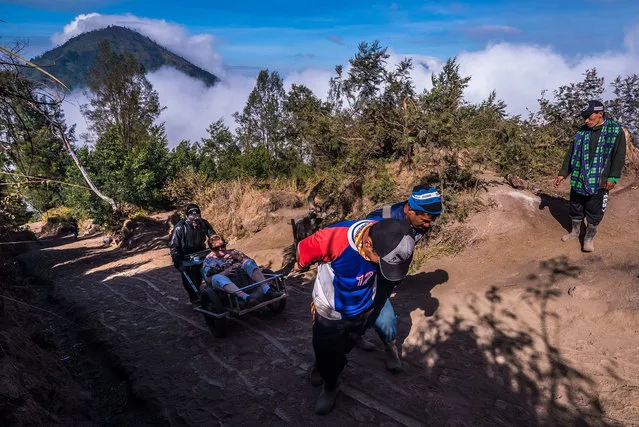
Miners pulling up lazy tourists to the rim of Kawah Ijen (Ijen Volcano), East Java, Indonesia on September 21, 2017. They will earn as much as they would bring down a load of sulfur. Nomadic Explorer, Cultural Lifestyle Photographer Claudio Sieber captured striking images of miners working at Ijen volcanic range in East Java, Indonesia. The sulphur miners risk their lives daily as they climb the active volcano carrying heavy loads, which they sell to sugar refineries. Shortly after midnight curious tourists are flocking in hundreds through the gate of Ijen's foothills to be right on time, driven by the images others took before them. Kawah Ijen is the one of the world's largest acidic volcanic crater lake; famous for its turquoise color as well as the unreal atmosphere it offers during darkness. A dusty path zigzags 3 kilometers up to the crater rim. This doesn't mean anything challenging; in particular, special sights have to be deserved anyway. The irritating smell of sulfur announces the near of the crater's existence. Arriving on the crater's rim the reward for the torture becomes visible. Blue fire darts its tongues through the fumes of sulfur dioxide. Somehow, the spectacle isn't as romantic as expected, since it is also the rough working space of approx. 150 sulfur miners who start their shift at 1 am. Lately, harvesting the abundance of devil's gold received international attention. This did obviously not really improve a miner's lifestyle; neither did it contribute to a better wage. (Photo by Claudio Sieber/Barcroft Images)

Miners pulling up lazy tourists to the rim of Kawah Ijen (Ijen Volcano), East Java, Indonesia on September 21, 2017. They will earn as much as they would bring down a load of sulfur. Nomadic Explorer, Cultural Lifestyle Photographer Claudio Sieber captured striking images of miners working at Ijen volcanic range in East Java, Indonesia. The sulphur miners risk their lives daily as they climb the active volcano carrying heavy loads, which they sell to sugar refineries. (Photo by Claudio Sieber/Barcroft Images)
Details
02 Oct 2017 08:31:00
Take me away, deer, Russia. The Nenet people of Arctic Russia use reindeer and sledges as a prime mode of transport. The animals’ navigational ability means that in severe conditions they are sometimes the only hope of survival. (Photo by Kamil Nureev/Smithsonian Photo Contest)

Take me away, deer, Russia. The Nenet people of Arctic Russia use reindeer and sledges as a prime mode of transport. The animals’ navigational ability means that in severe conditions they are sometimes the only hope of survival. (Photo by Kamil Nureev/Smithsonian Photo Contest)
Details
06 Mar 2017 00:05:00