Loading...
Done
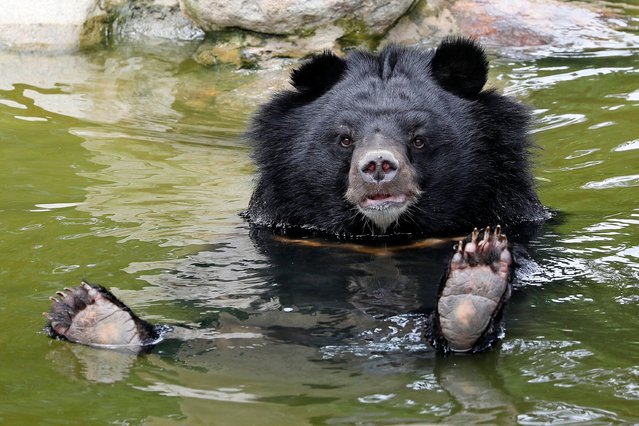
A moon bear rests in a pool inside an enclosure at the Vietnam bear rescue centre, in Tam Dao national park, Vinh Phuc, Vietnam, 09 July 2019. The center is operated by international organization Animals Asia. There are currently 184 bears living at the the Vietnam Bear Rescue Centre. It is estimated that there are less than a few hundred bears left in the wild in Vietnam. According to the latest data from the Ministry of Agriculture and Rural development, around 600 bears are still being kept on farms. In Vietnam, Animals Asia has rescued a total of 209 sun bears and moon bears. (Photo by Minh Hoang/EPA/EFE/Rex Features/Shutterstock)

A moon bear rests in a pool inside an enclosure at the Vietnam bear rescue centre, in Tam Dao national park, Vinh Phuc, Vietnam, 09 July 2019. The center is operated by international organization Animals Asia. There are currently 184 bears living at the the Vietnam Bear Rescue Centre. It is estimated that there are less than a few hundred bears left in the wild in Vietnam. According to the latest data from the Ministry of Agriculture and Rural development, around 600 bears are still being kept on farms. In Vietnam, Animals Asia has rescued a total of 209 sun bears and moon bears. (Photo by Minh Hoang/EPA/EFE/Rex Features/Shutterstock)
Details
14 Jul 2019 00:05:00
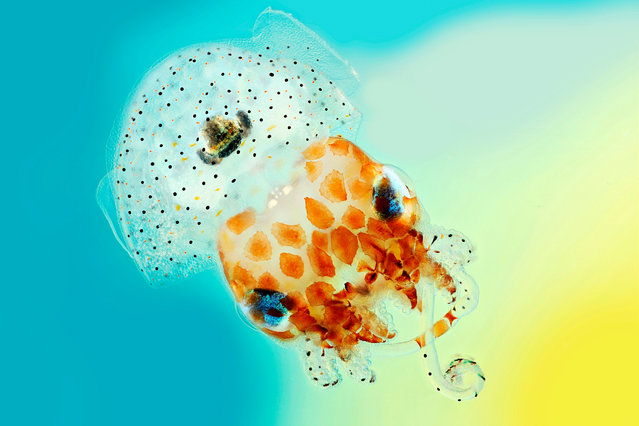
With its huge eyes, comical name and diminutive size, Mark R. Smith’s image of a baby Hawaiian bobtail squid can’t help but raise a smile. A curiously endearing creature, the cephalopod is just 1.5cm across, its mantle cavity bearing more than a passing resemblance to a rather natty shower cap. But it is also a beautiful example of symbiosis – nature’s version of “I’ll scratch your back if you scratch mine” – for on the underside of the squid is a light organ which houses bioluminescent bacteria. The squid offers the bacteria protection and food, while the bacteria emit a glow – a handy trait that the squid uses to offset its silhouette, helping it to evade predators in the depths below. Mark R. Smith’s entry combines several images of a Hawaiian bobtail squid with different focus lengths to create a final picture with greater depth of field than normal. (Photo by Mark R. Smith/Wellcome Images/Macroscopic Solutions)

With its huge eyes, comical name and diminutive size, Mark R. Smith’s image of a baby Hawaiian bobtail squid can’t help but raise a smile. A curiously endearing creature, the cephalopod is just 1.5cm across, its mantle cavity bearing more than a passing resemblance to a rather natty shower cap. But it is also a beautiful example of symbiosis – nature’s version of “I’ll scratch your back if you scratch mine” – for on the underside of the squid is a light organ which houses bioluminescent bacteria. The squid offers the bacteria protection and food, while the bacteria emit a glow – a handy trait that the squid uses to offset its silhouette, helping it to evade predators in the depths below. Mark R. Smith’s entry combines several images of a Hawaiian bobtail squid with different focus lengths to create a final picture with greater depth of field than normal. (Photo by Mark R. Smith/Wellcome Images/Macroscopic Solutions)
Details
08 Mar 2017 00:05:00
Broomfield Samson, a rare breed Suffolk punch, and his rider, Alison Carroll, cool off in the River Lune at Loyne Bridge near Gressingham in Lancashire, UK on May 21, 2024. (Photo by James Glossop/ The Times & Sunday Times)

Broomfield Samson, a rare breed Suffolk punch, and his rider, Alison Carroll, cool off in the River Lune at Loyne Bridge near Gressingham in Lancashire, UK on May 21, 2024. (Photo by James Glossop/ The Times & Sunday Times)
Details
25 Jun 2025 04:12:00
Indian Army Jawan (soldiers) of the “ASC Tornadoes” daredevil bike team perform during Independence Day celebrations in Bangalore, India, 15 August 2024. India celebrated its 78th Independence Day on 15 August. (Photo by Jagadeesh N.V./EPA)

Indian Army Jawan (soldiers) of the “ASC Tornadoes” daredevil bike team perform during Independence Day celebrations in Bangalore, India, 15 August 2024. India celebrated its 78th Independence Day on 15 August. (Photo by Jagadeesh N.V./EPA)
Details
22 Aug 2024 03:46:00
“Atzeries”, a fire beast sets off his fire crackers during a “Correfocs” in Barcelona's Gracia neighborhood, Spain on May 27, 2023. (Photo by Matthias Oesterle/Alamy Live News)

“Atzeries”, a fire beast sets off his fire crackers during a “Correfocs” in Barcelona's Gracia neighborhood, Spain on May 27, 2023. (Photo by Matthias Oesterle/Alamy Live News)
Details
03 Sep 2024 03:42:00
A general view of atmosphere at the annual VOLT Festival in Sopron, 208 kms west of Budapest, Hungary on August 16, 2016. (Photo by Rockstar Photographers)

A general view of atmosphere at the annual VOLT Festival in Sopron, 208 kms west of Budapest, Hungary on August 16, 2016. (Photo by Rockstar Photographers)
Details
28 Jul 2017 09:58:00
WWII: Women And The War Effort

These stunning color portraits, produced by the U.S. Office of War Information during World War II depict the role of women in the US war effort. All of the images were shot on 4x5 color transparency film by Howard R. Hollem and Alfred T. Palmer during 1942 and 1943 and were turned over to the Library of Congress Prints and Photographs Division in 1944. They are seen here with their original captions.
Details
18 Aug 2013 13:26:00
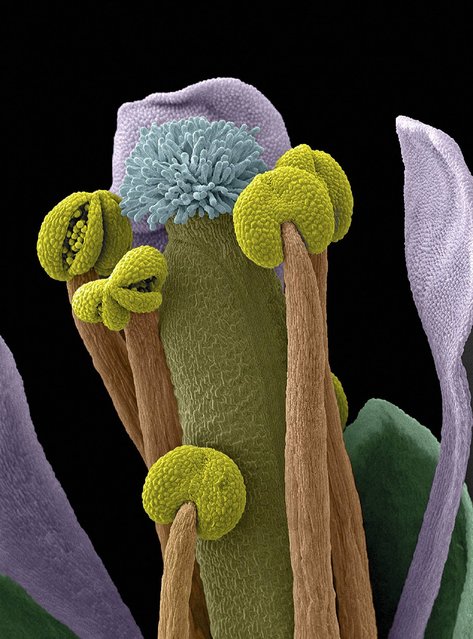
Scanning electron micrograph (SEM) of an Arabidopsis thaliana flower, also commonly known as thale cress. Some of the anthers are open, revealing pollen grains ready for dispersal. Arabidopsis was the first plant to have its entire genome sequenced and is widely used as a model organism in molecular and plant biology. Horizontal width of image is 1200 microns. Magnification 100x. (Photo by Stefan Eberhard/Wellcome Images)

Beautiful, strange and occasionally alarming pictures from the shortlist for this year’s Wellcome image awards – which celebrate the very best in science photography and imaging – from an x-ray of a bat to a micrograph of a kidney stone. The exhibition opens on 12 March at three science centres and the Museum of Science and Industry in Manchester. Photo: Scanning electron micrograph (SEM) of an Arabidopsis thaliana flower, also commonly known as thale cress. Some of the anthers are open, revealing pollen grains ready for dispersal. Arabidopsis was the first plant to have its entire genome sequenced and is widely used as a model organism in molecular and plant biology. Horizontal width of image is 1200 microns. Magnification 100x. (Photo by Stefan Eberhard/Wellcome Images)
Details
11 Mar 2014 05:58:00