Loading...
Done
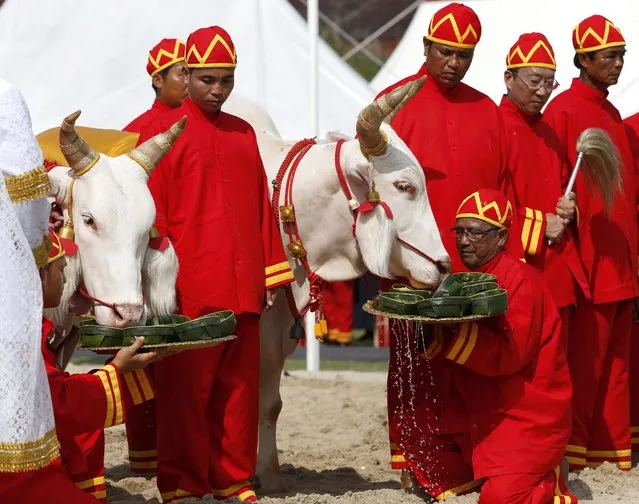
Royal sacred white oxen are offered food to consult the oracles during the Royal Ploughing Ceremony at the Royal Ground, Sanam Luang near the Grand Palace in Bangkok, Thailand, 09 May 2016. The ancient Brahmin rite is of great importance to the country's farmers. Thousands of farmers converge in Bangkok for the annual event, which is believed to assure a successful planting season and an abundance of crops. (Photo by Rungroj Yongrit/EPA)

Royal sacred white oxen are offered food to consult the oracles during the Royal Ploughing Ceremony at the Royal Ground, Sanam Luang near the Grand Palace in Bangkok, Thailand, 09 May 2016. The ancient Brahmin rite is of great importance to the country's farmers. Thousands of farmers converge in Bangkok for the annual event, which is believed to assure a successful planting season and an abundance of crops. This year the sacred oxen ate paddy, sesame seeds, water and liquor which according to traditional soothsayers predicts that the country will have abundant food, sufficient water for agriculture as well as communication and foreign trade will improve leading to the prosperous economy. (Photo by Rungroj Yongrit/EPA)
Details
10 May 2016 13:11:00
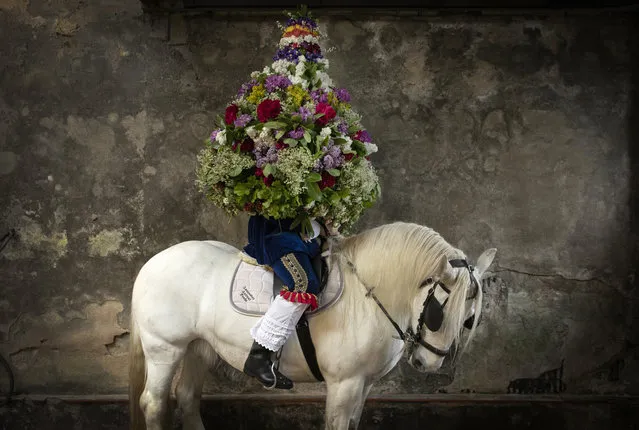
“The King”, Johnathon Haddock poses for a portrait with the Garland before the procession during “Castleton Garland Day” on May 29, 2019 in Castleton, England. The first records of Garland day date back to the 1700's and though it's true origins are not fully understood it is believed to be an ancient fertility rite with Celtic connections. The celebration also incorporates more recent elements of 'Oak Apple Day' which falls on May 29th, and celebrates the restoration of the monarchy in 1660. The garland is a framework of cut flowers which is prepared on the day by villagers before being placed on the head of the “King”, and paraded around the town on horseback with his “Consort”, also on horseback, dressed in Stuart costume. (Photo by Dan Kitwood/Getty Images)

“The King”, Johnathon Haddock poses for a portrait with the Garland before the procession during “Castleton Garland Day” on May 29, 2019 in Castleton, England. The first records of Garland day date back to the 1700's and though it's true origins are not fully understood it is believed to be an ancient fertility rite with Celtic connections. (Photo by Dan Kitwood/Getty Images)
Details
01 Jun 2019 00:07:00
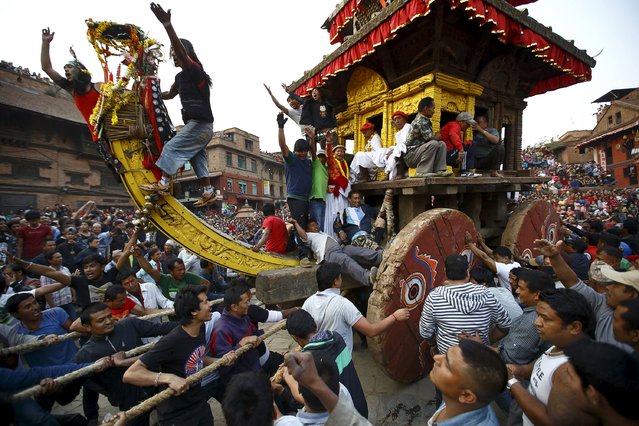
The chariot of God Bhairab is pulled through the city centre of Bhaktapur near Kathmandu during the Bisket festival April 10, 2015. The festival, which runs for more than a week and coincides with the Nepalese New Year, involves devotees offering prayers and the pulling of two chariots, one carrying the idol of God Bhairab and the other with the idol of Goddess Bhadrakali, around the ancient city of Bhaktapur. (Photo by Navesh Chitrakar/Reuters)

The chariot of God Bhairab is pulled through the city centre of Bhaktapur near Kathmandu during the Bisket festival April 10, 2015. The festival, which runs for more than a week and coincides with the Nepalese New Year, involves devotees offering prayers and the pulling of two chariots, one carrying the idol of God Bhairab and the other with the idol of Goddess Bhadrakali, around the ancient city of Bhaktapur. Devotees participate in the festival with the belief that they will be blessed with good health, fortune and harvest for the coming year. (Photo by Navesh Chitrakar/Reuters)
Details
12 Apr 2015 07:52:00
A laborer works at an upside-down house under construction at Fengjing Ancient Town, Jinshan District, south of Shanghai, March 17, 2014. Workers are putting the final touches on this eccentric tourist attraction built at the “China Folk Painting Village”. Furniture will also be placed upside down in the house, which is expected to open the public in April, according to local media. (Photo by Carlos Barria/Reuters)

A laborer works at an upside-down house under construction at Fengjing Ancient Town, Jinshan District, south of Shanghai, March 17, 2014. Workers are putting the final touches on this eccentric tourist attraction built at the “China Folk Painting Village”. Furniture will also be placed upside down in the house, which is expected to open the public in April, according to local media. (Photo by Carlos Barria/Reuters)
Details
21 Mar 2014 09:53:00
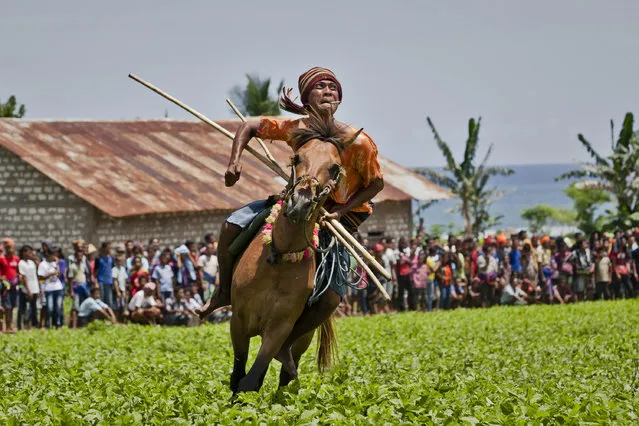
A Pasola rider reacts after throwing his spear during the Pasola war festival at Ratenggaro village on March 22, 2014 in Sumba Island, Indonesia. The Pasola Festival is an important annual event to welcome the new harvest season, which coincides with the arrival of  “Nyale” sea worms during February or March each year. Pasola, an ancient ritual fighting game, involves two teams of men on horseback charging towards each other while trying to hit their rivals with “pasol” javelins and avoid being hit themselves. (Photo by Ulet Ifansasti/Getty Images)

A Pasola rider reacts after throwing his spear during the Pasola war festival at Ratenggaro village on March 22, 2014 in Sumba Island, Indonesia. The Pasola Festival is an important annual event to welcome the new harvest season, which coincides with the arrival of “Nyale” sea worms during February or March each year. Pasola, an ancient ritual fighting game, involves two teams of men on horseback charging towards each other while trying to hit their rivals with “pasol” javelins and avoid being hit themselves. (Photo by Ulet Ifansasti/Getty Images)
Details
25 Mar 2014 07:54:00
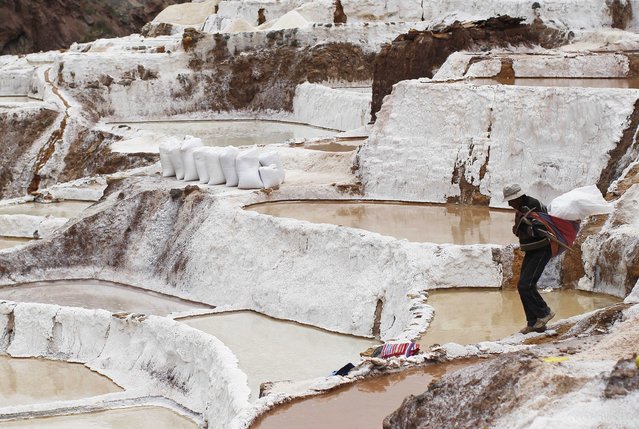
A worker carries a bag of salt after collecting it from a pond at the Maras mines in Cuzco December 3, 2014. Salt has been obtained in Maras since pre-Incan times by evaporating highly salty local subterranean stream water. The water is intricately channelled through constructions, flowing gradually down onto several hundred ancient terraced ponds. (Photo by Enrique Castro-Mendivil/Reuters)

A worker carries a bag of salt after collecting it from a pond at the Maras mines in Cuzco December 3, 2014. Salt has been obtained in Maras since pre-Incan times by evaporating highly salty local subterranean stream water. The water is intricately channelled through constructions, flowing gradually down onto several hundred ancient terraced ponds. From each pond, a local member of the mine cooperative can produce 150 to 200 kilos per month which can be sold in the markets at $0.34 per kilogram, according to miners. (Photo by Enrique Castro-Mendivil/Reuters)
Details
05 Dec 2014 13:36:00
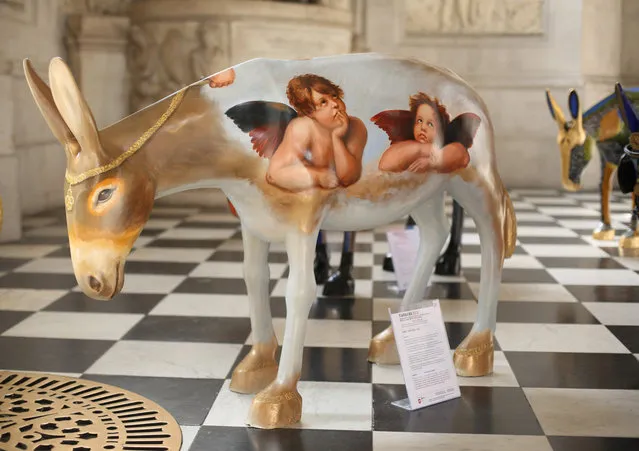
Artist painted donkey statues are displayed in the “Caravan” exhibition on August 30, 2013 in London, England. (Photo by Peter Macdiarmid/Getty Images)

Twenty five life-size donkeys have been given pride of place in St Paul's Cathedral as part of an interfaith exhibition. They've been painted by Egyptian and Western artists, to show solidarity for the people of Egypt. Photo: Artist painted donkey statues are displayed in the “Caravan” exhibition on August 30, 2013 in London, England. (Photo by Peter Macdiarmid)
Details
01 Sep 2013 09:39:00
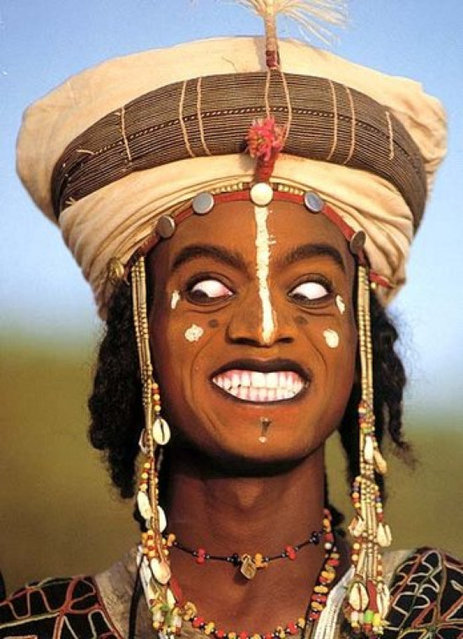
Beauty_By_Fulani

Fula people or Fulani or Fulbe are an ethnic group spread over many countries, predominantly in West Africa, but found also in Central Africa and Sudanese North Africa. African countries where they are present include Mauritania, Ghana, Senegal, Guinea, The Gambia, Mali, Nigeria, Sierra Leone, Benin, Burkina Faso, Guinea Bissau, Cameroon, Côte d'Ivoire, Niger, Chad, Togo, the Central African Republic, Liberia, and as far as Sudan and Egypt in the East. Fula people form a minority in every country they inhabit, but in Guinea they represent a plurality of the population (40%).
Details
25 Sep 2012 10:17:00