Loading...
Done
An Indian underprivileged bride gets her jewellery adjusted by a relative during a mass marriage ceremony in New Delhi, India, March 10, 2016. Fourteen  underprivileged couples tied up the nuptial knot in the mass marriage ceremony organised by various social organisations. (Photo by Rajat Gupta/EPA)

An Indian underprivileged bride gets her jewellery adjusted by a relative during a mass marriage ceremony in New Delhi, India, March 10, 2016. Fourteen underprivileged couples tied up the nuptial knot in the mass marriage ceremony organised by various social organisations. (Photo by Rajat Gupta/EPA)
Details
22 Mar 2016 11:01:00
An abandoned tank left by Boko Haram, February 20, 2016, seen on the road to Michika, Nigeria – a town formerly occupied by the insurgents. On April 14, 2014, 300 schoolgirls in the Chibok village in Nigeria were kidnapped by the terrorist group, Boko Haram. Two years later, the majority of these girls are still missing. According to the Global Terrorism Index Report 2015, Boko Haram, which operates mainly in Nigeria, has become the most deadly terrorist group in the world. (Photo by Danielle Villasana)

An abandoned tank left by Boko Haram, February 20, 2016, seen on the road to Michika, Nigeria – a town formerly occupied by the insurgents. On April 14, 2014, 300 schoolgirls in the Chibok village in Nigeria were kidnapped by the terrorist group, Boko Haram. Two years later, the majority of these girls are still missing. According to the Global Terrorism Index Report 2015, Boko Haram, which operates mainly in Nigeria, has become the most deadly terrorist group in the world. (Photo by Danielle Villasana)
Details
22 Apr 2016 13:13:00
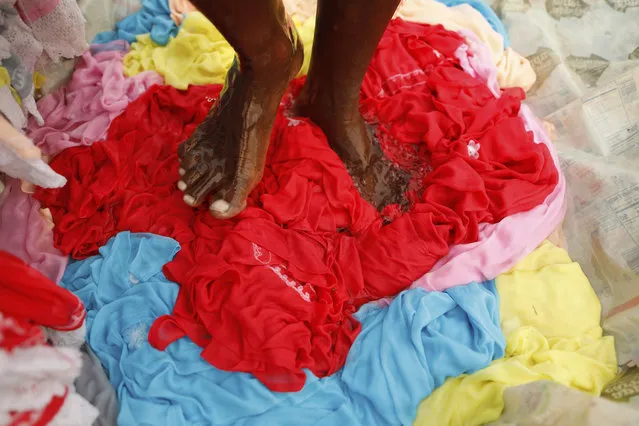
A dhobi, or a washerman washes cloths on the banks of the River Gomti in Lucknow, India, Saturday, September 12, 2020. Dhobis are traditional laundry workers who wash clothes by hand and dry them in the sun, an occupation which has been in existence for generations. Most cities in India have a Dhobi Ghat, or washermen's area, where the city's pile of clothes is laundered. This practice is still popular in India, despite of modern technology. Around 1,000 families work in Lucknow's Dhobi Ghat. However, in light of the novel coronavirus, their wages have decreased drastically. With each family earning around US$100-200 per month. (Photo by Rajesh Kumar Singh/AP Photo)

A dhobi, or a washerman washes cloths on the banks of the River Gomti in Lucknow, India, Saturday, September 12, 2020. Dhobis are traditional laundry workers who wash clothes by hand and dry them in the sun, an occupation which has been in existence for generations. Most cities in India have a Dhobi Ghat, or washermen's area, where the city's pile of clothes is laundered. This practice is still popular in India, despite of modern technology. Around 1,000 families work in Lucknow's Dhobi Ghat. However, in light of the novel coronavirus, their wages have decreased drastically. With each family earning around US$100-200 per month. (Photo by Rajesh Kumar Singh/AP Photo)
Details
25 Sep 2020 00:03:00
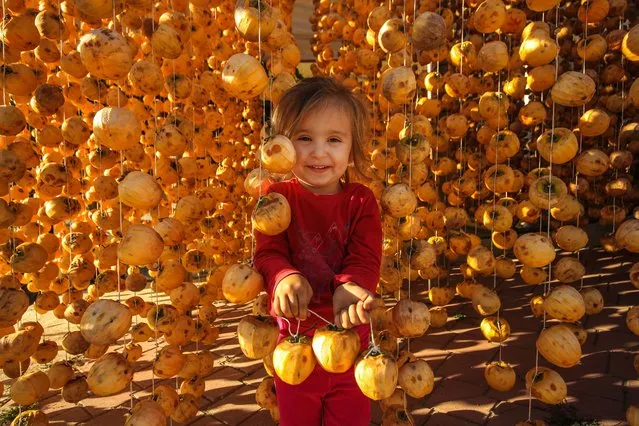
A child is seen with persimmons in Denizli, Turkiye on October 24, 2022. (Photo by Ummu Nisan Kandilcioglu/Anadolu Agency via Getty Images)

A child is seen with persimmons in Denizli, Turkiye on October 24, 2022. (Photo by Ummu Nisan Kandilcioglu/Anadolu Agency via Getty Images)
Details
09 Nov 2022 05:32:00
Germany's Angelique Kerber reacts after popping a bottle of champagne, a day following her win in the final match at the Australian Open tennis tournament, at the Government House in Melbourne, Australia, January 31, 2016. (Photo by Issei Kato/Reuters)

Germany's Angelique Kerber reacts after popping a bottle of champagne, a day following her win in the final match at the Australian Open tennis tournament, at the Government House in Melbourne, Australia, January 31, 2016. (Photo by Issei Kato/Reuters)
Details
01 Feb 2016 13:38:00
A dead crocodile is seen on Huangsha Seafood Market in Guangzhou, Guandong Province, China, 22 January 2018. Tsukiji Market of China or Huangsha Seafood Market is biggest one in Southern China and one of the biggest in China, as there are literally hundreds of different varieties of fish and seafood scattered throughout the market. Since the proximity of the fish market is so close to the Zhujiang River, it's quite easy for the large fishing vessels and fishermen to unload their fresh catch right at the market, which ensures that the fish and seafood remain fresh. Fish and other seafood are coming there from all around the globe. Seafood Market is full of different kinds of live fish, live shellfish, and live seafood on display in crystal clear tanks and it's common to see 5-star chefs, retailers and expats to source for fresh and high-quality seafood supplies for reasonable prices. While it is a wholesale fish market, since many Guangzhou restaurants and businesses come to purchase their seafood here, the public is welcome to come and even purchase. Many local Chinese have the vendors slice up fresh salmon fillets to take home or carry seafood into one of the nearby specialty restaurants, where they will cook if for them and serve it with vegetables and other side dishes of their choice. One of the biggest attractions for both, tourists and buyers, on market are crocodiles, which are brought there alive in wooden cases with taped jaws so they can?t accidentally bite. They are from crocodile farms from Guangdong, China and from Vietnam. Crocodile meat is popular in most Asian countries and it is consider as delicate one. Crocodiles weight from 10 to 25 kg and bigger ones are about 2 years old. They cost about 70 RMB (8.90 EURO) when bout as whole, or if you buy as parts most expensive and appreciated parts are paws 120 RMB (15.26 EURO) per kg, and tail 100 RMB (12.72 EURO) per kg. (Photo by Aleksandar Plavevski/EPA/EFE)

A dead crocodile is seen on Huangsha Seafood Market in Guangzhou, Guandong Province, China, 22 January 2018. Tsukiji Market of China or Huangsha Seafood Market is biggest one in Southern China and one of the biggest in China, as there are literally hundreds of different varieties of fish and seafood scattered throughout the market. (Photo by Aleksandar Plavevski/EPA/EFE)
Details
17 Apr 2020 00:05:00
Once applied, the designs are washed using warm water and cow dung. Herbs are applied to promote faster healing. (Photo by Ronny Sen/WaterAid/The Guardian)

For more than 2,000 years, women from the Baiga tribe in the highland district of Dindori, in central India’s Madhya Pradesh state, have been tattooed. Sumintra, 25, from Bona village, has the markings across her forehead, legs and arms. The women who work as tattoo artists are knowledgable about the different types of designs and pigments preferred by various tribes, and their meanings are passed to them by their mothers. The tattooing ‘season’ begins with the approach of winter. (Photo by Ronny Sen/WaterAid/The Guardian)
Details
19 Aug 2017 08:48:00
The Jinshanling Great Wall is seen after a rainfall on March 31, 2022 in Chengde, Hebei Province of China. (Photo by Zhou Wanping/VCG via Getty Images)

The Jinshanling Great Wall is seen after a rainfall on March 31, 2022 in Chengde, Hebei Province of China. (Photo by Zhou Wanping/VCG via Getty Images)
Details
20 May 2022 05:08:00