Loading...
Done
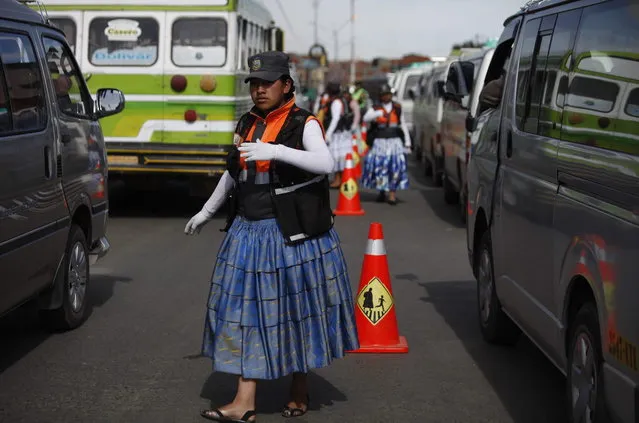
In this December 3, 2013 photo, an Aymara woman cops directs traffic on the streets of El Alto, Bolivia. The women wear the bright petticoats and shawls of indigenous women in the Andes, called cholitas in Bolivian slang, the main difference being that instead of bowler hats they wear khaki green police-style caps. Some don fluorescent traffic vests. (Photo by Juan Karita/AP Photo)

“This city in Bolivia's highlands has hired Aymara women dressed in traditional multilayered Andean skirts and brightly embroidered vests to work as traffic cops and bring order to its road chaos. About 20 of the “traffic cholitas” have been trained to direct cars and buses in El Alto, a teeming, impoverished sister city of La Paz in Bolivia's Andes mountains”. – El Alto via Associated Press. Photo: In this December 3, 2013 photo, an Aymara woman cops directs traffic on the streets of El Alto, Bolivia. The women wear the bright petticoats and shawls of indigenous women in the Andes, called cholitas in Bolivian slang, the main difference being that instead of bowler hats they wear khaki green police-style caps. Some don fluorescent traffic vests. (Photo by Juan Karita/AP Photo)
Details
25 Dec 2013 10:48:00
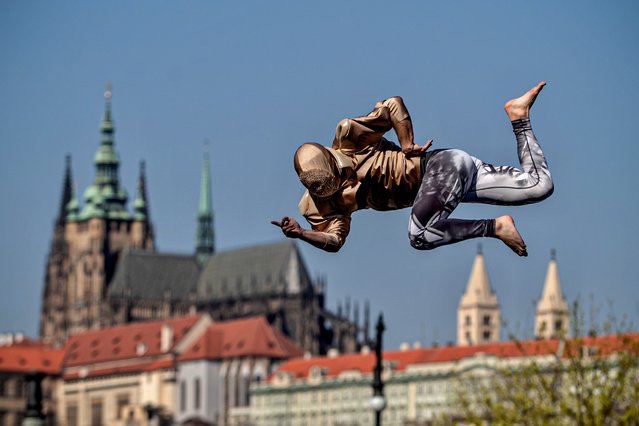
A member of the contemporary circus company Cirk La Putyka perform on the mobile trampoline as he amuses local residents in Prague, Czech Republic, 09 April 2020. The aim of the Cirk La Putyka events in the streets of Czech capital is to get live art back to people during the lockdown. According to them, when people can't go to the artists, to the theater, the actors go to the people. The Czech government has imposed a lockdown in an attempt to slow down the spread of the pandemic COVID-19 disease caused by the SARS-CoV-2 coronavirus. (Photo by Martin Divisek/EPA/EFE)

A member of the contemporary circus company Cirk La Putyka perform on the mobile trampoline as he amuses local residents in Prague, Czech Republic, 09 April 2020. The aim of the Cirk La Putyka events in the streets of Czech capital is to get live art back to people during the lockdown. According to them, when people can't go to the artists, to the theater, the actors go to the people. The Czech government has imposed a lockdown in an attempt to slow down the spread of the pandemic COVID-19 disease caused by the SARS-CoV-2 coronavirus. (Photo by Martin Divisek/EPA/EFE)
Details
11 Apr 2020 00:07:00
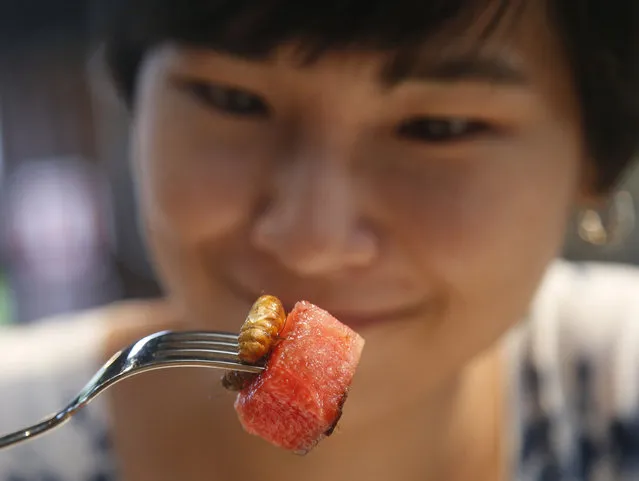
In this Tuesday, September 12, 2017 photo, Amornrat Simapsaisan, a local shop manager, watches before she ate watermelon salad with bamboo worms, at Inspects in the Backyard restaurant, Bangkok, Thailand. Tucking into insects is nothing new in Thailand, where street vendors pushing carts of fried crickets and buttery silkworms have long fed locals and adventurous tourists alike. But bugs are now fine-dining at the Bangkok bistro aiming to revolutionize views of nature’s least-loved creatures and what you can do with them. She tucked in quite happily to her watermelon and cricket salad on a recent evening.  “It’s tasty. It’s munchy”, she said. (Photo by Sakchai Lalit/AP Photo)

In this Tuesday, September 12, 2017 photo, Amornrat Simapsaisan, a local shop manager, watches before she ate watermelon salad with bamboo worms, at Inspects in the Backyard restaurant, Bangkok, Thailand. Tucking into insects is nothing new in Thailand, where street vendors pushing carts of fried crickets and buttery silkworms have long fed locals and adventurous tourists alike. But bugs are now fine-dining at the Bangkok bistro aiming to revolutionize views of nature’s least-loved creatures and what you can do with them. She tucked in quite happily to her watermelon and cricket salad on a recent evening. “It’s tasty. It’s munchy”, she said. (Photo by Sakchai Lalit/AP Photo)
Details
04 Oct 2017 06:54:00
People drink in the street in the Soho area of London, on April 12, 2021 as coronavirus restrictions are eased across the country in step two of the government's roadmap out of England's third national lockdown. Britons on Monday toasted a significant easing of coronavirus restrictions, with early morning pints – and much-needed haircuts – as the country took a tentative step towards the resumption of normal life. Businesses including non-essential retail, gyms, salons and outdoor hospitality were all able to open for the first time in months in the second step of the government's roadmap out of lockdown. (Photo by Tolga Akmen/AFP Photo)

People drink in the street in the Soho area of London, on April 12, 2021 as coronavirus restrictions are eased across the country in step two of the government's roadmap out of England's third national lockdown. Britons on Monday toasted a significant easing of coronavirus restrictions, with early morning pints – and much-needed haircuts – as the country took a tentative step towards the resumption of normal life. Businesses including non-essential retail, gyms, salons and outdoor hospitality were all able to open for the first time in months in the second step of the government's roadmap out of lockdown. (Photo by Tolga Akmen/AFP Photo)
Details
13 Apr 2021 08:02:00
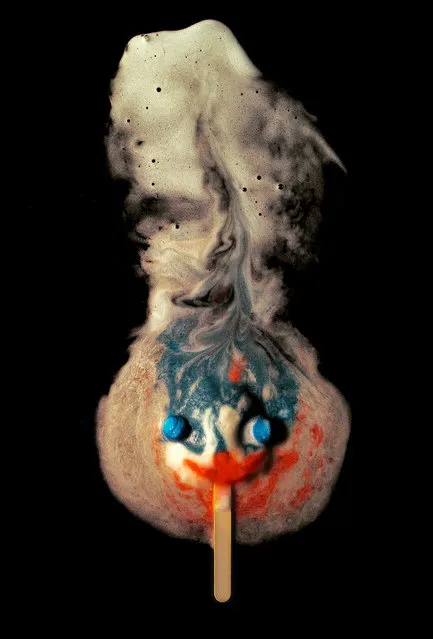
Melted Ice Cream By Michael Massaia

Michael Massaia's photographs are as nostalgic as they are disturbing. His long-exposure images capture a subject matter familiar to most. From a SpongeBob SquarePants popsicle to a Neapolitan ice cream sandwich, he frames the frozen treats most people's summer memories are made of. Yet, Massaia doesn't just realistically render his ice cream. He distorts the childhood favorites by melting them before his lens, until the pops resemble ominous pools of paint or celestial snapshots.
Details
09 Jul 2015 08:32:00
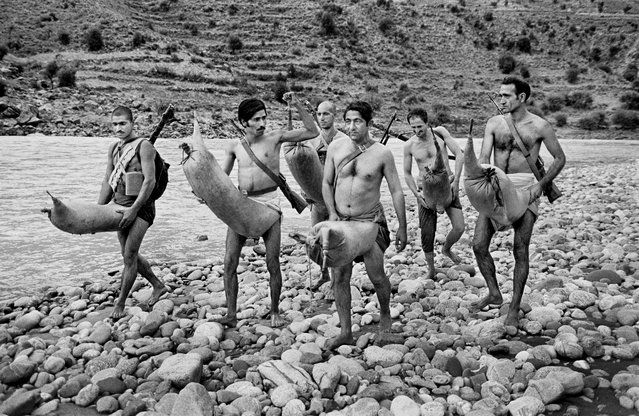
Kunar province, 1980. Armed mujahideen carry animal skins to use as inflatable buoys to cross rapids. (Photo by  Steve McCurry/Taschen/Magnum Photos/The Guardian)

Afghanistan, published by Taschen later July, is a retrospective portfolio of the Magnum photographer Steve McCurry’s most striking images of the country, from 1979 to 2016. Here: Kunar province, 1980. Armed mujahideen carry animal skins to use as inflatable buoys to cross rapids. (Photo by Steve McCurry/Taschen/Magnum Photos/The Guardian)
Details
12 Aug 2017 05:54:00
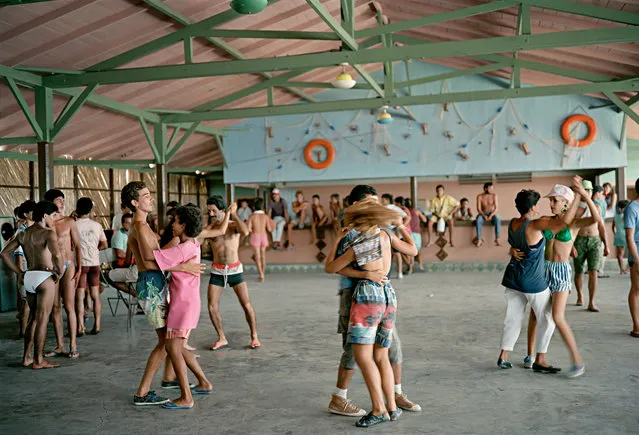
Giovan set out to capture the people’s resilience, during what Fidel Castro, with typical hyperbole, called the “special period”. (Photo by Tria Giovan/The Guardian)

As an American in 1990s Cuba, Tria Giovan risked being branded a traitor. But the photographer continued to visit and, from the dance hall to the hair salon, she captured the resilient spirit of the Cuban people. The 120 images in Tria Giovan’s “The Cuba Archive” are from the period in the 90s when, as an American, travel to Cuba could have seen her branded a traitor, as the country was subject to a US trade embargo. Her trip required lots of planning – and patience. (Photo by Tria Giovan/The Guardian)
Details
21 Sep 2017 09:04:00
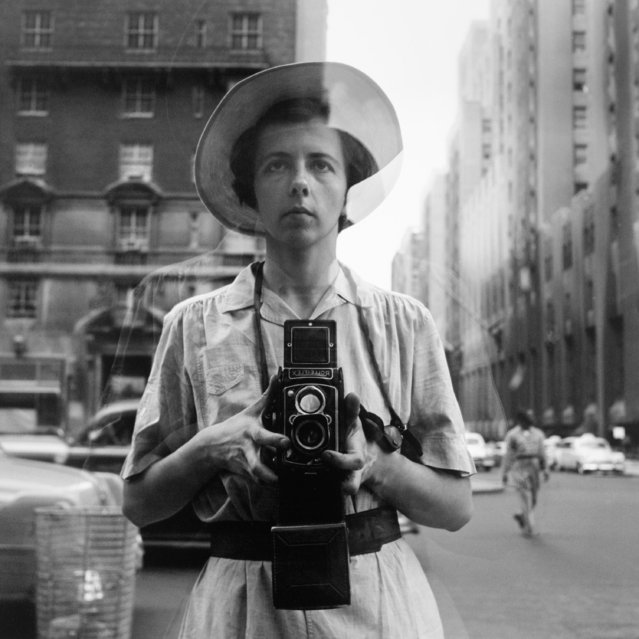
This 1950s photo provided by the Estate of Vivian Maier and John Maloof Collection shows Maier in a self-portrait as she looks into a storefront wearing a hat in New York. (Photo by Vivian Maier/Estate of Vivian Maier and John Maloof Collection via AP Photo)

This 1950s photo provided by the Estate of Vivian Maier and John Maloof Collection shows Maier in a self-portrait as she looks into a storefront wearing a hat in New York. New research about Maier shows the enigmatic Chicago nanny was obsessive about honing her skills as a photographer starting in 1950. (Photo by Vivian Maier/Estate of Vivian Maier and John Maloof Collection via AP Photo)
Details
29 Sep 2017 07:40:00