Loading...
Done
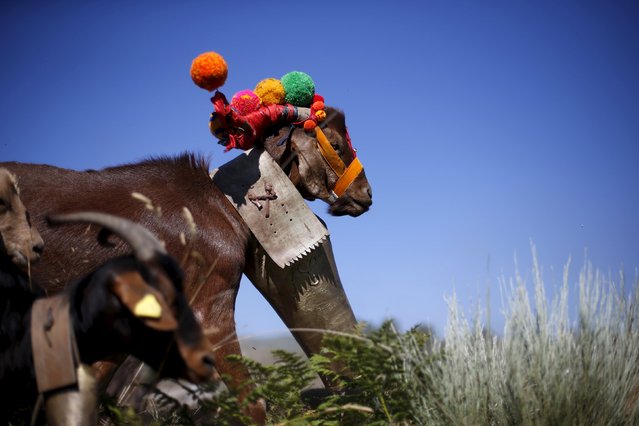
Sheep walk as they are herded to summer pastures in Serra da Estrela, near Seia, Portugal June 27, 2015. (Photo by Rafael Marchante/Reuters)

Sheep walk as they are herded to summer pastures in Serra da Estrela, near Seia, Portugal June 27, 2015. In late June, shepherds young and old in the Seia region of central Portugal start guiding sheep, goats and cattle to the Serra da Estrela, the country’s highest mountains, in search of better pastures. There they stay until the end of September. Modern-day shepherds may have mobile phones to keep in touch with family and friends, but their lifestyle has changed little for centuries. The sound of cowbells and the bark of longhaired mastiffs starts early in the morning as the animals – often decorated with traditional woollen balls on their horns – are herded up steep, narrow paths. (Photo by Rafael Marchante/Reuters)
Details
14 Jul 2015 13:48:00
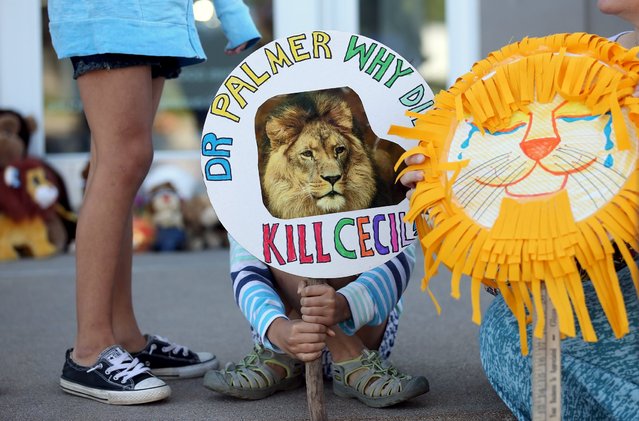
Piper Hoppe, 10, from Minnetonka, Minnesota, holds a sign at the doorway of River Bluff Dental clinic in protest against the killing of a famous lion in Zimbabwe, in Bloomington, Minnesota July 29, 2015. (Photo by Eric Miller/Reuters)

Piper Hoppe, 10, from Minnetonka, Minnesota, holds a sign at the doorway of River Bluff Dental clinic in protest against the killing of a famous lion in Zimbabwe, in Bloomington, Minnesota July 29, 2015. A Zimbabwean court on Wednesday charged a professional local hunter Theo Bronkhorst with failing to prevent an American from unlawfully killing “Cecil”, the southern African country's best-known lion. The American, Walter James Palmer, a Minnesota dentist who paid $50,000 to kill the lion, has left Zimbabwe. He says he did kill the animal but believed the hunt was legal and that the necessary permits had been issued. (Photo by Eric Miller/Reuters)
Details
30 Jul 2015 12:01:00
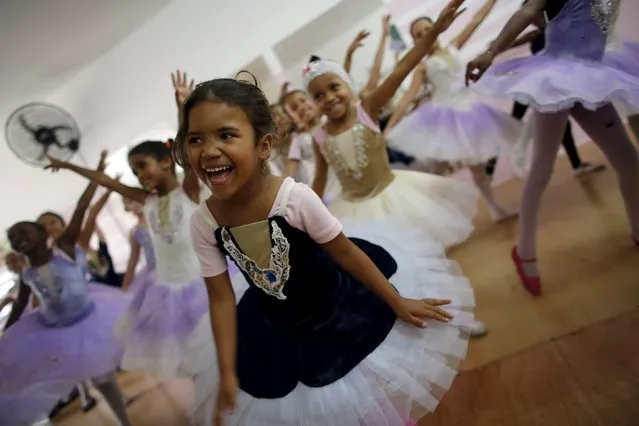
Young girls take ballet lessons at the New Dreams dance studio in the Luz neighborhood known to locals as Cracolandia (Crackland) in Sao Paulo, Brazil, August 14, 2015. (Photo by Nacho Doce/Reuters)

Young girls take ballet lessons at the New Dreams dance studio in the Luz neighborhood known to locals as Cracolandia (Crackland) in Sao Paulo, Brazil, August 14, 2015. For the young girls learning to jump and plie, the dance studio provides a way forward and out of the difficult environment they have grown up in. Brazil is one of the world's highest consuming countries of crack cocaine, and Cracolandia, or “Crack Land”, located in the outskirts of Sao Paulo, is one of the most intense and brutal hubs. (Photo by Nacho Doce/Reuters)
Details
18 Aug 2015 13:59:00
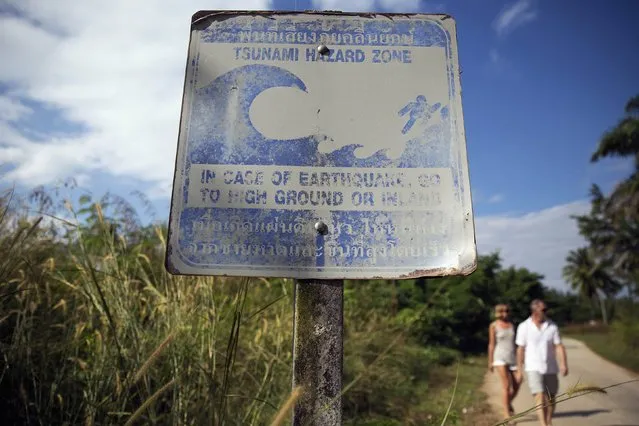
Tourists walk behind a faded sign warning of tsunami hazard in Khao Lak, Phang Nga province December 15, 2014. Ahead of the anniversary of the 2004 tsunami, experts and officials say key weaknesses remain across the region in the system designed to warn people of the next disaster, and get them to safety. (Photo by Damir Sagolj/Reuters)

Tourists walk behind a faded sign warning of tsunami hazard in Khao Lak, Phang Nga province December 15, 2014. Ahead of the anniversary of the 2004 tsunami, experts and officials say key weaknesses remain across the region in the system designed to warn people of the next disaster, and get them to safety. Thailand prepares to mark the tenth anniversary of the 2004 tsunami, the deadliest on the record, that killed at least 226,000 people in 13 Asian and African countries. (Photo by Damir Sagolj/Reuters)
Details
21 Dec 2014 11:01:00
This picture taken on February 1, 2015 shows participants competing in a tofu (beancurd) wrestling competition in Fogang county, south China's Guangdong province. Participants, mostly women, fight it out in an inflatable pool which is filled with nearly two tons of fresh milk and tofu, in a promotion to attract tourists for the upcoming Chinese Lunar New Year holiday. (Photo by AFP Photo/Stringer)

This picture taken on February 1, 2015 shows participants competing in a tofu (beancurd) wrestling competition in Fogang county, south China's Guangdong province. Participants, mostly women, fight it out in an inflatable pool which is filled with nearly two tons of fresh milk and tofu, in a promotion to attract tourists for the upcoming Chinese Lunar New Year holiday. The upcoming Chinese lunar new year of the sheep, which will fall on February 19 this year, marks the biggest festival of the year in China as hundreds of millions of people journey across the country to celebrate the season with their families. (Photo by AFP Photo/Stringer)
Details
07 Feb 2015 14:44:00
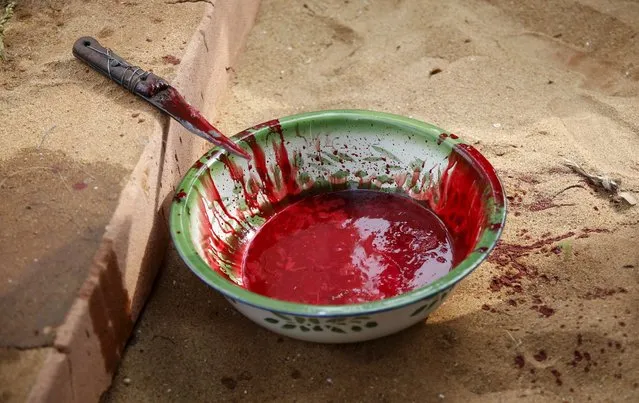
A knife is seen beside a bowl containing blood after a ram was killed as a sacrifice in front of a shrine at the annual voodoo festival in Ouidah, Benin, January 10, 2016. (Photo by Akintunde Akinleye/Reuters)

A knife is seen beside a bowl containing blood after a ram was killed as a sacrifice in front of a shrine at the annual voodoo festival in Ouidah, Benin, January 10, 2016. In Ouidah, a small town and former slave port in the West African country of Benin, the annual voodoo festival gathers visitors from far and wide. It's a week that brings together priests and dignitaries, rich and poor, locals and visitors from as far afield as the Caribbean and France. The festival commemorates the estimated 60 million people who lost their homelands and their freedom during the African slave trade. (Photo by Akintunde Akinleye/Reuters)
Details
23 Jan 2016 12:55:00
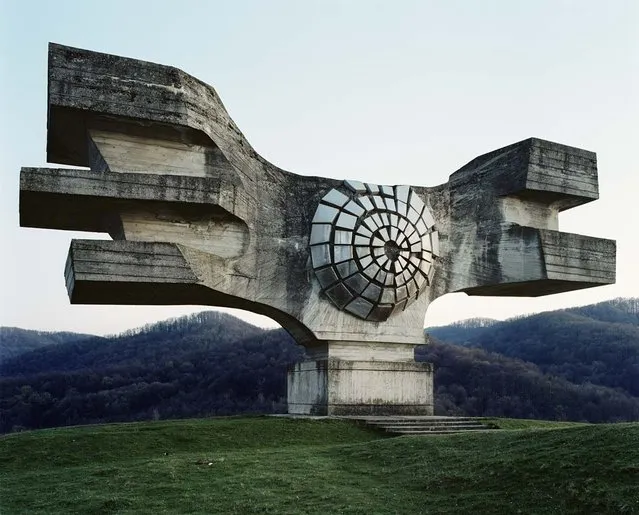
The monument of Ilirska Bistrica was designed by Janez Lenassi and built in 1965. It is dedicated to Slovenian soldiers that fell in World War II. (Photo by Jan Kempenaers)

The brutalist war memorials found throughout the former Yugoslavia were weird enough when they were built in the 1960s and 70s. Today, separated by the end of an architectural movement and the disintegration of the country, they seem almost alien. Belgian photographer Jan Kempenaers treats them purely as artistic objects in his book, “Spomenik”, named for the Serb-Croat word for monument. Known for photographing geographical oddities, Kempenaers was captivated by the spomenik after seeing them in an art encyclopedia. After hearing that many had been destroyed or abandoned, he set out to record what was left. (Photo by Jan Kempenaers)
Details
18 Aug 2014 09:07:00
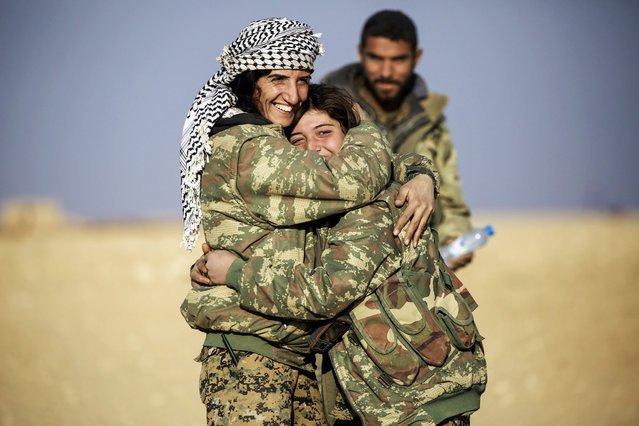
Rougine, a 19-year-old female Arab fighter among the Syrian Democratic Forces, made up of US-backed Kurdish and Arab fighters, stands in fatigues embracing another colleague near the village of al-Torshan, 20 km on the outskirts of Raqa on February 6, 2017. Unlike Syria's Kurds, who have emphasised gender equality in both their militias and nascent autonomous governing institutions in north and northeast Syria, the Arab tribes in the same region are among the more conservative segments of the country's population, and most Arab families find the concept of female fighters “hard to accept”. (Photo by Delil Souleiman/AFP Photo)

Rougine, a 19-year-old female Arab fighter among the Syrian Democratic Forces, made up of US-backed Kurdish and Arab fighters, stands in fatigues embracing another colleague near the village of al-Torshan, 20 km on the outskirts of Raqa on February 6, 2017. (Photo by Delil Souleiman/AFP Photo)
Details
13 Feb 2017 00:05:00