Loading...
Done
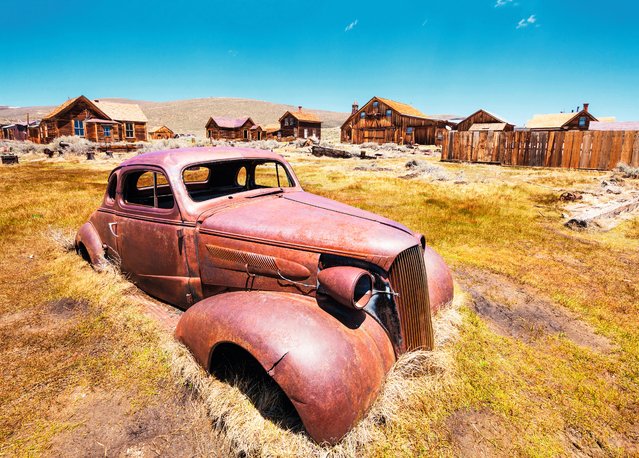
Bodie, Mono County, California. Gold was discovered at Bodie in 1859 (just after the initial California gold rush) and it went from mining camp to boomtown. Its decline began in 1880, when word spread of new boomtowns elsewhere. The Standard Consolidated Mine closed in 1913, and four years later the Bodie Railway was abandoned. By 1940 the population was down to 40. Today, Bodie is maintained in a state of arrested decay as a visitor attraction. (Photo by Alamy Stock Photo)

Kieron Connolly’s new book of photographs of more than 100 once-busy and often elegant buildings gives an idea of how the world might look if humankind disappeared. Here: Bodie, Mono County, California. Gold was discovered at Bodie in 1859 (just after the initial California gold rush) and it went from mining camp to boomtown. Its decline began in 1880, when word spread of new boomtowns elsewhere. The Standard Consolidated Mine closed in 1913, and four years later the Bodie Railway was abandoned. By 1940 the population was down to 40. Today, Bodie is maintained in a state of arrested decay as a visitor attraction. (Photo by Alamy Stock Photo)
Details
07 Sep 2016 09:50:00
Workers carry a metal sheet at a dockyard in Dhaka, Bangladesh, December 5, 2018. (Photo by Mohammad Ponir Hossain/Reuters)

Workers carry a metal sheet at a dockyard in Dhaka, Bangladesh, December 5, 2018. (Photo by Mohammad Ponir Hossain/Reuters)
Details
12 Dec 2018 00:03:00
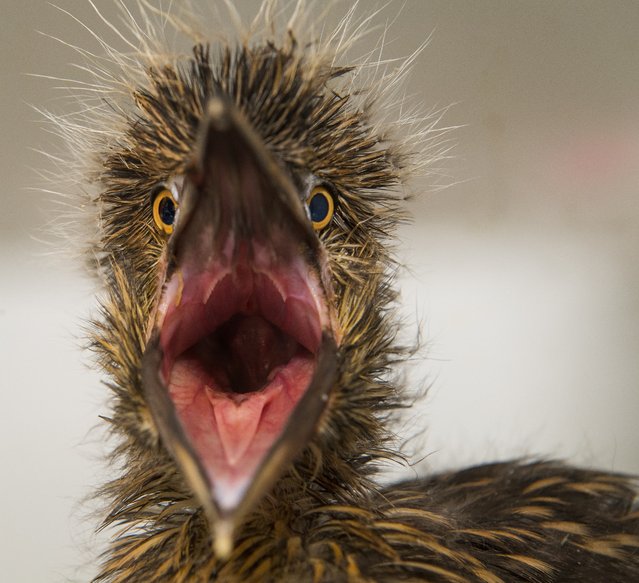
A baby Black-crowned Night Heron squawks in its incubator while being cared for at City Wildlife rescue and rehabilitation center in Washington, DC on May 31, 2017. The heron is one of several that have been brought to CW by the staff at The National Zoo over the past few years. The heron is a native bird and has made an established rookery inside the zoo grounds over a hundred years ago.  Every year at this time, some of the chicks get pushed or fall out of the nest and require human care.  Because the birds are native and not part of the Smithsonian collection, they partnered with CW to rehabilitate the herons for re-release back to the flock inside Zoo. They're reintroduced back to their flock so that they can migrate together in the Fall. The Black-crowned heron usually migrates from the DC area down to southeast North Carolina, some going as far as Jacksonville, FL in winter. The Black-crowned heron is the species of greatest conservation need in the District of Columbia because their numbers are in such rapid decline due to habitat loss. (Photo Linda Davidson/The Washington Post)

A baby Black-crowned Night Heron squawks in its incubator while being cared for at City Wildlife rescue and rehabilitation center in Washington, DC on May 31, 2017. The heron is one of several that have been brought to CW by the staff at The National Zoo over the past few years. (Photo Linda Davidson/The Washington Post)
Details
04 Jun 2017 08:04:00
Cuban actor Ana de Armas seen attending Bond: No Time To Die – world film premiere afterparties on September 28, 2021 in London, England. (Photo by Backgrid USA)

Cuban actor Ana de Armas seen attending Bond: No Time To Die – world film premiere afterparties on September 28, 2021 in London, England. (Photo by Backgrid USA)
Details
08 Oct 2021 08:52:00
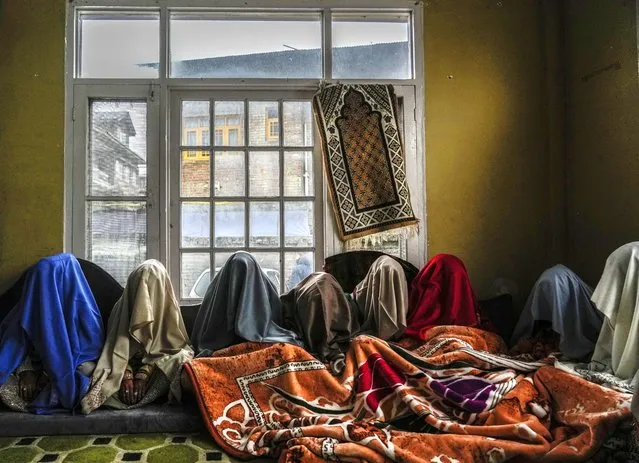
Kashmiri Muslim brides sit during a mass marriage of 30 couples in Srinagar, Indian controlled Kashmir, Wednesday, February 21, 2024. Mass weddings in India are organized by social organizations primarily to help economically weaker families who cannot afford the high ceremony costs as well as the customary dowry and expensive gifts that are still prevalent in many communities. (Photo by Mukhtar Khan/AP Photo)

Kashmiri Muslim brides sit during a mass marriage of 30 couples in Srinagar, Indian controlled Kashmir, Wednesday, February 21, 2024. Mass weddings in India are organized by social organizations primarily to help economically weaker families who cannot afford the high ceremony costs as well as the customary dowry and expensive gifts that are still prevalent in many communities. (Photo by Mukhtar Khan/AP Photo)
Details
27 Feb 2024 07:08:00
“Red Pepperpion. (Photo by Vanessa Dualib)

“Red Pepperpion. Red Pepperpions are secretive, nocturnal arachilli which can be spotted in kitchens of arid climates all around the world.

Red Pepperpions are equipped with a delicious (and depending on the quantity...deadly!) stinger at the end of its tail. If you happen to get bitten (or if you bite him!) it will produce a burning sensation on your taste nerves.

However, there is no need to worry, since the fact is that his potent stinger is usually only used when hunting or whenever the Pepperpion feels like he might become part of someones meal...

At daylight or when encountering a larger foe, such as a Saucier Chef, they retreat into burrows inside the fridge or hide beneath the oven”. (Photo and comment by Vanessa Dualib)


Details
08 Feb 2013 09:24:00
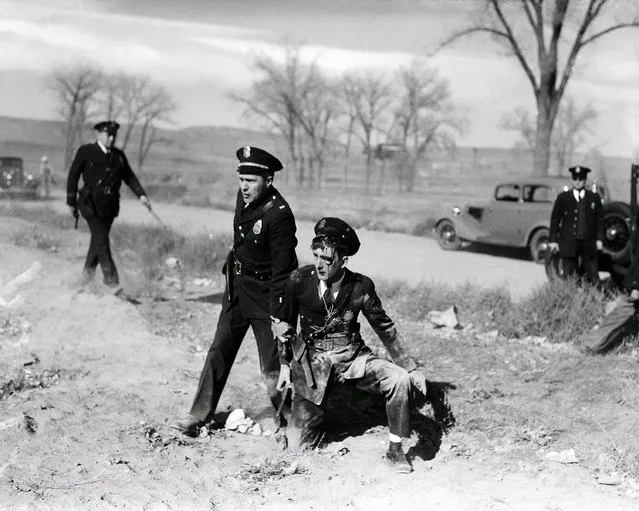
A fellow officer comes to the aid of injured patrolman C.V. Satt, who was pelted with rocks and beer bottles during a clash between police and relief demonstrators in Denver September 23, 1935. (Photo by Henry G. Eisenhand/AP Photo)

A fellow officer comes to the aid of injured patrolman C.V. Satt, who was pelted with rocks and beer bottles during a clash between police and relief demonstrators in Denver September 23, 1935. (Photo by Henry G. Eisenhand/AP Photo)
Details
24 Sep 2015 10:57:00
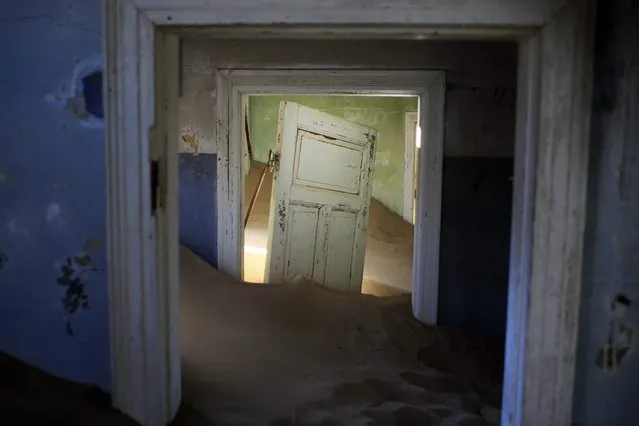
In this July 23, 2013 photo, sand fills an abandoned house in Kolmanskop, Namibia. Kolmanskop, was a diamond mining town south of Namibia, build in 1908 and deserted in 1956. SInce then, the desert slowly reclaims its territory, with sand invading the buildings where 350 German colonists and more than 800 local workers lived during its hay-days of the 1920s. (Photo by Jerome Delay/AP Photo)

In this July 23, 2013 photo, sand fills an abandoned house in Kolmanskop, Namibia. Kolmanskop, was a diamond mining town south of Namibia, build in 1908 and deserted in 1956. SInce then, the desert slowly reclaims its territory, with sand invading the buildings where 350 German colonists and more than 800 local workers lived during its hay-days of the 1920s. (Photo by Jerome Delay/AP Photo)
Details
14 Nov 2014 14:34:00