Loading...
Done
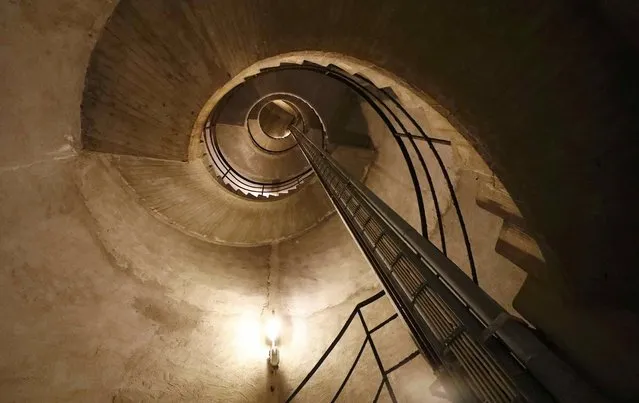
A 20 metre high spiral staircase in a tower used as an emergency exit, is seen inside a Federal Reserve bank (Bundesbank) bunker, prior to the bunker's official opening to the public in Cochem, Germany, March 18, 2016. (Photo by Kai Pfaffenbach/Reuters)

A 20 metre high spiral staircase in a tower used as an emergency exit, is seen inside a Federal Reserve bank (Bundesbank) bunker, prior to the bunker's official opening to the public in Cochem, Germany, March 18, 2016. West Germany's Central Bank (Deutsche Bundesbank) stored some 20 billion German marks of emergency notes in two underground bunkers, one in Frankfurt the other in Cochem, between 1964-1988 during the cold war. (Photo by Kai Pfaffenbach/Reuters)
Details
19 Mar 2016 12:36:00
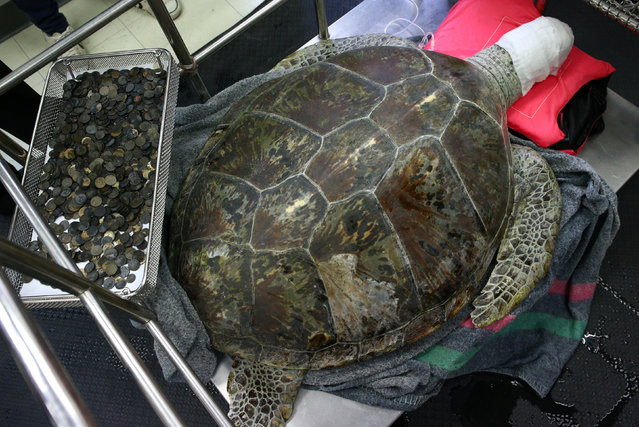
Omsin, a 25 year old femal green sea turtle, rests next to a tray of coins that were removed from her stomach after a surgical operation at the Faculty of Veterinary Science, Chulalongkorn University in Bangkok, Thailand, March 6, 2017. (Photo by Athit Perawongmetha/Reuters)

Omsin, a 25 year old femal green sea turtle, rests next to a tray of coins that were removed from her stomach after a surgical operation at the Faculty of Veterinary Science, Chulalongkorn University in Bangkok, Thailand, March 6, 2017. (Photo by Athit Perawongmetha/Reuters)
Details
08 Mar 2017 00:02:00
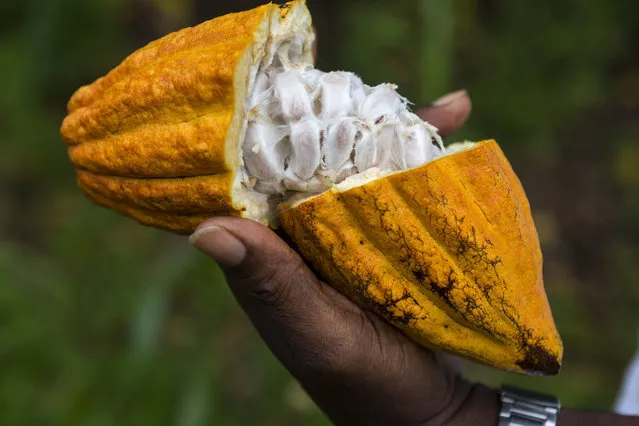
Farmer holding a freshly cut cocoa bean pod, revealing the pulp and seed inside on a rainforest farm. (Photo by Doug McKinlay/Getty Images)

Chocolate is the greatest gift the Earth has given us. The dessert table would be a sad sight without it. It’s so beloved, so appreciated, that the Swedish scientist who named the cocoa plant that gives us chocolate called it Theobroma cacao, which means “food of the gods”. Here: Farmer holding a freshly cut cocoa bean pod, revealing the pulp and seed inside on a rainforest farm. (Photo by Doug McKinlay/Getty Images)
Details
10 Aug 2016 10:20:00
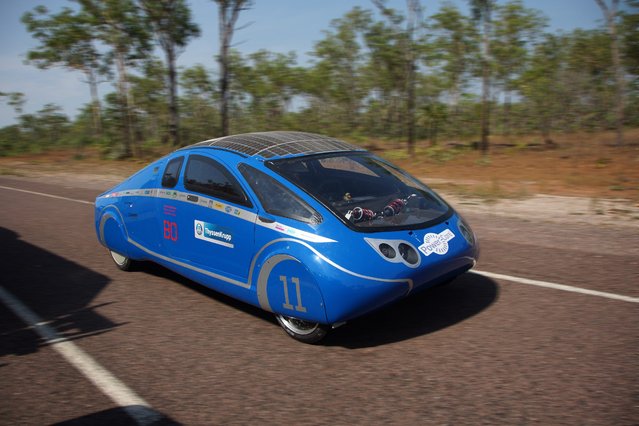
A undated handout image provided by the Bochum University of Applied Sciences (Hochschule Bochum) on 04 October 2013 shows the German team Bochum's Cruiser class solar car during a test drive in the Northern Territoty, Australia, 16 September 2013. The Dutch vehicle is competing in the World Solar Challenge, driving from Darwin to Adelaide starting on 06 October 2013. (Photo by Hochschule Bochum/EPA)

A undated handout image provided by the Bochum University of Applied Sciences (Hochschule Bochum) on 04 October 2013 shows the German team Bochum's Cruiser class solar car during a test drive in the Northern Territoty, Australia, 16 September 2013. The Dutch vehicle is competing in the World Solar Challenge, driving from Darwin to Adelaide starting on 06 October 2013. (Photo by Hochschule Bochum/EPA)
Details
29 Oct 2013 12:37:00
A fuzzy caterpillar on a basil plant in west Bengal, India on December 25, 2023. The caterpillar’s defence system is its hair, which has microscopic barbs that break off easily in the skin of would-be predators. (Photo by Soumyabrata Roy/NurPhoto/Rex Features/Shutterstock)

A fuzzy caterpillar on a basil plant in west Bengal, India on December 25, 2023. The caterpillar’s defence system is its hair, which has microscopic barbs that break off easily in the skin of would-be predators. (Photo by Soumyabrata Roy/NurPhoto/Rex Features/Shutterstock)
Details
09 Feb 2024 10:47:00
Picks him up at 25 miles an hour! If the modern auto or truck hits you don't worry. Equipped with this device you are simply given a free ride. This man even came from behind another car, was struck but not even scratched. The demonstration was given recently in Washington, D.C. (1924 December 17). (Photo by Library of Congress)

Picks him up at 25 miles an hour! If the modern auto or truck hits you don't worry. Equipped with this device you are simply given a free ride. This man even came from behind another car, was struck but not even scratched. The demonstration was given recently in Washington, D.C. (1924 December 17). (Photo by Library of Congress)
Details
14 Dec 2024 03:56:00
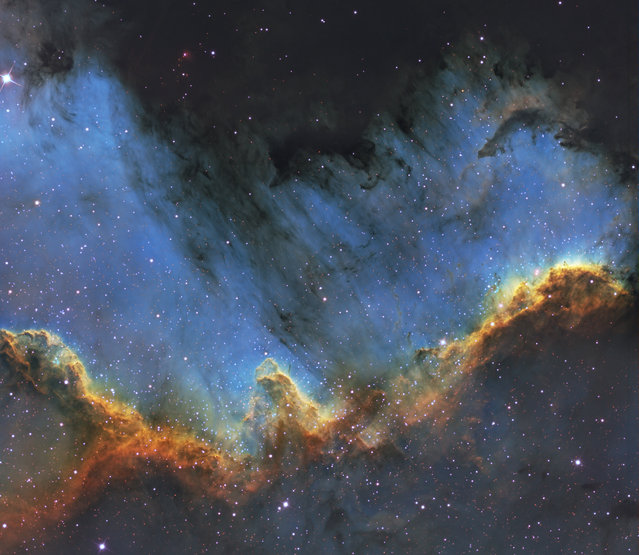
The Cygnus Wall is in the southern  area of NGC7000 also known as the North America Nebula. It is approximately 1800 light years from Earth, and is in the constellation Cygnus. The Wall is an energized shock front and contains the most concentrated star formations in the nebula. The size of the North America Nebula is about 4 full moons. (Bill Snyder)

Amateur astronomer Bill Snyder has been involved with astrophotography since 2007. Photo: The Cygnus Wall is in the southern area of NGC7000 also known as the North America Nebula. It is approximately 1800 light years from Earth, and is in the constellation Cygnus. The Wall is an energized shock front and contains the most concentrated star formations in the nebula. The size of the North America Nebula is about 4 full moons. (Photo and caption by Bill Snyder)
Details
30 Oct 2013 09:15:00
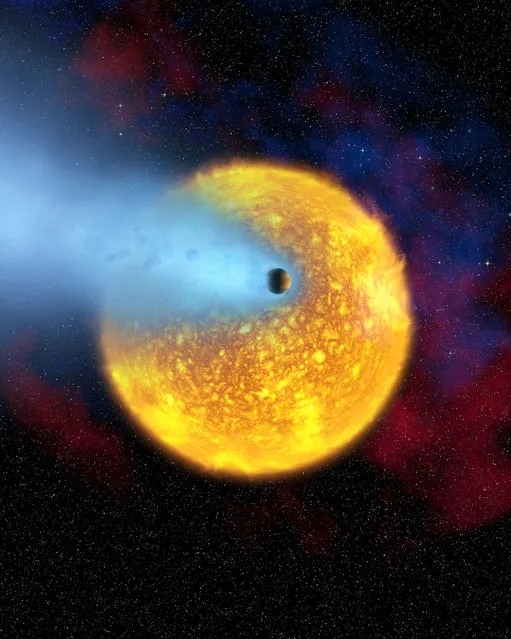
Dramatic changes spotted in HD 189733b exoplanet atmosphere

This artist's rendering illustrates the evaporation of HD 189733b's atmosphere in response to a powerful eruption from its host star. NASA's Hubble Space Telescope detected the escaping gases and NASA's Swift satellite caught the stellar flare. (Credit: NASA's Goddard Space Flight Center)
Details
29 Jun 2012 09:45:00