Loading...
Done
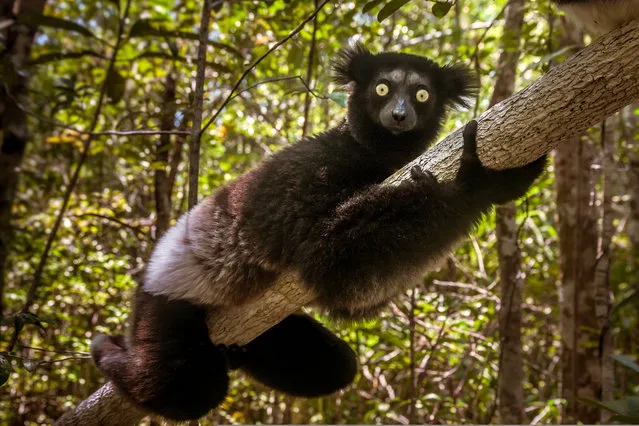
The secretive indri (Indri indri) of Madagascar, the largest living lemur. It is also critically endangered and highly evolutionarily distinct with no close relatives, which makes its branch one of most precarious on the mammal evolutionary tree. In the likely event that the indri goes extinct, we will lose 19m years of unique evolutionary history from the mammal tree of life. (Photo by Pierre-Yves Babelon/Aarhus University)

The secretive indri (Indri indri) of Madagascar, the largest living lemur. It is also critically endangered and highly evolutionarily distinct with no close relatives, which makes its branch one of most precarious on the mammal evolutionary tree. In the likely event that the indri goes extinct, we will lose 19m years of unique evolutionary history from the mammal tree of life. (Photo by Pierre-Yves Babelon/Aarhus University)
Details
18 Nov 2018 00:02:00
Personal trainer Antonietta Orsini carries out an exercise class for her neighbours from her balcony while Italians cannot leave their homes due to the coronavirus disease (COVID-19) outbreak, in Rome, Italy, March 18, 2020. (Photo by Remo Casilli/Reuters)

Personal trainer Antonietta Orsini carries out an exercise class for her neighbours from her balcony while Italians cannot leave their homes due to the coronavirus disease (COVID-19) outbreak, in Rome, Italy, March 18, 2020. (Photo by Remo Casilli/Reuters)
Details
21 Mar 2020 00:03:00
A man walks near a tree unrooted by high winds brought by Super Typhoon Saola in Causeway Bay in Hong Kong on September 1, 2023. Super Typhoon Saola threatened southern China on September 1 with some of the strongest winds the region has endured, forcing the megacities of Hong Kong and Shenzhen to effectively shut down. (Photo by Mladen Antonov/AFP Photo)

A man walks near a tree unrooted by high winds brought by Super Typhoon Saola in Causeway Bay in Hong Kong on September 1, 2023. Super Typhoon Saola threatened southern China on September 1 with some of the strongest winds the region has endured, forcing the megacities of Hong Kong and Shenzhen to effectively shut down. (Photo by Mladen Antonov/AFP Photo)
Details
06 Sep 2023 03:01:00
An aerial view of the Grand Mosque is seen on the second day of Eid al-Adha, during the annual haj pilgrimage in the holy city of Mecca September 25, 2015. (Photo by Ahmad Masood/Reuters)

An aerial view of the Grand Mosque is seen on the second day of Eid al-Adha, during the annual haj pilgrimage in the holy city of Mecca September 25, 2015. (Photo by Ahmad Masood/Reuters)
Details
28 Sep 2015 08:00:00
In 1831 an unsuccessful uprising against the Russian czar left many rebels dead. Relatives of the dead rebels, with no bodies to bury, instead left crosses, according to the Daily Mail. (Photo by Richard Gardner/Rex USA)

The phenomenon of the Hill of Crosses in northern Lithuania began when people started leaving crosses there hundreds of years ago – and continues to this day. These photos of a hill covered in crosses show the amazing sight it has become. Photo: In 1831 an unsuccessful uprising against the Russian czar left many rebels dead. Relatives of the dead rebels, with no bodies to bury, instead left crosses, according to the Daily Mail. (Photo by Richard Gardner/Rex USA)
Details
06 Jun 2013 09:56:00
Samurai commiting seppuku (hara-kiri) in Japan, circa 1880. (Photo by adoc-photos/Corbis via Getty Images)

Samurai commiting seppuku (hara-kiri) in Japan, circa 1880. (Photo by adoc-photos/Corbis via Getty Images)
Details
27 Jan 2017 10:43:00
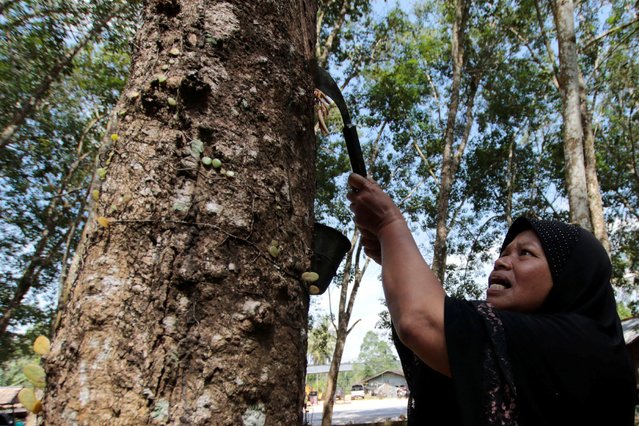
A woman works in a rubber plantation in Yala province, southern Thailand, January 30, 2017. (Photo by Surapan Boonthanom/Reuters)

A woman works in a rubber plantation in Yala province, southern Thailand, January 30, 2017. Thai rubber exporters say they have enough of the commodity in stockpiles to ensure only minimal disruption to scheduled shipments in the wake of deadly floods in key growing regions. (Photo by Surapan Boonthanom/Reuters)
Details
02 Feb 2017 05:08:00
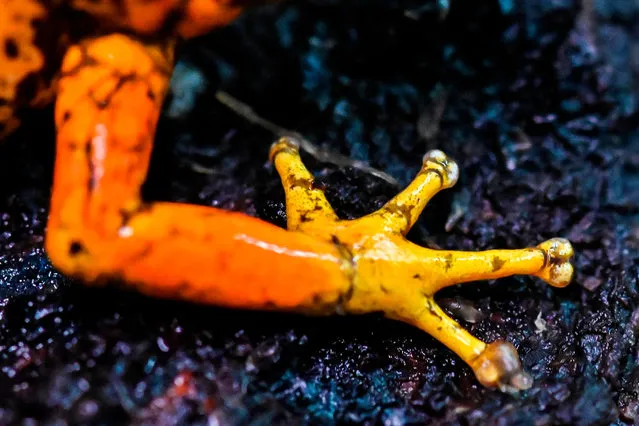
A leg of a “diablito” frog (Oophaga sylvatica) is photographed in a laboratory at a laboratory in the zoo of Cali, Colombia, on July 19, 2019. Colombia is the second country with the largest number of amphibians in the world after Brazil. More than 40% of amphibian species worldwide are in danger of extinction. (Photo by Luis Robayo/AFP Photo)

A leg of a “diablito” frog (Oophaga sylvatica) is photographed in a laboratory at a laboratory in the zoo of Cali, Colombia, on July 19, 2019. Colombia is the second country with the largest number of amphibians in the world after Brazil. More than 40% of amphibian species worldwide are in danger of extinction. (Photo by Luis Robayo/AFP Photo)
Details
28 Nov 2020 00:03:00