Loading...
Done
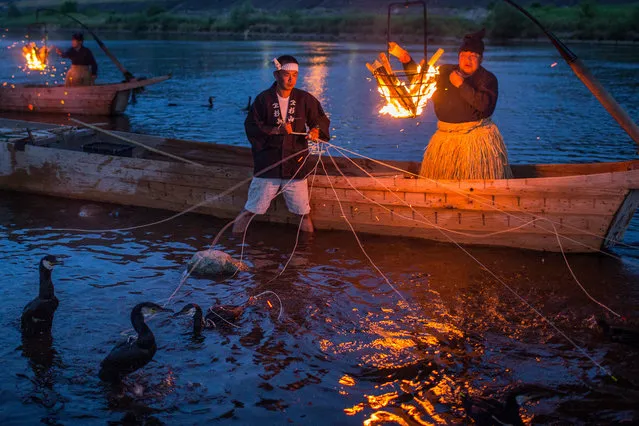
Cormorant masters and boatmen prepare sea cormorants for the nights “Ukai” on July 2, 2014 in Gifu, Japan. In this traditional fishing art “ukai”, a cormorant master called “usho” manages cormorants to capture ayu or sweetfish. The ushos of River Nagara have been the official staff of the Imperial Household Agency of Japan since 1890. Currently six imperial fishermen of Nagara River conduct special fishing to contribute to the Imperial family eight times a year, on top of daily fishing from mid-May to mid-October. (Photo by Chris McGrath/Getty Images)

Cormorant masters and boatmen prepare sea cormorants for the nights “Ukai” on July 2, 2014 in Gifu, Japan. In this traditional fishing art “ukai”, a cormorant master called “usho” manages cormorants to capture ayu or sweetfish. The ushos of River Nagara have been the official staff of the Imperial Household Agency of Japan since 1890. Currently six imperial fishermen of Nagara River conduct special fishing to contribute to the Imperial family eight times a year, on top of daily fishing from mid-May to mid-October. (Photo by Chris McGrath/Getty Images)
Details
04 Jul 2014 09:41:00
In this Tuesday, July 29, 2014, photo, Syrian refugee Samah, 5, poses for a picture at Zaatari refugee camp, near the Syrian border, in Mafraq, Jordan. More than 2.8 million Syrian children inside and outside the country – nearly half the school-aged population – cannot get an education because of the devastation from the civil war, according to the U.N. children's agency, UNICEF. (Photo by Muhammed Muheisen/AP Photo)

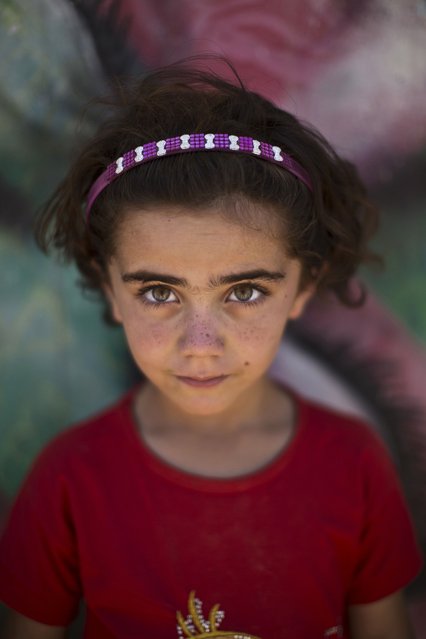
In this Tuesday, July 29, 2014, photo, Syrian refugee Samah, 5, poses for a picture at Zaatari refugee camp, near the Syrian border, in Mafraq, Jordan. More than 2.8 million Syrian children inside and outside the country – nearly half the school-aged population – cannot get an education because of the devastation from the civil war, according to the U.N. children's agency, UNICEF. That number is likely higher, as UNICEF can't count the children whose parents didn't register with the United Nations refugee agency. (Photo by Muhammed Muheisen/AP Photo)
Details
03 Aug 2014 07:46:00
These images, scanned from old glass negatives which had surfaced in northern France, were believed to have been taken by a local amateur photographer in 1916. They showed British and a few Australian soldiers, in formal or informal poses, during or just before the most murderous battle in the history of the British Empire – Battle of the Somme. Who are these British and British Empire soldiers? The identity of the soldiers is, and may always remain, a mystery. (Property of Bernard Gardin/Dominique Zanardi/Joel Scribe/The Independent Magazine)

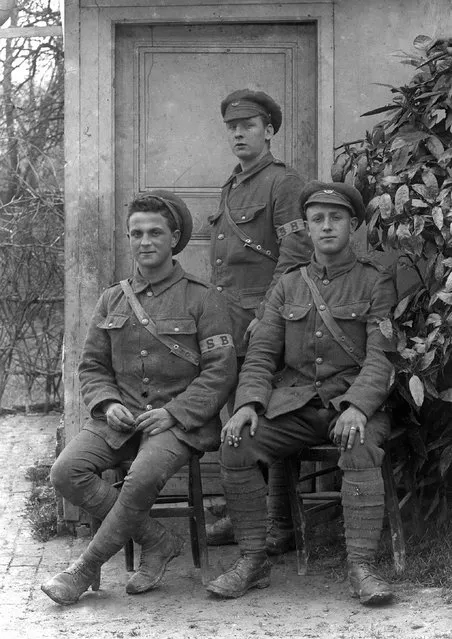
These images, scanned from old glass negatives which had surfaced in northern France, were believed to have been taken by a local amateur photographer in 1916. They showed British and a few Australian soldiers, in formal or informal poses, during or just before the most murderous battle in the history of the British Empire – Battle of the Somme. Who are these British and British Empire soldiers? The identity of the soldiers is, and may always remain, a mystery... (Property of Bernard Gardin/Dominique Zanardi/Joel Scribe/The Independent Magazine)
Details
04 Aug 2014 14:06:00
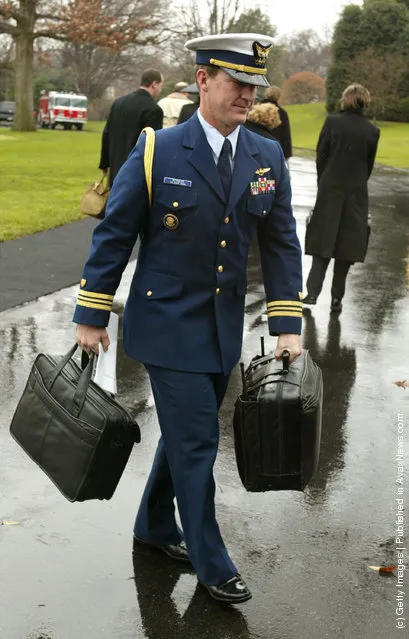
Nuclear Football

“The nuclear football (also known as the atomic football, the president's emergency satchel, the button, the black box, or just the football) is a briefcase, the contents of which are to be used by the President of the United States of America to authorize a nuclear attack while away from fixed command centers, such as the White House Situation Room. It functions as a mobile hub in the strategic defense system of the United States. It is a metallic Zero Halliburton briefcase carried in a black leather “jacket”. The package weighs around 45 pounds (20 kilograms). A small antenna protrudes from the bag near the handle”. – Wikipedia

Photo: A U.S. Military officer carries the “football”, which carries nuclear launch codes, on South Lawn after returning with U.S. President George W. Bush to the White House January 7, 2002 in Washington, DC. (Photo by Mark Wilson/Getty Images)
Details
06 Aug 2011 12:53:00
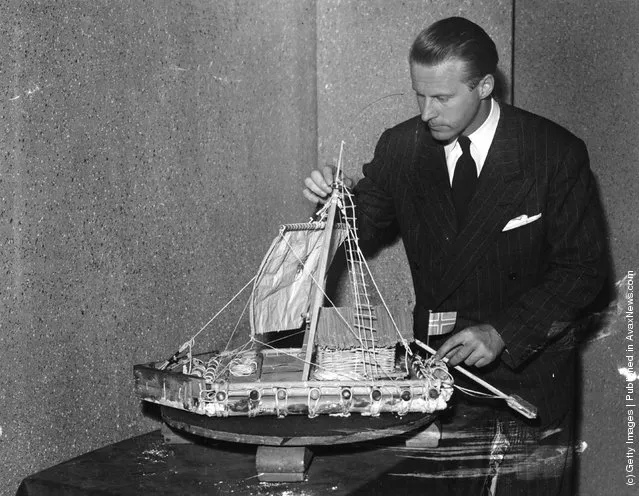
Thor Heyerdahl with a model of the balsa raft Kon Tiki

“Thor Heyerdahl (October 6, 1914, Larvik, Norway – April 18, 2002, Colla Micheri, Italy) was a Norwegian ethnographer and adventurer with a background in zoology and geography. He became notable for his Kon-Tiki expedition, in which he sailed 8,000 km (4,300 miles) by raft from South America to the Tuamotu Islands. All his expeditions are shown in the Kon-Tiki Museum, Oslo”. – Wikipedia

Photo: Norwegian anthropologist Thor Heyerdahl with a model of the balsa raft “Kon-Tiki” on which he drifted 4,300 miles from Peru to the Tuamotu Islands, proving his theory that Polynesia could originally have been populated by South Americans. (Photo by Express/Express/Getty Images). 1950
Details
09 Aug 2011 11:05:00
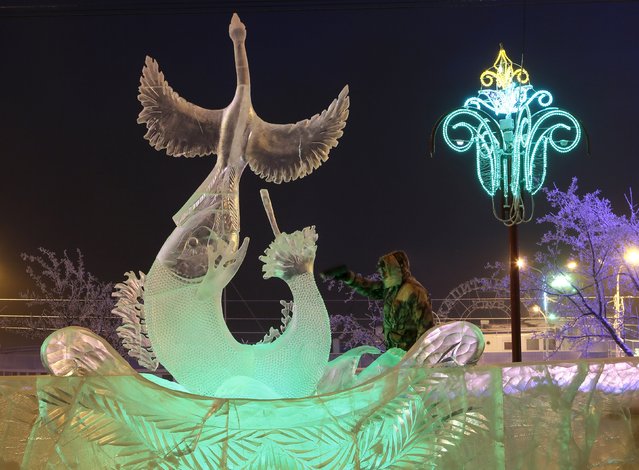
Mikhail Vasilenko, a participant from the Siberian town of Nizhny Tagil, works on an ice sculpture called “The Predator”, on the last day of the annual international festival of snow and ice sculptures “The Magical Ice of Siberia”, with the air temperature at about minus 28 degrees Celsius (minus 18.4 degrees Fahrenheit), in Krasnoyarsk, Russia, January 17, 2016. (Photo by Ilya Naymushin/Reuters)

Mikhail Vasilenko, a participant from the Siberian town of Nizhny Tagil, works on an ice sculpture called “The Predator”, on the last day of the annual international festival of snow and ice sculptures “The Magical Ice of Siberia”, with the air temperature at about minus 28 degrees Celsius (minus 18.4 degrees Fahrenheit), in Krasnoyarsk, Russia, January 17, 2016. (Photo by Ilya Naymushin/Reuters)
Details
19 Jan 2016 08:00:00
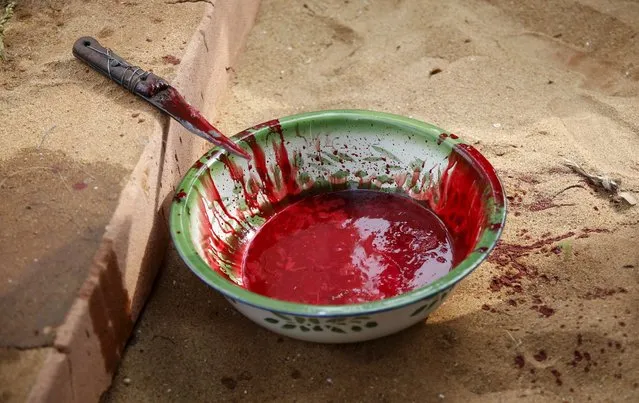
A knife is seen beside a bowl containing blood after a ram was killed as a sacrifice in front of a shrine at the annual voodoo festival in Ouidah, Benin, January 10, 2016. (Photo by Akintunde Akinleye/Reuters)

A knife is seen beside a bowl containing blood after a ram was killed as a sacrifice in front of a shrine at the annual voodoo festival in Ouidah, Benin, January 10, 2016. In Ouidah, a small town and former slave port in the West African country of Benin, the annual voodoo festival gathers visitors from far and wide. It's a week that brings together priests and dignitaries, rich and poor, locals and visitors from as far afield as the Caribbean and France. The festival commemorates the estimated 60 million people who lost their homelands and their freedom during the African slave trade. (Photo by Akintunde Akinleye/Reuters)
Details
23 Jan 2016 12:55:00
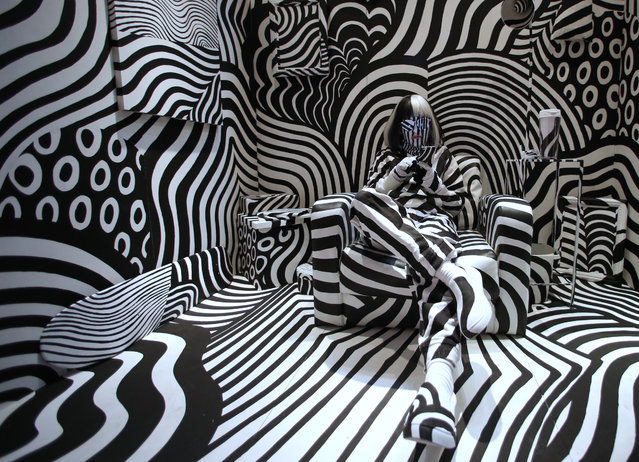
Model feebee poses as part of art installation “Dazzle room” made by artist Shigeki Matsuyama at Room 32 fashion and design exhibition in Tokyo, Friday, February 19, 2016. Matsuyama's installation features a strong contrast of black and white, which he learned from dazzle camouflage used mainly in World War I, in Tokyo, Friday, Feb. 19, 2016. (Photo by Shuji Kajiyama/AP Photo)

Model feebee poses as part of art installation “Dazzle room” made by artist Shigeki Matsuyama at Room 32 fashion and design exhibition in Tokyo, Friday, February 19, 2016. Matsuyama's installation features a strong contrast of black and white, which he learned from dazzle camouflage used mainly in World War I, in Tokyo, Friday, Feb. 19, 2016. (Photo by Shuji Kajiyama/AP Photo)
Details
20 Feb 2016 10:55:00