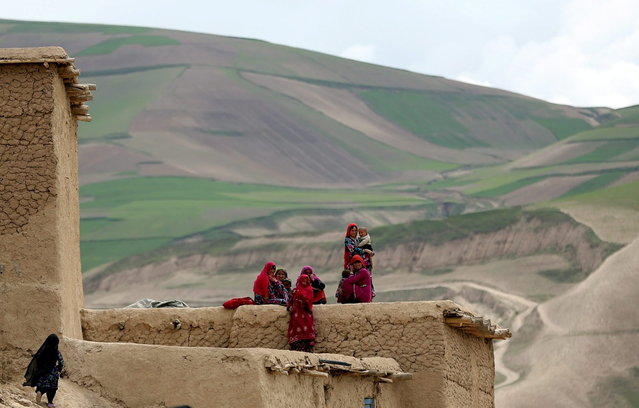
In this Sunday, May 4, 2014 photo, Survivors sit with their possessions near the site of Friday's landslide that buried Abi-Barik village in Badakhshan province, northeastern Afghanistan. Stranded and with no homes, many of the families have struggled to get aid. Some have gone to nearby villages to stay with relatives or friends, while others have slept in tents provided by aid groups. The unlucky ones have slept outside. (Photo by Massoud Hossaini/AP Photo)
“The Net thrower”. The fisherman are conducting activities on Situgunung Lake. Photo location: Situgunung lake, Sukabumi, West Java, Indonesia. (Photo and caption by Dody Kusuma/National Geographic Photo Contest)
Revelers jump on a rainbow painted crosswalk in Church Street, Toronto's LGBT neighbourhood, before “WorldPride”, a gay pride parade, in Toronto, June 29, 2014. Toronto is hosting WorldPride, a week-long event that celebrates the lesbian, gay, bisexual and transgender (LGBT) community. (Photo by Mark Blinch/Reuters)
This artist's scoreboard displays a fictional game between Mars and Earth, with Mars in the lead. It refers to the success rate of sending missions to Mars, both as orbiters and landers. Of the previous 39 missions targeted for Mars from around the world, 15 have been successes and 24 failures. For baseball fans, that's a batting average of .385. The United States has had 13 successes out of 18 attempts, or a “batting average” of .722. NASA's Curiosity rover, set to land on the Red Planet the evening of Aug. 5, 2012 PDT (morning of Aug. 6 EDT), will mark the United States' 19th attempt to tackle the challenge of Mars, and the world's 40th attempt. (Image by NASA/JPL-Caltech)
Participants wear traditional clogs as shepherds lead their sheep through the center of Madrid, October 28, 2012. (Photo by Andres Kudacki/Associated Press)
A model has makeup applied backstage prior to Lebanese designer Zuhair Murad fashion show held during the Haute Couture Fall/Winter 2014-2015 fashion collections in Paris July 10, 2014. (Photo by Philippe Wojazer/Reuters)
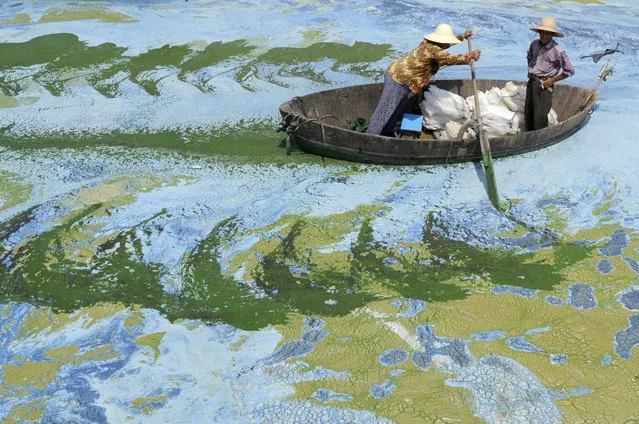
Growing cities, overuse of fertilizers and factory wastewater have degraded China's water supplies to the extent that half the nation's rivers and lakes are severely polluted. China aims to spend $850 billion to improve filthy water supplies over the next decade, but even such huge outlays may do little to reverse damage caused by decades of pollution and overuse in Beijing's push for rapid economic growth. Photo: Fishermen row a boat in the algae-filled Chaohu Lake in Hefei, Anhui province, June 19, 2009. (Photo by Jianan Yu/Reuters)