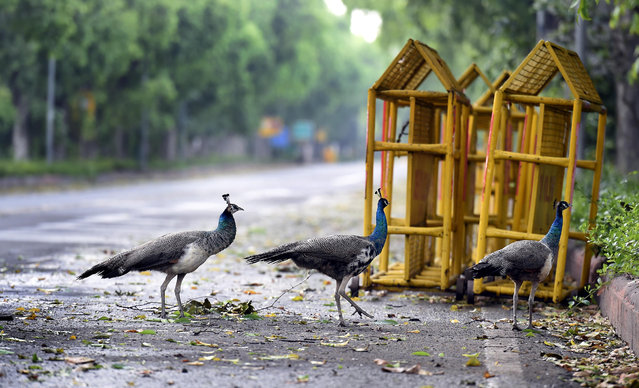
Peahens seen at Motilal Nehru Marg during lockdown to curb the spread of coronavirus, on April 19, 2020 in New Delhi, India. (Photo by Arvind Yadav/Hindustan Times via Getty Images)
A model rehearses with a fabric face mask on, designed by Zhou Li for her Autumn/Winter 2020 collection show, during China Fashion Week in Beijing, following the novel coronavirus disease (COVID-19) outbreak, China on May 3, 2020. (Photo by Tingshu Wang/Reuters)
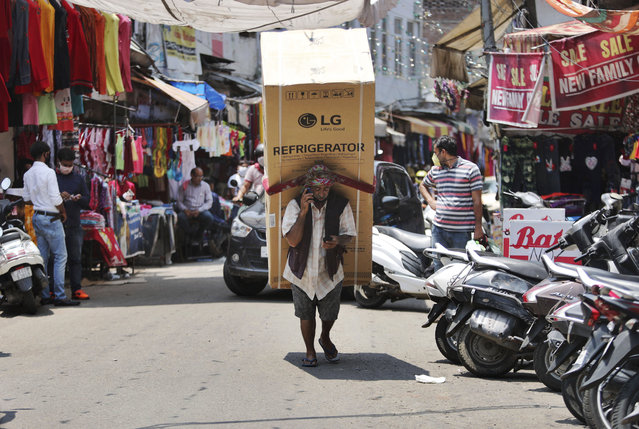
An Indian laborer talks on his mobile phone as he transports a refrigerator on his back at a market in Jammu, India, Sunday, June 7, 2020. India whose coronavirus caseload is fifth highest in the world has partially restored trains and domestic flights and allowed reopening of shops and manufacturing. (Photo by Channi Anand/AP Photo)
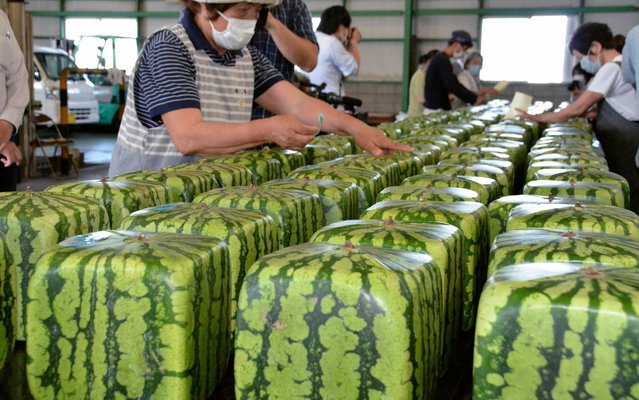
Japan Agricultural Cooperation Kagawa employees arrange cubic watermelons to be shipped within the country, in Zentsuji city, Kagawa prefecture, western Japan, Wednesday, June 24, 2020. The about 18x18x18-centimeter (7x7x7-inch) square watermelons, grown in transparent square containers, will be sold for about 10,000 yen ($94) each. (Photo ny Maiko Hirai/Kyodo News via AP Photo)
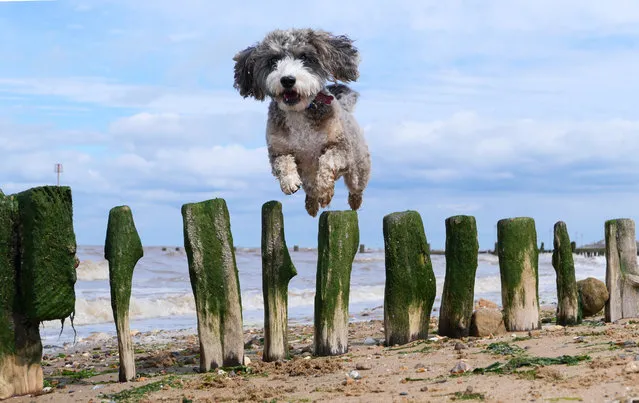
Cookie the cockapoo dog is enjoying herself on the beach by jumping over a sea defence as the sun shines at Heacham, West Norfolk, England on July 14, 2020. (Photo by Paul Marriott/Rex Features/Shutterstock)
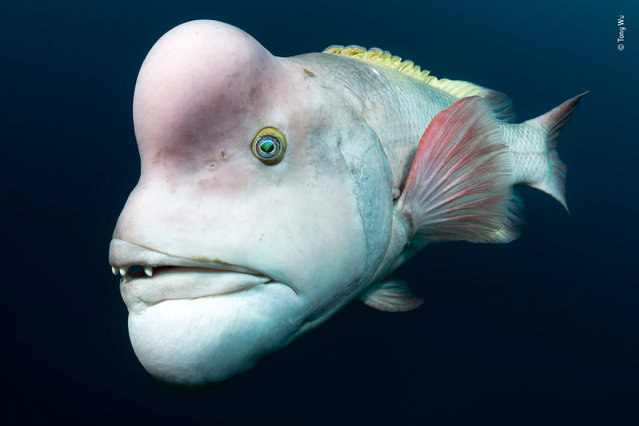
Looking for love by Tony Wu, USA. Highly commended, Animal Portraits. “Accentuating his mature appearance with pastel colours, protruding lips and an outstanding pink forehead, this Asian sheepshead wrasse sets out to impress females and see off rivals, which he will head-butt and bite, near Japan’s remote Sado Island. Individuals start out as females, and when they reach a certain age and size – up to a metre (more than 3 feet) long – can transform into males. Long-lived and slow-growing, the species is intrinsically vulnerable to overfishing”. (Photo by Tony Wu/2018 Wildlife Photographer of the Year)
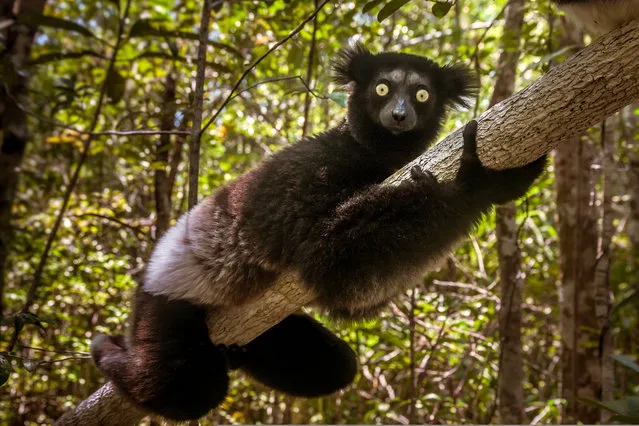
The secretive indri (Indri indri) of Madagascar, the largest living lemur. It is also critically endangered and highly evolutionarily distinct with no close relatives, which makes its branch one of most precarious on the mammal evolutionary tree. In the likely event that the indri goes extinct, we will lose 19m years of unique evolutionary history from the mammal tree of life. (Photo by Pierre-Yves Babelon/Aarhus University)
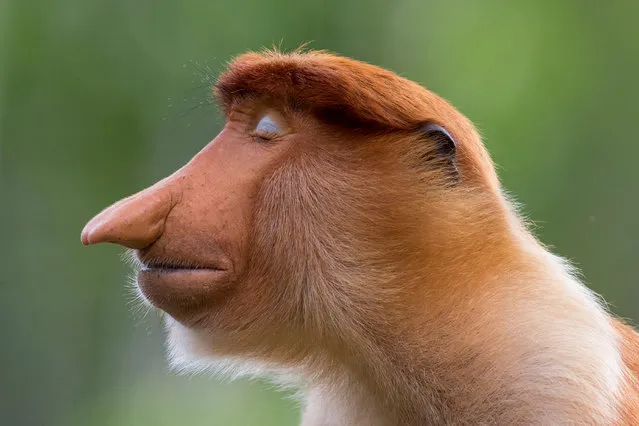
Winner – Animal Portraits: The pose by Mogens Trolle, Denmark. A young male proboscis monkey cocks his head slightly and closes his eyes. Unexpected pale blue eyelids now complement his immaculately groomed auburn hair. He poses for a few seconds as if in meditation. He is a wild visitor to the feeding station at Labuk Bay Proboscis Monkey Sanctuary in Sabah, Borneo – “the most laid-back character”, says Trolle, “quite unlike anything I’ve ever seen on another monkey” – connects us, he hopes, with a fellow primate. (Photo by Mogens Trolle/Wildlife Photographer of the Year 2020)