Loading...
Done
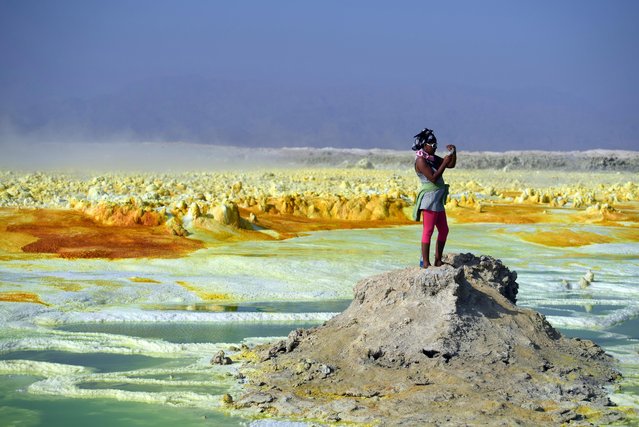
A tourist take a photograph of a sulphur lake in the Danakil Depression on January 23, 2017 near Dallol, Ethiopia. (Photo by Carl Court/Getty Images)

A tourist take a photograph of a sulphur lake in the Danakil Depression on January 23, 2017 near Dallol, Ethiopia. The depression lies 100 metres below sea level and is one of the hottest and most inhospitable places on Earth. Despite the gruelling conditions, Ethiopians continue a centuries old industry of mining salt from the ground by hand in temperatures that average 34.5 degrees centigrade but have risen to over 50 degrees. (Photo by Carl Court/Getty Images)
Details
25 Jan 2017 11:36:00
A rainbow arcs over a girl on the platform of Stadion station. (Photo by Conor MacNeill/The Observer)

Beneath the Swedish capital lies an intricate web of underground train lines. More than 90 of the 100 stations in the 110km tunnel system, sometimes referred to as “the world’s longest art gallery”, have been decorated with paintings, installations, mosaics and sculptures by 150 artists since the 1950s. After spending a couple of weeks exploring arctic Norway and Sweden, London-based travel photographer Conor MacNeill headed underground to capture images of the metro stations. Here: A rainbow arcs over a girl on the platform of Stadion station. (Photo by Conor MacNeill/The Observer)
Details
05 Jun 2016 13:21:00
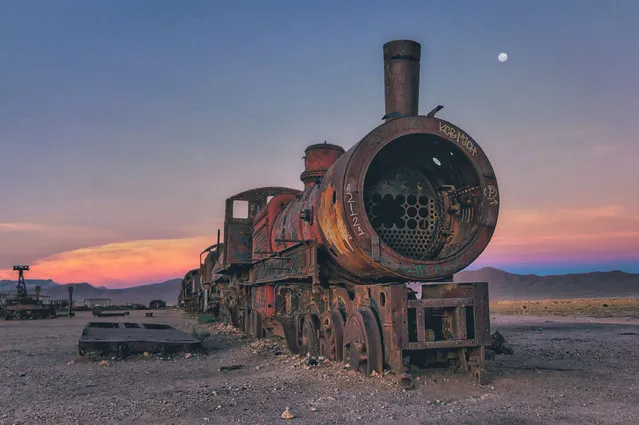
Many of the trains and locomotives are British imports and have been eroded by the harsh Bolivian climate. (Photo by Chris Staring/Rex Features/Shutterstock)

Chris Staring photographs a mysterious train graveyard in the heart of southern Bolivia, where the skeletons of British steam locomotives and rail cars rust away on the edge of the world’s largest salt flats. More than 100 rail cars and locomotives can be found in different states of decay in the train graveyard. (Photo by Chris Staring/Rex Features/Shutterstock)
Details
03 Jul 2016 10:46:00
Members of a historical re-enactment group dressed as U.S. and Soviet Army soldiers take part in Elbe Day celebrations, in eastern German city of Torgau at the river Elbe, April 25, 2015. (Photo by Stefanie Loos/Reuters)

Members of a historical re-enactment group dressed as U.S. and Soviet Army soldiers take part in Elbe Day celebrations, in eastern German city of Torgau at the river Elbe, April 25, 2015. Elbe Day commemorates the encounter of the Allies 70 years ago, on the 25th of April 1945 when American and Soviet army units joined together on the destroyed bridge over the river Elbe. The photograph of the meaningful handshake made its way around the world and became a symbol of the near end of World War II in Europe. (Photo by Stefanie Loos/Reuters)
Details
26 Apr 2015 08:58:00
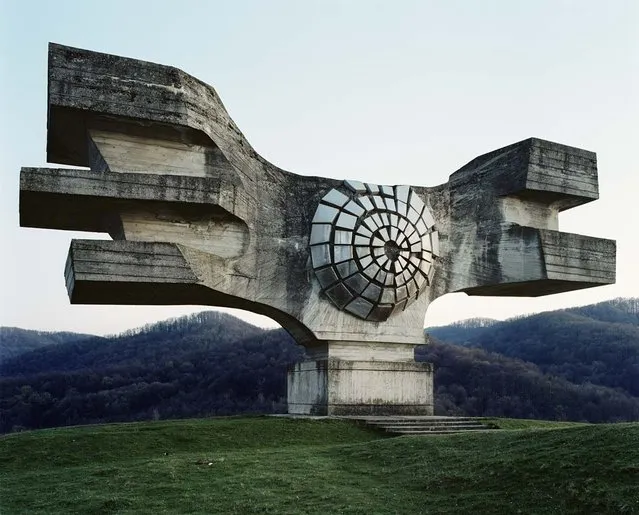
The monument of Ilirska Bistrica was designed by Janez Lenassi and built in 1965. It is dedicated to Slovenian soldiers that fell in World War II. (Photo by Jan Kempenaers)

The brutalist war memorials found throughout the former Yugoslavia were weird enough when they were built in the 1960s and 70s. Today, separated by the end of an architectural movement and the disintegration of the country, they seem almost alien. Belgian photographer Jan Kempenaers treats them purely as artistic objects in his book, “Spomenik”, named for the Serb-Croat word for monument. Known for photographing geographical oddities, Kempenaers was captivated by the spomenik after seeing them in an art encyclopedia. After hearing that many had been destroyed or abandoned, he set out to record what was left. (Photo by Jan Kempenaers)
Details
18 Aug 2014 09:07:00


(R-L) Jean-Jacques Cattier and his son Alexandre Cattier pose with the world largest bottle of Champagne “The Midas” by Armand de Brignac on April 6, 2011 in Berlin, Germany. The Midas is a massive 30-liter vessel and weights exactly 100 pounds. It's like having 40 pieces of the 750ml in one. Number one champagne brand in the world, Armand de Brignac is the luxury Champagne from the award-winning Champagne Cattier chateau of Chigny-les-Roses, France. (Photo by Andreas Rentz/Getty Images)
Details
09 Apr 2011 06:50:00


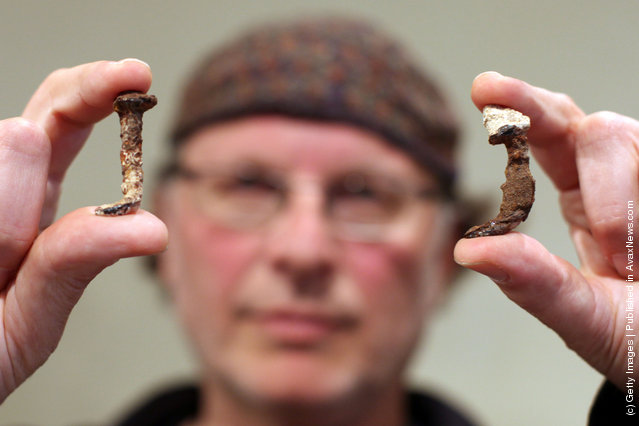
Canadian-Israeli film director Simcha Jacobovici holds two nails during a press conference on April 12, 2011. Jacobovici believes that the two nails discovered in a Jerusalem cave were used in the crucifixion of Jesus Christ. Jacobovici claims that the nails were tracked to an archeology laboratory in Tel Aviv, and though cannot be 100 per cent certain that they are the nails used in the crucifixion of Jesus, he claims if “you put two and two together and they seem to imply that these are the nails”. Experts at the Israel Antiquities Authority though cast doubt on Jacobovici's claims, and suggest that nails are commonly found in such locations. (Photo by Lior Mizrahi/Getty Images)
Details
13 Apr 2011 06:48:00


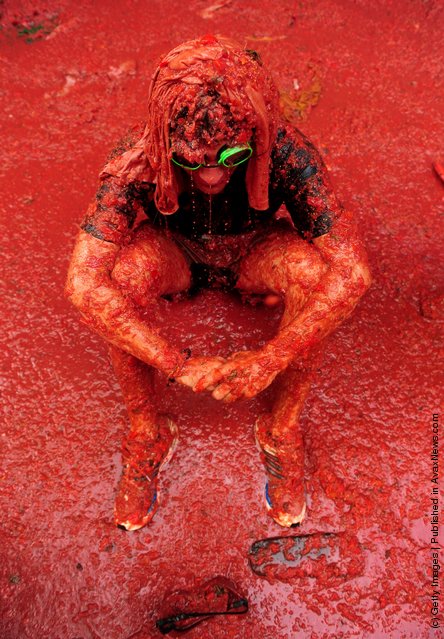
“La Tomatina is a festival that is held in the Valencian town of Buñol, in which participants throw tomatoes at each other”. – Wikipedia

Photo: A man sits in tomato pulp at the end of the world's biggest tomato fight at La Tomatina festival on August 26, 2009 in Bunol, Spain. More than 45000 people from all over the world descended on the small Valencian town to participate La Tomatina festival, with the local town hall estimating that over 100 tons of rotten and over-ripe tomatoes were thrown. (Photo by Jasper Juinen/Getty Images)
Details
24 May 2011 09:27:00