Loading...
Done
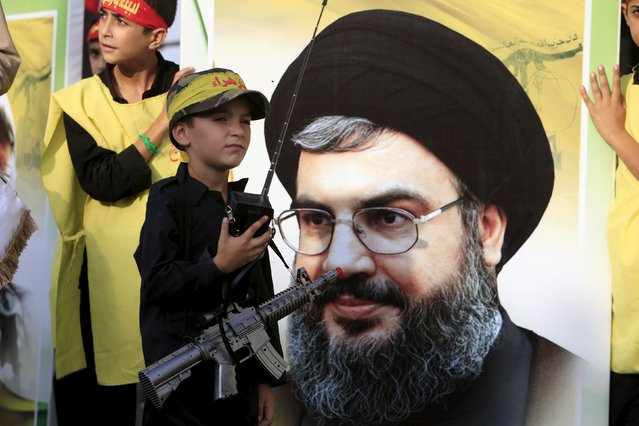
A Muslim Shi'ite boy carries a toy gun while standing next to a picture of Hezbollah leader Sayyed Hassan Nasrallah as he takes part in a march organised by Hezbollah during a re-enactment of the battle of Kerbala during a mourning process, ahead of the day of Ashura, in Saksakieh village, southern Lebanon, October 18, 2015. (Photo by Ali Hashisho/Reuters)

A Muslim Shi'ite boy carries a toy gun while standing next to a picture of Hezbollah leader Sayyed Hassan Nasrallah as he takes part in a march organised by Hezbollah during a re-enactment of the battle of Kerbala during a mourning process, ahead of the day of Ashura, in Saksakieh village, southern Lebanon, October 18, 2015. Ashoura, the most important day in the Shi'ite calendar, commemorates the death of Imam Hussein, grandson of the Prophet Mohammad, in the 7th century battle of Kerbala. (Photo by Ali Hashisho/Reuters)
Details
21 Oct 2015 08:00:00
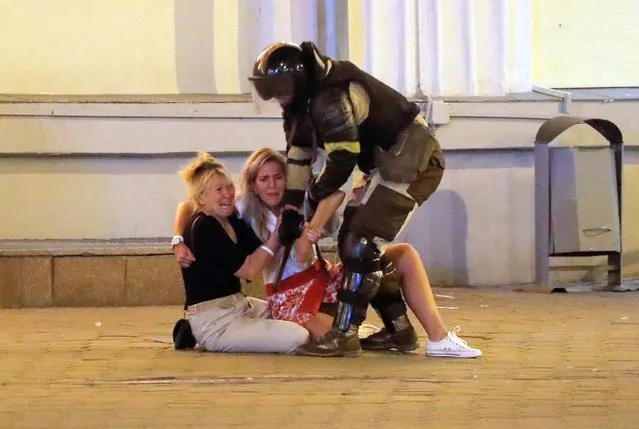
A Belarusian law enforcement officer approaches women, who react while sitting on the pavement during a rally of opposition supporters following the presidential election in Minsk, Belarus on August 10, 2020. Belarusian police clashed with protesters on Monday after the opposition accused President Alexander Lukashenko of rigging his re-election victory amid a chorus of criticism from Western leaders. (Photo by Vasily Fedosenko/Reuters)

A Belarusian law enforcement officer approaches women, who react while sitting on the pavement during a rally of opposition supporters following the presidential election in Minsk, Belarus on August 10, 2020. Belarusian police clashed with protesters on Monday after the opposition accused President Alexander Lukashenko of rigging his re-election victory amid a chorus of criticism from Western leaders. (Photo by Vasily Fedosenko/Reuters)
Details
12 Aug 2020 00:07:00
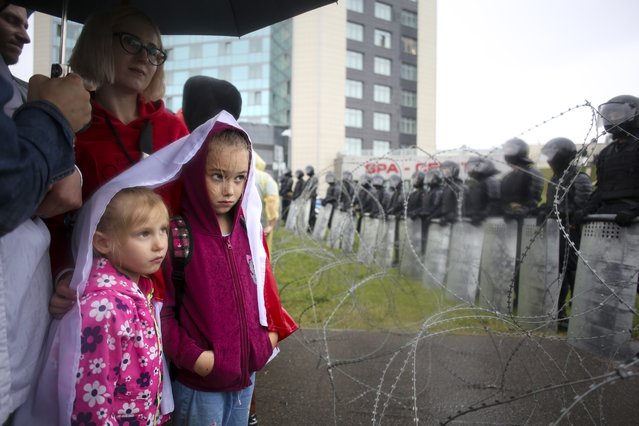
In this Sunday, September 6, 2020 file photo, people with their children stand at a barbed wire fence in front of a police line toward the Independence Palace, residence of the President Alexander Lukashenko, during Belarusian opposition supporters rally in Minsk, Belarus. Belarus President Alexander Lukashenko has relied on massive arrests and intimidation tactics to hold on to power despite nearly three months of protests sparked by his re-election to a sixth term, but continuing protests have cast an unprecedented challenge to his 26-year rule. (Photo by TUT.by via AP Photo)

In this Sunday, September 6, 2020 file photo, people with their children stand at a barbed wire fence in front of a police line toward the Independence Palace, residence of the President Alexander Lukashenko, during Belarusian opposition supporters rally in Minsk, Belarus. Belarus President Alexander Lukashenko has relied on massive arrests and intimidation tactics to hold on to power despite nearly three months of protests sparked by his re-election to a sixth term, but continuing protests have cast an unprecedented challenge to his 26-year rule. (Photo by TUT.by via AP Photo)
Details
06 Nov 2020 00:01:00
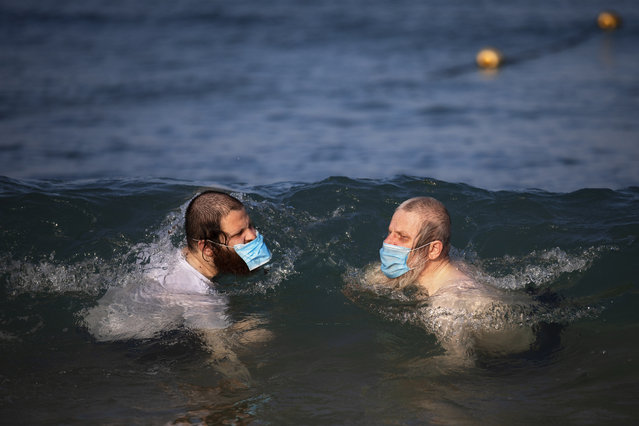
Ultra-orthodox Jewish men wearing protective face masks swim in the Mediterranean Sea, on a beach segregated for males three days a week, in Tel Aviv, Israel, Wednesday, July 8, 2020. In an effort to quell the rapid spread of the coronavirus, Israel has re-imposed a series of restrictions on the public. This week, the Israeli government limited gatherings and ordered reception halls, restaurants, bars, theaters, fitness centers and pools be shut down again. (Photo by Oded Balilty/AP Photo)

Ultra-orthodox Jewish men wearing protective face masks swim in the Mediterranean Sea, on a beach segregated for males three days a week, in Tel Aviv, Israel, Wednesday, July 8, 2020. In an effort to quell the rapid spread of the coronavirus, Israel has re-imposed a series of restrictions on the public. This week, the Israeli government limited gatherings and ordered reception halls, restaurants, bars, theaters, fitness centers and pools be shut down again. (Photo by Oded Balilty/AP Photo)
Details
10 Jul 2020 00:07:00
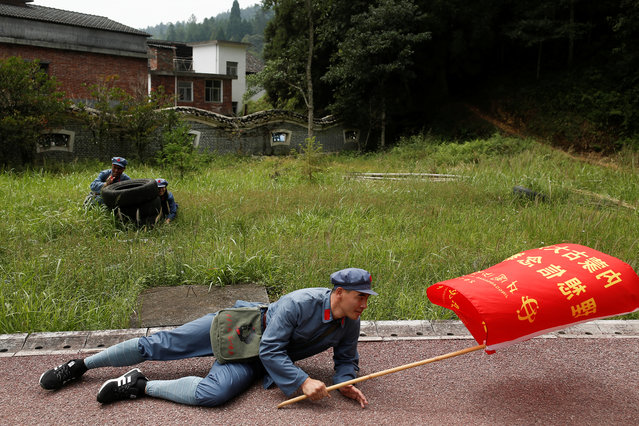
A man in “Red Army” garb hits the pavement during a simulated attack during a re-staging of part of the Long March in Jinggangshan September 14, 2017. The scene brings alive an extraordinary chapter in China's history that established the supremacy of Chairman Mao Zedong and the Communist Party. Deep in the mountains of Jinggangshan in the southeastern province of Jiangxi, a classroom of bank tellers participates in an ideological boot camp that plays into Chinese President Xi Jinping's drive to further consolidate his grip on power. (Photo by Thomas Peter/Reuters)

A man in “Red Army” garb hits the pavement during a simulated attack during a re-staging of part of the Long March in Jinggangshan September 14, 2017. The scene brings alive an extraordinary chapter in China's history that established the supremacy of Chairman Mao Zedong and the Communist Party. Deep in the mountains of Jinggangshan in the southeastern province of Jiangxi, a classroom of bank tellers participates in an ideological boot camp that plays into Chinese President Xi Jinping's drive to further consolidate his grip on power. (Photo by Thomas Peter/Reuters)
Details
25 Sep 2017 06:46:00
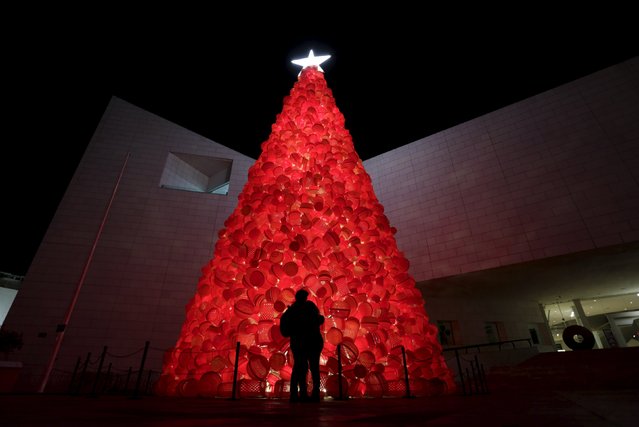
A couple hugs while standing near a Christmas tree made out of plastic bins and plastic hampers outside the Museum of History in Monterrey, Mexico, December 4, 2015. (Photo by Daniel Becerril/Reuters)

A couple hugs while standing near a Christmas tree made out of plastic bins and plastic hampers outside the Museum of History in Monterrey, Mexico, December 4, 2015. The humble Christmas tree has a rich history, from evergreen trees used to symbolise eternal life in Ancient Egypt to tree worship among pagan Europeans. The modern version has its origins in Germany, where the song “O Tannenbaum” is still a festive favourite. Today the traditional tree with lights and decorations appears in cities including Washington, Moscow and Beirut. Alternative constructions range from recycled rubbish in Mexico City to old window frames in Rakvere, Estonia. Whatever the shape or size, the message is the same: Merry Christmas. (Photo by Neil Hall/Reuters)
Details
23 Dec 2015 08:01:00
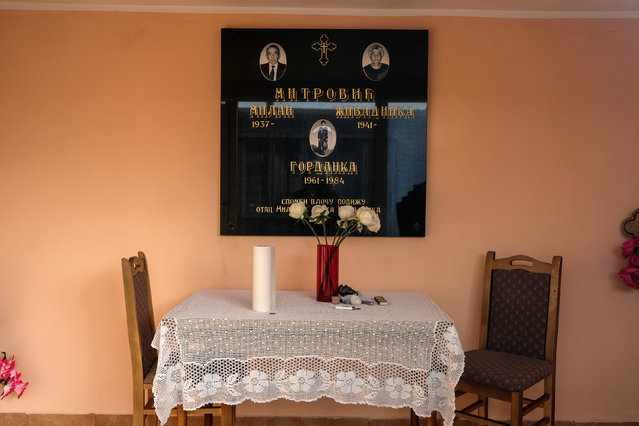
Pictures of deceased people are seen inside a chapel at a cemetery in the village of Smoljinac, Serbia, October 25, 2016. (Photo by Marko Djurica/Reuters)

Pictures of deceased people are seen inside a chapel at a cemetery in the village of Smoljinac, Serbia, October 25, 2016. From a distance, the cemetery in the eastern Serbian village of Smoljinac looks like a residential neighbourhood eerily placed among graves. But once inside the grounds, after passing a section with the usual stone slabs, visitors find rows of small bungalows painted in pastel colours. They have one or two rooms, large windows and ornate plaques – some inside, some outside – memorialising the deceased. These are the burial chapels of Smoljinac, cosy cabins with a furnished room inside, a storage place for wreaths and funeral paraphernalia, and the family crypt below. Some even have electric power inside. (Photo by Marko Djurica/Reuters)
Details
12 Nov 2016 10:37:00
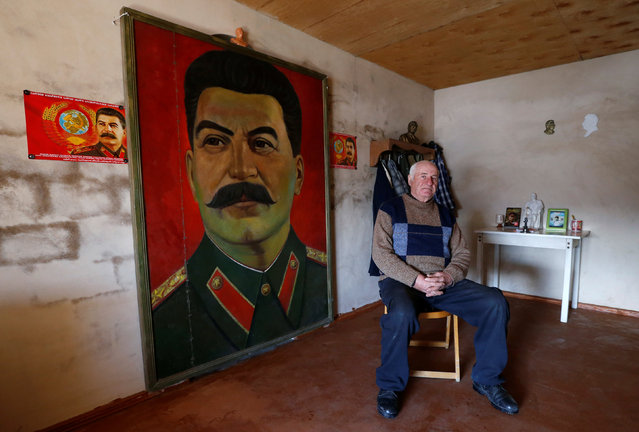
Retired builder Vasili Sidamonidze, 70, poses for a portrait at his home in Gori, Georgia, December 6, 2016. “Unfortunately, Stalin is not popular nowadays. Our people don't respect him. Only we, members of the (Communist) Party, respect him”, Sidamonidze said. “I always try to attend Stalin's birthday anniversaries in Gori. Unfortunately many people don't want to join us even if they live nearby. They look at us from their windows”. Stalin, who was born in Gori in 1878 and died in 1953, is largely reviled today in Georgia, which regained its independence during the 1991 collapse of the Soviet Union. Over the years, his memorials have been dismantled, most recently in 2010 when authorities removed a statue of the dictator from Gori's central square. But Stalin is still revered by a small group of mainly elderly supporters who stress his role in the industrialisation of the Soviet Union and in defeating Nazi Germany in World War Two. Each Dec. 21, a few dozen people mark his birthday by gathering outside a Gori museum dedicated to Stalin, where they make speeches and walk to the square where a 6-meter-high bronze statue of him once stood, calling for it to be reinstated. Opponents say it was a symbol of Moscow's still lingering shadow. In 2008, Russia fought a brief war with Georgia and recognised its breakaway regions of Abkhazia and South Ossetia as independent states. (Photo by David Mdzinarishvili/Reuters)

Retired builder Vasili Sidamonidze, 70, poses for a portrait at his home in Gori, Georgia, December 6, 2016. “Unfortunately, Stalin is not popular nowadays. Our people don't respect him. Only we, members of the (Communist) Party, respect him”, Sidamonidze said. “I always try to attend Stalin's birthday anniversaries in Gori. Unfortunately many people don't want to join us even if they live nearby. They look at us from their windows”. (Photo by David Mdzinarishvili/Reuters)
Details
17 Dec 2016 07:59:00