Loading...
Done
The eruption of Cordon Caulle began on June 4, 2011, located in the Region of Los Rios in Chile. For about 12 months, people and animals became accustomed to living with the daily fall of ash, which also caused problems in the air traffic in South America. The explosions and lightning during first days of the eruption could be seen from hundreds of miles around. This photograph was taken on the second night of eruption from the town of Lago Ranco. (Photo and caption by Francisco Negroni/National Geographic Traveler Photo Contest)

The eruption of Cordon Caulle began on June 4, 2011, located in the Region of Los Rios in Chile. For about 12 months, people and animals became accustomed to living with the daily fall of ash, which also caused problems in the air traffic in South America. The explosions and lightning during first days of the eruption could be seen from hundreds of miles around. This photograph was taken on the second night of eruption from the town of Lago Ranco. (Photo and caption by Francisco Negroni/National Geographic Traveler Photo Contest)

ATTENTION! All pictures are presented in high resolution. To see Hi-Res images – just TWICE click on any picture. In other words, click small picture – opens the BIG picture. Click BIG picture – opens VERY BIG picture.
Details
23 Jun 2013 11:24:00
The Soviet Union Abandoned: A Communist Empire In Decay By Rebecca Litchfield

Only the most intrepid urban explorers cross the tattered ruins of the old Iron Curtain to endure the excessive bureaucracy, military paranoia and freezing winds of the East to hunt for the ghosts of an empire. Rebecca Litchfield is one who couldn’t resist the haunting allure of the ruins of the Soviet Union.
Details
21 Jul 2014 11:03:00
Alex Plunkett, left, and Sean Hart, both of Arlington, Va., join hundreds participating in the annual International Pillow Fight Day on April 5. Massive pillow fights broke out on the Mall in Washington and in cities around the world. (Photo by Marvin Joseph/The Washington Post)

Alex Plunkett, left, and Sean Hart, both of Arlington, Va., join hundreds participating in the annual International Pillow Fight Day on April 5. Massive pillow fights broke out on the Mall in Washington and in cities around the world. (Photo by Marvin Joseph/The Washington Post)
Details
28 Dec 2014 10:39:00
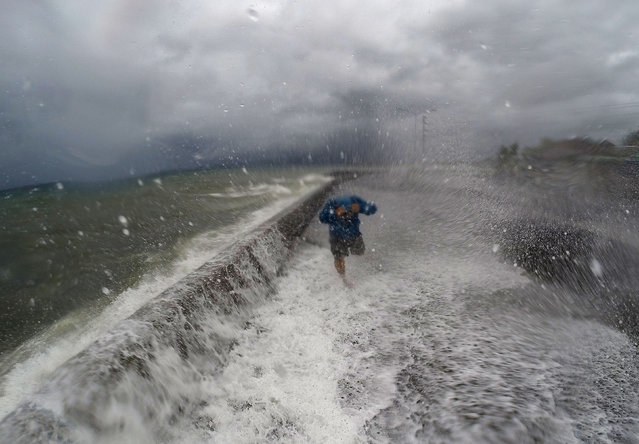
A resident walks past big waves spilling over a wall onto a coastal road in the city of Legaspi in Albay province, south of Manila on December 14, 2015, as typhoon Melor approaches the city. More than 700,000 people fled the central Philippines amid threats of giant waves, floods and landslides as powerful Typhoon Melor approached the archipelago nation, officials said December 14. (Photo by Charism Sayat/AFP Photo)

A resident walks past big waves spilling over a wall onto a coastal road in the city of Legaspi in Albay province, south of Manila on December 14, 2015, as typhoon Melor approaches the city. More than 700,000 people fled the central Philippines amid threats of giant waves, floods and landslides as powerful Typhoon Melor approached the archipelago nation, officials said December 14. (Photo by Charism Sayat/AFP Photo)
Details
15 Dec 2015 11:34:00
A view of traditional bolinhos de bacalhau (fried codfish balls) in Rio de Janeiro, Brazil, May 7, 2016. (Photo by Sergio Moraes/Reuters)

If the most popular foods of Rio de Janeiro have one thing in common, it is their informality. You can find fine restaurants in the city, but they do not set Rio apart from other places. What does set it apart, and what invariably brings its residents, known as "Cariocas," together is the unpretentious food they eat in bright, loud, crowded bars and restaurants, on busy street corners, or after a day at the beach. Here: A view of traditional bolinhos de bacalhau (fried codfish balls) in Rio de Janeiro, Brazil, May 7, 2016. (Photo by Sergio Moraes/Reuters)
Details
05 Aug 2016 13:20:00
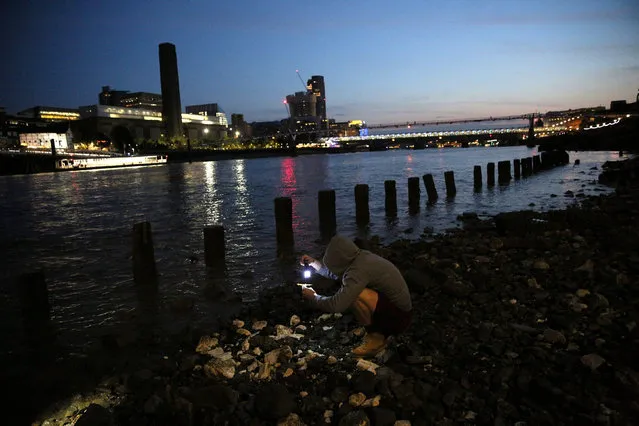
A mudlark uses a torch to look for items on the bank of the River Thames in London, Britain June 06, 2016. Mudlarking is believed to trace its origins to the 18th and 19th century, when scavengers searched the Thames' shores for items to sell. These days, history and archaeology fans are the ones hoping to find old relics such as coins, ceramics, artifacts or everyday items from across centuries. They wait for the low tide and then scour specific areas of exposed shores. "If you're in a field you could be out all day long, with the river you're restricted to about two or three hours," mudlark Nick Stevens said. While many just use the naked eye for their searches, others rely on metal detectors for which a permit from the Port of London Authority is needed. Digging also requires consent. (Photo by Neil Hall/Reuters)

A mudlark uses a torch to look for items on the bank of the River Thames in London, Britain June 06, 2016. Mudlarking is believed to trace its origins to the 18th and 19th century, when scavengers searched the Thames' shores for items to sell. These days, history and archaeology fans are the ones hoping to find old relics such as coins, ceramics, artifacts or everyday items from across centuries. their finds with the Portable Antiquities Scheme. Any item over 300 years old must be recorded. (Photo by Neil Hall/Reuters)
Details
27 Aug 2016 10:43:00
Schoolchildren look at a lifelike animatronics display of a dinosaur at the dinosaur-themed Zoo-rassic Park in Singapore on November 16, 2016. To raise awareness on the sixth mass extinction, the Singapore Zoo and River Safari displayed lifelike dinosaur animatronics where visitors can trail along the Dinosaur Valley which does not involve living animals. (Photo by Roslan Rahman/AFP Photo)

Schoolchildren look at a lifelike animatronics display of a dinosaur at the dinosaur-themed Zoo-rassic Park in Singapore on November 16, 2016. To raise awareness on the sixth mass extinction, the Singapore Zoo and River Safari displayed lifelike dinosaur animatronics where visitors can trail along the Dinosaur Valley which does not involve living animals. (Photo by Roslan Rahman/AFP Photo)
Details
17 Nov 2016 11:47:00
People gather at the site of a train derailment near Beni Suef, Egypt, Thursday, February 11, 2016 that  injured dozens of people were injured as it was traveling north toward Cairo. Railroad accidents due to negligence are common in Egypt. Egyptians have long complained that the government has failed to deal with the country's chronic transport problems. (Photo by Samer Abdallah/AP Photo)

People gather at the site of a train derailment near Beni Suef, Egypt, Thursday, February 11, 2016 that injured dozens of people were injured as it was traveling north toward Cairo. Railroad accidents due to negligence are common in Egypt. Egyptians have long complained that the government has failed to deal with the country's chronic transport problems. (Photo by Samer Abdallah/AP Photo)
Details
12 Feb 2016 13:08:00