The Aurora Australis, also known as the Southern Lights, glow on the horizon over waters of Lake Ellesmere on the outskirts of Christchurch on May 11, 2024. (Photo by Sanka Vidanagama/AFP Photo)
A purple haze of heather as the sun rises over the New Forest near Lyndhurst, Hampshire in UK on July 28, 2025. (Photo by Steve Hogan/Bournemouth News)
Participants wear traditional clogs as shepherds lead their sheep through the center of Madrid, October 28, 2012. (Photo by Andres Kudacki/Associated Press)
A visitor and an employee dressed as Snegurochka (Snow Maiden), the granddaughter of Ded Moroz (Russian equivalent of Santa Claus), pose for a picture inside an upside down house, constructed as an attraction for local residents and tourists and located at the Royev Ruchey Park of Flora and Fauna in the suburbs of Krasnoyarsk, Russia, December 7, 2016. (Photo by Ilya Naymushin/Reuters)
These stunning images show the beauty and drama of Mother Nature at work. Captured deep in heart of the Danakil Desert in East Africa, the images show the acid pools near the Erta Ale volcano. Pools of brightly colored acid can be seen amid the dramatic blast of volcanic ash. The photos were taken by Neta Dekel, an Israeli photographer. He the acid pools were one of the most extraordinary sights he had ever seen. (Photo by Neta Dekel/Caters News Agency)
Pamukkale, Turkey, is home to these terrace pools, formed by the build-up of carbonate mineral from the warm water flowing from the thermal springs above. (Photo by Image Courtesy of Jennifer Hayes/Getty Images)
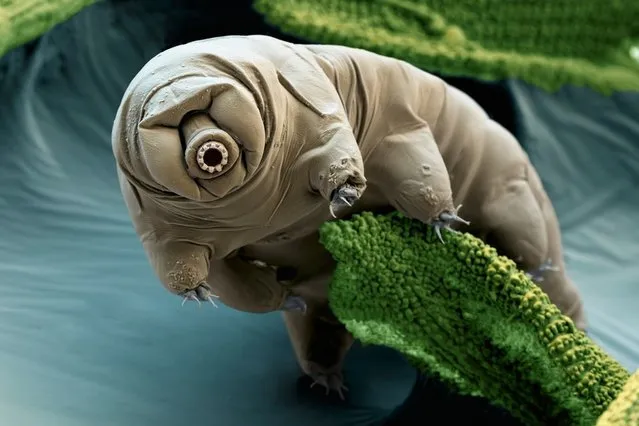
“Tardigrades (commonly known as waterbears or moss piglets) are small, water-dwelling, segmented animals with eight legs. Tardigrades were first discovered in 1773 by Johann August Ephraim Goeze, who called them kleiner Wasserbär, meaning “little water bear” in German. The name Tardigrada means “slow walker” and was given by Lazzaro Spallanzani in 1777. The name water bear comes from the way they walk, reminiscent of a bear's gait. The biggest adults may reach a body length of 1.5 millimetres (0.059 in), the smallest below 0.1 mm. Freshly hatched tardigrades may be smaller than 0.05 mm”. – Wikipedia. Photo: Tardigrades. (Photo by SPL/East News)