Loading...
Done
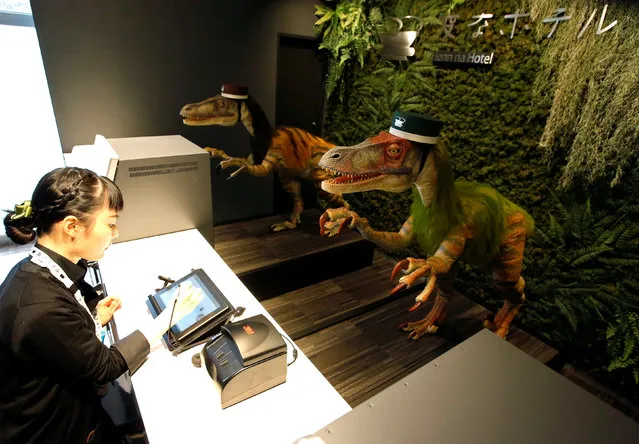
Dinosaur robots acting as receptionist greet a hotel employee demonstrating how to check-in to the hotel during a press preview for the newly-opening Henn na Hotel Maihama Tokyo Bay in Urayasu, east of Tokyo, Japan March 15, 2017. The reception desk is handled by robots that speak Japanese, English, Chinese and Korean, as well as porter robots that help guests carry luggage to their rooms. Tasks such as window-cleaning and vacuuming are also handled by robots. Japan's second robot-run hotel Henn na Hotel (“strange hotel” in Japanese) opened on March 15, 2017 as the robot-staffed hotel near Tokyo, operating company H.I.S. Co. said. (Photo by Issei Kato/Reuters)

Dinosaur robots acting as receptionist greet a hotel employee demonstrating how to check-in to the hotel during a press preview for the newly-opening Henn na Hotel Maihama Tokyo Bay in Urayasu, east of Tokyo, Japan March 15, 2017. The reception desk is handled by robots that speak Japanese, English, Chinese and Korean, as well as porter robots that help guests carry luggage to their rooms. Tasks such as window-cleaning and vacuuming are also handled by robots. Japan's second robot-run hotel Henn na Hotel (“strange hotel” in Japanese) opened on March 15, 2017 as the robot-staffed hotel near Tokyo, operating company H.I.S. Co. said. (Photo by Issei Kato/Reuters)
Details
16 Mar 2017 09:54:00
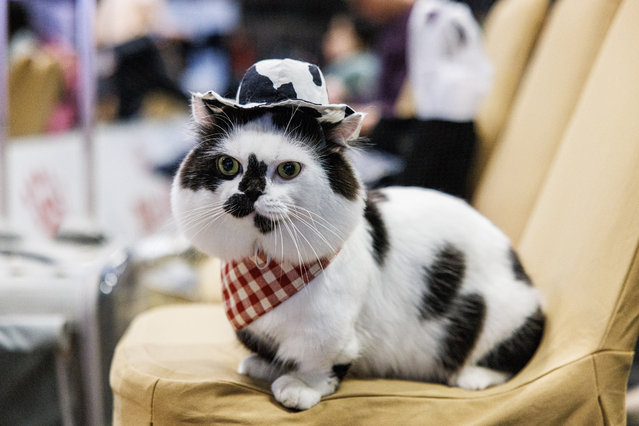
A participant in the “Cats Who Look Like Cows” competition wears a cowboy outfit back stage before judging on March 05, 2023 in Bangkok, Thailand. Thailand's Cat Fanciers' Club hosted a “Cats Who Look Like Cows” competition during a Cat Expo in Bangkok's Ladphro neighborhood. Over 100 cats were judged on how similarly their pattern resembled a cow, color, fur softness and personality. A relaxed, fluffy cat named Arpo took home first prize. (Photo by Lauren DeCicca/Getty Images)

A participant in the “Cats Who Look Like Cows” competition wears a cowboy outfit back stage before judging on March 05, 2023 in Bangkok, Thailand. Thailand's Cat Fanciers' Club hosted a “Cats Who Look Like Cows” competition during a Cat Expo in Bangkok's Ladphro neighborhood. Over 100 cats were judged on how similarly their pattern resembled a cow, color, fur softness and personality. A relaxed, fluffy cat named Arpo took home first prize. (Photo by Lauren DeCicca/Getty Images)
Details
18 Jul 2024 05:04:00
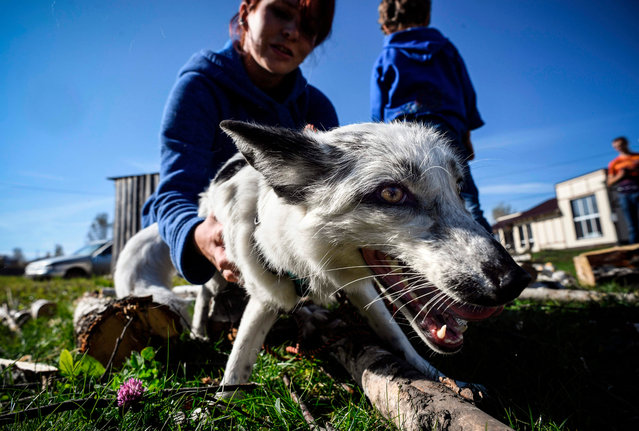
Tatyana Abramova, 33, plays with her home fox Plombir at her countryside house outside Siberian city of Novosibirsk on September 12, 2020. The official start of the Soviet experiment to better understand the domestication of animals by humans began in 1959, and was initiated by geneticists Dmitri Beliaiev and Lioudmila Trout on a farm in Akademgorodok, the scientific center of excellence in Siberia. Their primary objective was to domesticate foxes, to understand how the ancestor of wolves, another canine, evolved into a loyal and loving dog. And understand what this domestication tells us about the genetic evolution of species. (Photo by Alexander Nemenov/AFP Photo)

Tatyana Abramova, 33, plays with her home fox Plombir at her countryside house outside Siberian city of Novosibirsk on September 12, 2020. The official start of the Soviet experiment to better understand the domestication of animals by humans began in 1959, and was initiated by geneticists Dmitri Beliaiev and Lioudmila Trout on a farm in Akademgorodok, the scientific center of excellence in Siberia. Their primary objective was to domesticate foxes, to understand how the ancestor of wolves, another canine, evolved into a loyal and loving dog. And understand what this domestication tells us about the genetic evolution of species. (Photo by Alexander Nemenov/AFP Photo)
Details
25 Oct 2020 00:05:00
“A snapshot from mountaineer's life”. Have you ever wondered how does a mountaineer's day start? (Photo and caption by Kamil Tamiola/National Geographic Traveler Photo Contest)

“A snapshot from mountaineer's life”. Have you ever wondered how does a mountaineer's day start? I will give you a hint: you wake up at 3 am, set the stove, wake up your partner, pretend it is warm, quickly consume a high-calorie breakfast, watch your friends slowly ascending the icy slopes of your dream summit with their tiny head torches glimmering against perfectly blue ice, and hope for the good weather. One would ask: why all this trouble? The answer is easy: for the love of the adventure and the unknown. Location: Chamonix, Haute Savoye, France. (Photo and caption by Kamil Tamiola/National Geographic Traveler Photo Contest)

ATTENTION! All pictures are presented in high resolution. To see Hi-Res images – just TWICE click on any picture. In other words, click small picture – opens the BIG picture. Click BIG picture – opens VERY BIG picture.
Details
27 Jun 2013 12:47:00
Spectacular images offering insight into the lives of the Huaorani people in the Ecuadorian Amazon have been revealed showing how they use traditional methods to hunt monkeys for food. The stunning pictures were taken by conservation photographer Pete Oxford from Torquay, Devon in the Ecuadorian Amazon. “The Huaorani Indians are a forest people highly in tune with their environment. Many are now totally acculturated since the 1950s by missionaries”, said Pete. “Today they face radical change to their culture to the proximity of oil exploration within their territory and the Yasuni National Park and Biosphere Reserve, they are vastly changed. Some still live very traditionally and for this shoot, through my Huaorani friend, a direct relative of those photographed he wanted to depict them as close to their original culture as possible. They still largely hunt with blow pipes and spears eating a lot of monkeys and peccaries”. The Huaorani are also known as the Waorani, Waodani or the Waos and are native Amerindians. Their lands are located between the Curaray and Napo rivers and speak the Huaorani language. Pete says that during his visit he was welcomed into the group and hopes that ancient cultures can be saved. Here: The tribe were seen celebrating after a hunter returned to camp with a wild pig. (Photo by Pete Oxford/Mediadrumworld.com)

Spectacular images offering insight into the lives of the Huaorani people in the Ecuadorian Amazon have been revealed showing how they use traditional methods to hunt monkeys for food. The stunning pictures were taken by conservation photographer Pete Oxford from Torquay, Devon in the Ecuadorian Amazon. Here: The tribe were seen celebrating after a hunter returned to camp with a wild pig. (Photo by Pete Oxford/Mediadrumworld.com)
Details
20 Jan 2017 07:58:00
A boy walks past boats docked at the entrance gate of the fishermen's village in the El Max area of the Mediterranean city of Alexandria September 12, 2014.  El Max, where hundreds of boats dart through the canals, has been called the “Venice of Egypt” for its waterways and relaxed atmosphere. Its fishermen, however, worry about how they will make ends meet on meagre earnings they  say are being reduced further by polluted waters that are making fishing more difficult. (Photo by Amr Abdallah Dalsh/Reuters)

A boy walks past boats docked at the entrance gate of the fishermen's village in the El Max area of the Mediterranean city of Alexandria September 12, 2014. El Max, where hundreds of boats dart through the canals, has been called the “Venice of Egypt” for its waterways and relaxed atmosphere. Its fishermen, however, worry about how they will make ends meet on meagre earnings they say are being reduced further by polluted waters that are making fishing more difficult. While the government has tried to fix the state's bloated finances by cutting subsidies and reining in spending, some argue the reforms hurt Egypt's most vulnerable who have long relied on a generous system of fuel and food subsidies to supplement low incomes. (Photo by Amr Abdallah Dalsh/Reuters)
Details
12 Dec 2014 12:42:00
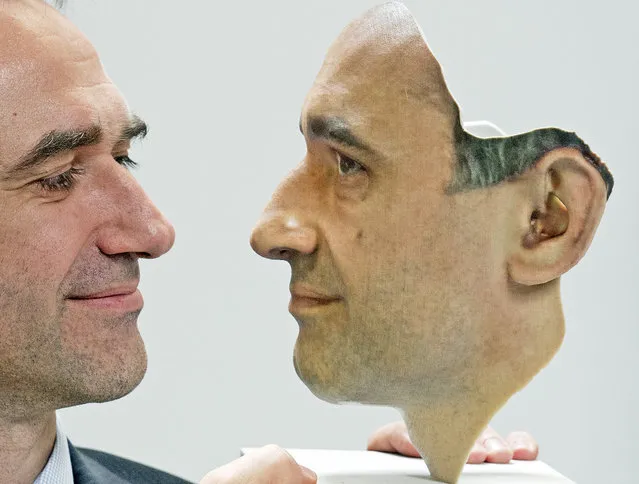
Mario Huettenhofer, chief of the German company 3D Fab, presents his own face as 3d print during the international fairs FabCon 3.D and Rapid.Tech in Erfurt, Germany, Thursday, May 15, 2014. 130 exhibitors from all over the world present the entire world of 3D printing. (Photo by Jens Meyer/AP Photo)

Mario Huettenhofer, chief of the German company 3D Fab, presents his own face as 3d print during the international fairs FabCon 3.D and Rapid.Tech in Erfurt, Germany, Thursday, May 15, 2014. 130 exhibitors from all over the world present the entire world of 3D printing. The trade fairs are accompanied by specialist programs featuring 80 scientists, practitioners and trend analysts from ten countries, who will explain the latest findings, trends and applications for additive processes in industry and for 3D printing in the private sector to newcomers, experts and consumers alike. (Photo by Jens Meyer/AP Photo)
Details
17 May 2014 13:06:00
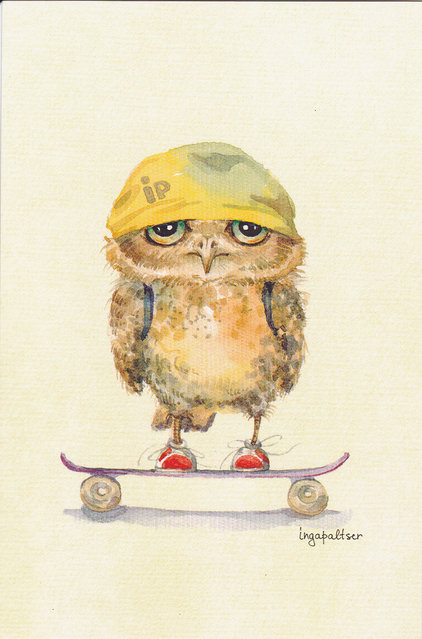
Owlets By Inga Paltser

Inga Paltser is a young painter from Severodvinsk known for her watercolor illustrations and paintings of owls. Inga prefers working with paper, but sometimes also creates on textile, wood, and canvas. She started painting in her childhood at the local school of arts. However, after high school Inga decided to become a biologist and now she works as a researcher. Even though art hasn’t become her profession, Inga finds time to create wonderful paintings presented on this website. Her first owls were painted spontaneously – Inga decided to utilize small pieces of watercolor and pastel paper and created two cute owls called “Friends”. Inga’s owls instantly received recognition across the web and social networks and now are greatly loved by thousands of people around the world.
Details
18 Nov 2013 10:08:00